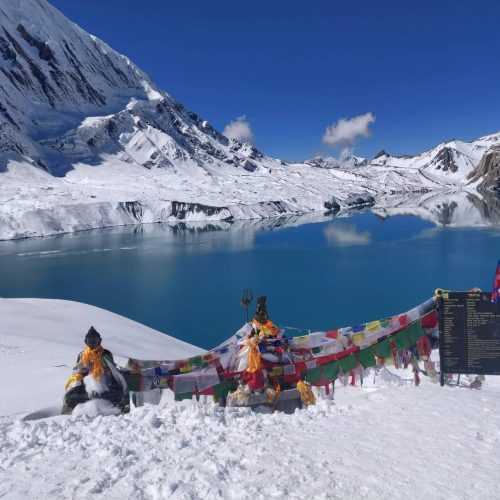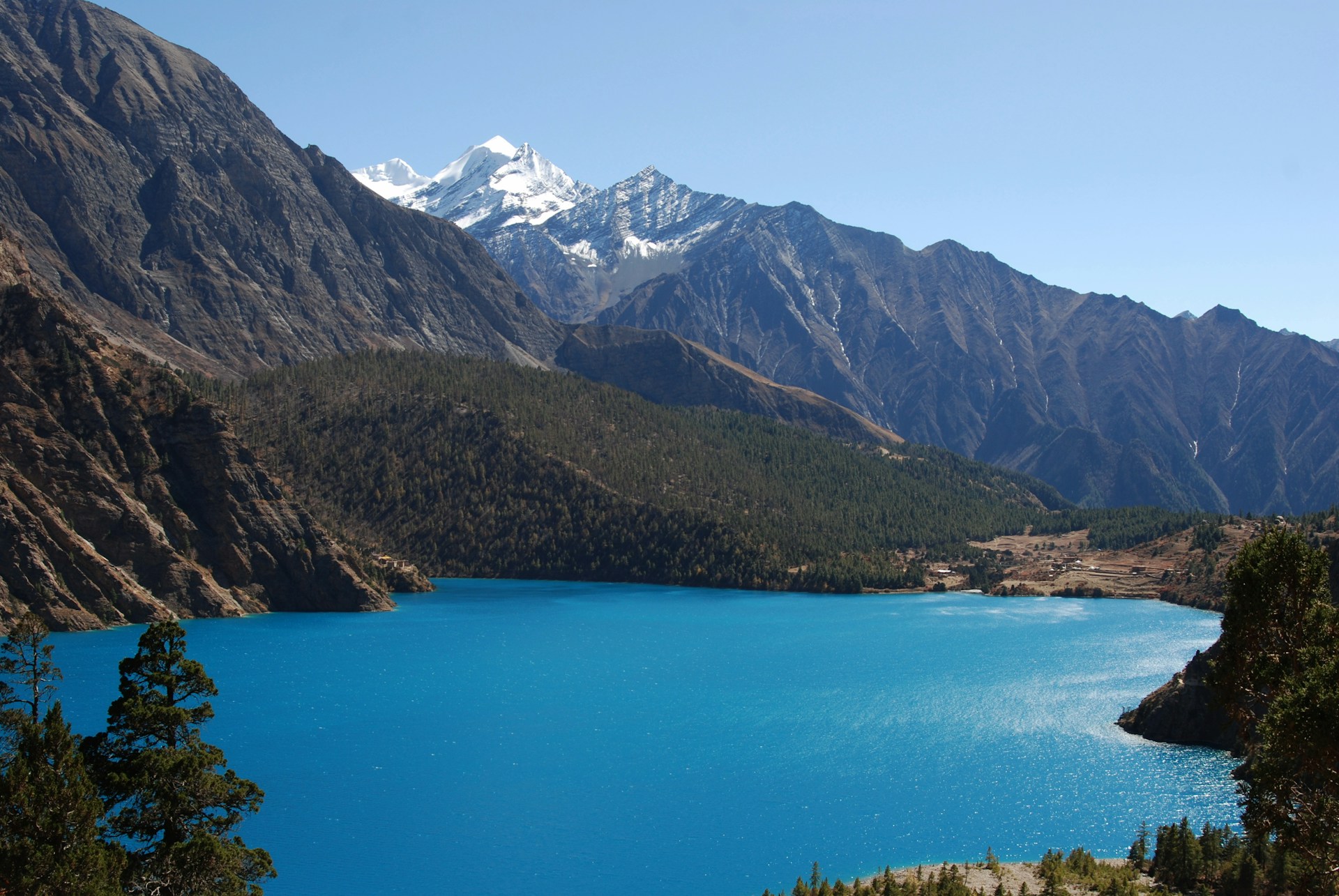
The Shey Phoksundo Lake Trek leads to one of the most visually striking natural features in the entire Himalayan range. Phoksundo Lake sits at 3,611 meters in the heart of Shey Phoksundo National Park, Nepal’s largest national park by area, and holds the distinction of being the deepest lake in the country. Its color — an intense, almost unnatural turquoise generated by the mineral composition of the surrounding geology and the clarity of glacial inflows — is unlike anything else in Nepal. The lake does not resemble other Himalayan lakes. It looks like something that should not exist at this altitude in this landscape, and that quality is exactly what draws trekkers who have already seen the more accessible parts of Nepal and are looking for something genuinely different.
This 9-day Shey Phoksundo Lake Trek package covers the complete logistics: domestic flights from Kathmandu to Nepalgunj and onward to Juphal, all national park permits, tea house accommodation throughout, full board meals, and an experienced guide who knows the Dolpo region specifically. The page below contains everything you need to evaluate this package honestly before making a booking decision.
Shey Phoksundo Lake Trek Facts
| Detail | Information |
|---|---|
| Duration | 9 Days |
| Maximum Altitude | 3,611m (Phoksundo Lake) |
| Trek Difficulty | Moderate to Strenuous |
| Trek Style | Tea House Trek |
| Region | Shey Phoksundo National Park, Dolpo District, Karnali Province |
| Starting Point | Kathmandu → Nepalgunj → Juphal (by flight) |
| Ending Point | Juphal → Nepalgunj → Kathmandu (by flight) |
| Package Cost | USD 1,450 per person |
| Best Season | May–June and September–November |
| Group Size | 2–10 trekkers |
| Accommodation | Tea houses and basic guesthouses |
| Meals | Full board during trekking days |
| Minimum Age | 14 years (with guardian) |
| Minimum Experience | Prior moderate trekking experience recommended |
Trip Overview
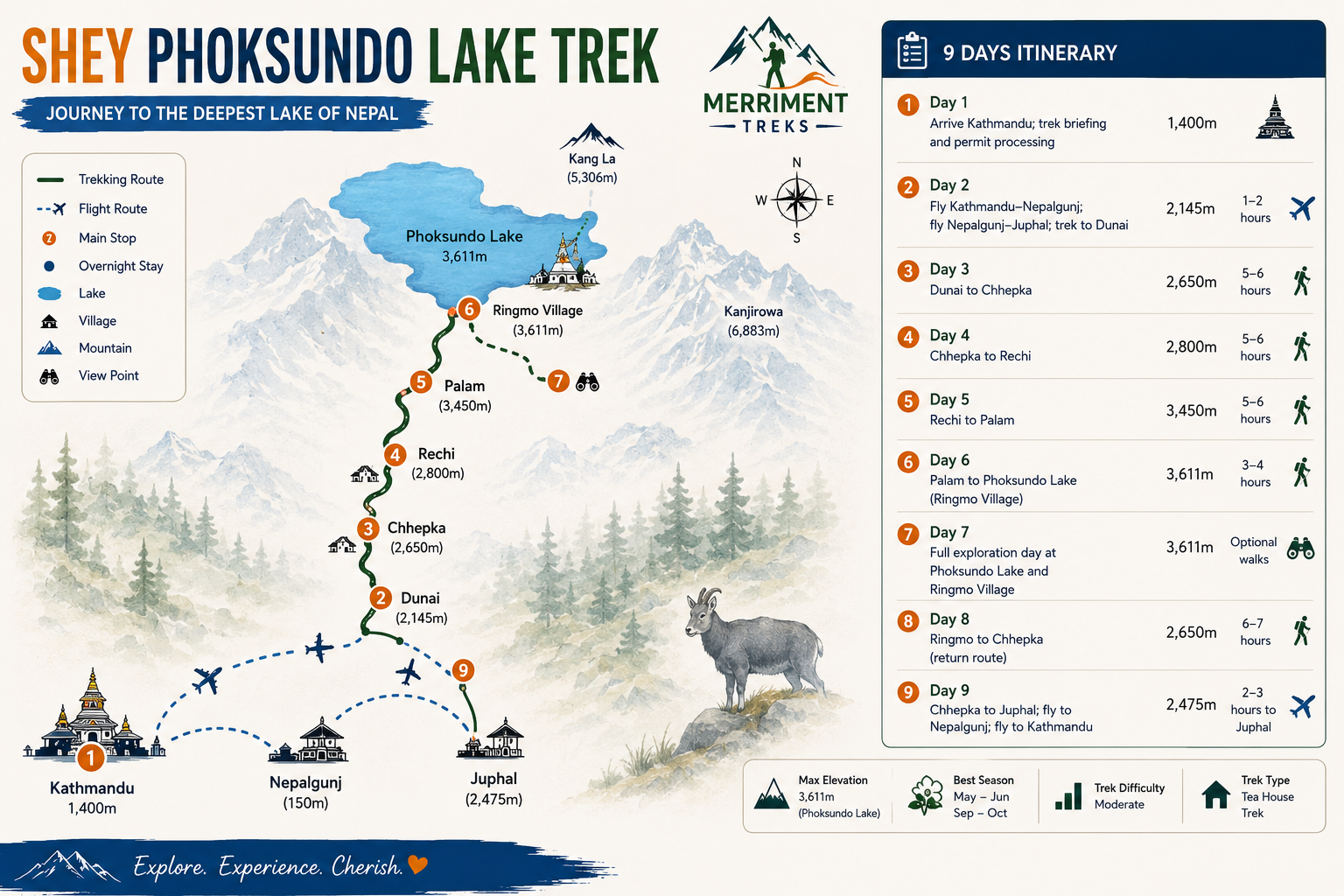
The Shey Phoksundo Lake Trek operates in one of Nepal’s most remote and least-visited trekking regions. The Dolpo district sits in the far northwest of the country, beyond the reach of road networks that have transformed most of Nepal’s other trekking corridors. Access requires two domestic flights from Kathmandu — first to Nepalgunj in the southern lowlands, then to the Juphal airstrip near Dunai, the district headquarters of Dolpo — making the logistics more complex than standard Nepal treks but also contributing to the region’s preserved character.
From Juphal, the route heads northwest along the Bheri River valley, passing through Dunai and the villages of Chhepka and Rechi before the trail begins its ascent through increasingly dramatic landscape toward the national park boundary. The final approach to Phoksundo Lake passes through the ancient village of Palam and follows the Suligad River gorge to the spectacular waterfall at the lake’s outlet, one of the most photographed natural features in the Dolpo region.
Ringmo Village, a small community of Tibetan Buddhist and Bon practitioners situated on the shores of Phoksundo Lake, is the primary cultural destination of the trek. The village maintains a way of life that has changed little over centuries, with flat-roofed stone houses, prayer flags strung across rooftops, and an ancient gompa that predates the arrival of Tibetan Buddhism in the region.
The return follows the same route, giving trekkers the opportunity to see the landscape from a different direction and at different times of day.
Why Choose the Shey Phoksundo Lake Trek
- The lake itself justifies the journey. Phoksundo Lake’s mineral-blue color is a function of its geology, not its altitude, and it reads differently in photographs than it does in person. The surrounding cliff faces, the reflection of the Kanjiroba Himal in calm conditions, and the waterfall at the lake’s southern outlet combine to create a visual environment that is genuinely exceptional. Trekkers who have visited lakes across the Nepal Himalaya consistently describe Phoksundo as the most visually distinctive.
- The Dolpo region is among the least commercialized in Nepal. The combination of remote access, double domestic flight requirement, and relatively limited promotion means annual visitor numbers remain very low. The tea houses along the Shey Phoksundo route are family-operated and simple, the trails are not crowded, and the interaction with local communities is more organic than on routes where trekker traffic is heavy year-round.
- The cultural environment is rare. The Bon religion — Tibet’s pre-Buddhist spiritual tradition — is actively practiced in Ringmo and several surrounding villages. This is not a cultural performance for tourists; it is daily life for a community that has maintained its traditions in geographic isolation for centuries. The gompa at Ringmo practices Bon rituals, and the prayer walls and chortens along the approach route follow Bon rather than Buddhist conventions in several details. Trekkers with an interest in Himalayan culture and religious history will find material here that is not available on any other standard Nepal trekking route.
- Nine days is the right duration for this destination. Some operators offer shorter versions of this route that require rushed daily stages or significant itinerary compression. This 9-day package allows adequate time for the journey, a full day at the lake, and comfortable pacing throughout without forcing trekkers to walk at unsustainable speeds to meet tight schedules.
Shey Phoksundo Lake Trek Itinerary Overview
| Day | Route | Altitude | Walking Hours |
|---|---|---|---|
| Day 1 | Arrive Kathmandu; trek briefing and permit processing | 1,400m | — |
| Day 2 | Fly Kathmandu–Nepalgunj; fly Nepalgunj–Juphal; trek to Dunai | 2,145m | 1–2 hours |
| Day 3 | Dunai to Chhepka | 2,650m | 5–6 hours |
| Day 4 | Chhepka to Rechi | 2,800m | 5–6 hours |
| Day 5 | Rechi to Palam | 3,450m | 5–6 hours |
| Day 6 | Palam to Phoksundo Lake (Ringmo Village) | 3,611m | 3–4 hours |
| Day 7 | Full exploration day at Phoksundo Lake and Ringmo Village | 3,611m | Optional walks |
| Day 8 | Ringmo to Chhepka (return route) | 2,650m | 6–7 hours |
| Day 9 | Chhepka to Juphal; fly to Nepalgunj; fly to Kathmandu | 2,475m | 2–3 hours to Juphal |
Altitude Profile
| Location | Altitude |
|---|---|
| Kathmandu | 1,400m |
| Nepalgunj | 150m |
| Juphal | 2,475m |
| Dunai | 2,145m |
| Chhepka | 2,650m |
| Rechi | 2,800m |
| Palam | 3,450m |
| Phoksundo Lake / Ringmo | 3,611m |
The altitude gain on this trek is gradual and well-distributed. The maximum altitude of 3,611 meters places this route well below the threshold where serious altitude sickness typically occurs, making it accessible to a wider range of trekkers than the high-pass routes of the Annapurna or Everest regions. That said, the remote location means any medical issue must be managed carefully, as evacuation logistics are more complex than in better-serviced trekking areas.
Shey Phoksundo Lake Trek Highlights
- Fly into Juphal over the dramatic Karnali River gorge on one of Nepal’s most scenic domestic flight approaches
- Trek through the remote Suligad River valley, one of the least-visited major river valleys in western Nepal
- Witness the extraordinary turquoise waters of Phoksundo Lake, the deepest lake in Nepal, set against sheer cliff faces and the Kanjiroba Himal
- Explore Ringmo Village and its ancient Bon-influenced gompa, one of the last active centers of Bon practice in Nepal
- Walk alongside yak caravans on ancient trade routes that predate the modern Nepal state
- Experience the dramatic Phoksundo waterfall at the lake’s southern outlet, a multi-tiered cascade clearly visible from the approach trail
- Pass through the traditional villages of Dunai, Chhepka, and Palam, each reflecting the distinct cultural character of the Dolpo region
- Trek inside Shey Phoksundo National Park, Nepal’s largest national park, with exceptional wildlife and botanical diversity
Difficulty Level of Shey Phoksundo Lake Trek
Overall Rating: Moderate to Strenuous
The Shey Phoksundo Lake Trek is not technically difficult, but several factors make it harder than its maximum altitude suggests.
- Daily walking distance and terrain: The stages between Chhepka and Ringmo involve sustained hiking on trails that follow the steep walls of the Suligad River gorge. The path is well-defined but narrow in sections, with significant elevation gain and loss as it traverses ridges and descends to river crossings. Trekkers should expect genuine physical effort on Days 4 and 5.
- Return route: The return from Ringmo to Juphal is completed in two days rather than the four days of the approach. This means two long days with 6–7 hours of walking that require good energy reserves and well-functioning knees on the descents.
- Remoteness: The difficulty of any remote trek is not only physical. The absence of evacuation options, limited communication, and basic facilities all require a level of mental and logistical self-sufficiency that adds to the overall demand of the experience.
Fitness Requirements
| Fitness Level | Assessment |
|---|---|
| No trekking experience | Not recommended |
| Occasional hiker (weekend day walks) | Possible with preparation but challenging |
| Regular hiker (3–4 times per week, 4–6 hour walks) | Well-suited |
| Experienced trekker with prior Nepal experience | Ideal |
Begin physical preparation 6–8 weeks before departure. Long-distance hiking with a loaded daypack on consecutive days is the most relevant training. Cardiovascular fitness — running, cycling, or sustained walking — builds the endurance base needed for the longer stages on this route. Descents put significant stress on knee joints; trekkers with prior knee issues should train specifically for downhill walking and consider trekking poles.
Permits and Entry Requirements
| Permit | Cost | Notes |
|---|---|---|
| Shey Phoksundo National Park Entry Permit | NPR 3,000 (~USD 22) | Required for all foreign trekkers entering the park |
| Dolpo Restricted Area Permit | USD 10 per day (Lower Dolpo) | Required for foreign trekkers in the Dolpo district |
| TIMS Card | NPR 2,000 (~USD 15) | Mandatory for all foreign trekkers |
All permits are included in this package and processed by our team before departure. You provide passport copies and passport-sized photographs; we handle all applications and coordinate with the relevant government offices in Kathmandu. Permits must be carried throughout the trek and presented at national park entry checkpoints.
Important note on the Dolpo Restricted Area Permit: Lower Dolpo (the area covered by this trek, including Shey Phoksundo National Park) uses a different, more affordable permit structure than Upper Dolpo. The USD 10 per day rate is specifically for the Lower Dolpo zone. This is one of the factors that makes the Shey Phoksundo Lake Trek significantly more accessible financially than Upper Mustang or Upper Dolpo treks.
Culture and Local Experience
The Dolpo region sits at the intersection of Tibetan, Bon, and Nepali cultural influences, and that layering is visible in every village on this route. Dunai, as the district headquarters, is the most administratively connected settlement, but even here the pace of life and the built environment reflect a community that operates largely outside the mainstream of Nepali commerce and culture.
The Bon religion in Ringmo: Bon is often described as the pre-Buddhist spiritual tradition of Tibet, but this description undersells its complexity. In Ringmo, Bon is not a historical artifact — it is a living practice observed daily. The gompa at Ringmo performs Bon rituals that differ from Tibetan Buddhist ceremony in specific details: the direction of circumambulation around sacred objects, the iconography inside the prayer hall, and the structure of the rituals themselves. Trekkers who spend the exploration day at the lake observing community life gain a perspective on Himalayan spirituality that is not available anywhere on the more heavily visited trekking circuits.
Yak caravans: The trail between Dunai and Phoksundo Lake is part of an ancient trade network. Yak caravans carrying salt, wool, and goods between the Tibetan plateau and the lower Karnali valleys have used this path for centuries. Encountering a caravan on the trail — the sound of bells, the weight of loaded animals moving in single file, the handlers walking alongside in traditional dress — provides a direct connection to the commercial history of the Himalayan region that is increasingly rare elsewhere.
Village etiquette and cultural respect:
- Walk clockwise around all chortens, mani walls, and religious structures
- Remove footwear before entering the Ringmo gompa
- Ask permission before photographing community members, particularly during religious activities
- Do not touch religious objects, wall paintings, or sacred items inside the gompa
- The gompa charges a small entry fee that contributes to maintenance; pay it without negotiation
Best Time for Shey Phoksundo Lake Trek
The Shey Phoksundo Lake Trek’s best seasons align with the Dolpo region’s position partially in the Himalayan rain shadow, which moderates but does not eliminate monsoon impact.
| Season | Months | Weather | Conditions | Suitability |
|---|---|---|---|---|
| Spring | March–April | Cool to warm; some cloud | Good trail conditions; some snow above 3,500m | Good |
| Pre-Monsoon | May–June | Warm; increasingly humid lower down | Excellent; rhododendron season in May | Best |
| Monsoon | July–August | Significant rainfall at lower elevations; drier above 3,000m | Trail can be muddy and slippery below 2,500m | Possible but challenging |
| Autumn | September–November | Stable, clear, cooling | Excellent post-monsoon clarity | Best |
| Winter | December–February | Cold; snow possible on approach | Difficult; some tea houses close | Not recommended |
May to June is an excellent window that is underutilized by most trekkers. The rhododendron forests on the lower approach are at their peak in May, and the rain shadow effect keeps the Dolpo plateau considerably drier than the rest of western Nepal even as pre-monsoon moisture builds further south.
October is the single best month. Post-monsoon clarity delivers exceptional visibility of the Kanjiroba Himal from the lake shore, and the stable conditions make flight connections to Juphal more reliable.
Weather Overview
| Month | Day Temp | Night Temp | Precipitation | Suitability |
|---|---|---|---|---|
| March | 8–16°C | -2–5°C | Low | Good |
| April | 10–18°C | 0–7°C | Low | Good |
| May | 12–20°C | 3–10°C | Low–Moderate | Very Good |
| June | 15–22°C | 8–13°C | Moderate | Good |
| September | 12–20°C | 2–8°C | Low | Excellent |
| October | 5–15°C | -5–2°C | Very Low | Best |
| November | 0–10°C | -10– -2°C | Very Low | Good |
At Phoksundo Lake (3,611m), temperatures drop noticeably after sunset even in the warmest months. Bring a sleeping bag rated to at least -5°C regardless of your travel season. In October and November, nights at the lake can fall to -10°C or below. A sleeping bag rated to -10°C is the appropriate minimum for autumn trekkers.
Accommodation
The Shey Phoksundo Lake Trek is a tea house trek throughout, with no camping required. The standard of facilities varies significantly between the lower village guesthouses and the simple lodges at Ringmo.
| Location | Accommodation Type | Bathroom | Hot Water | Electricity |
|---|---|---|---|---|
| Dunai | Guesthouses | Shared / some private | Available (fee) | Reliable |
| Chhepka | Basic tea houses | Shared outdoor | Cold only | Solar / limited |
| Rechi | Basic tea houses | Shared outdoor | Cold / bucket | Solar / minimal |
| Palam | Very basic lodges | Outdoor | None | Solar / minimal |
| Ringmo (Phoksundo Lake) | Simple guesthouses | Shared | Cold only | Solar |
Ringmo guesthouses are operated by local families and are the most basic on the route. Rooms are simple with foam or traditional mattresses. Blankets are provided but quality varies; a personal sleeping bag is non-negotiable. Hot showers do not exist in Ringmo; washing facilities are cold water only. Solar electricity in Ringmo is limited and charging devices may require payment and a wait.
This is not a route where accommodation comfort is a selling point. The destination is the selling point, and the simplicity of the lodging is part of what keeps visitor numbers low and the environment intact.
Meals
All meals are included from Day 2 dinner through Day 9 breakfast. The tea house menu in the Dolpo region is simpler than on the Annapurna Circuit or Everest trails, reflecting the limited supply chain into this remote district.
Standard menu items:
- Dal bhat (the most reliably nutritious choice throughout the route)
- Noodle soups and thenthuk (Tibetan flat noodle soup)
- Fried rice and potato dishes
- Tibetan bread with butter or jam
- Eggs in various preparations
- Tsampa (roasted barley porridge) in higher villages
Meat is available in some lower village tea houses but supply chain limitations make freshness uncertain above Chhepka. Experienced guides recommend vegetarian meals from Rechi onward. Dal bhat provides the best sustained energy for the longer walking days and is available at every tea house on the route.
Drinking water: All water sources on this trek must be treated before consumption. Your guide will advise on safe water sources at each stop. Options include:
- Boiled water from tea houses (small fee; most reliable)
- Personal water filter (SteriPen or Sawyer Squeeze recommended)
- Water purification tablets (backup)
Minimize single-use plastic bottle purchases. The Dolpo region has very limited waste management, and plastic bottles transported in from Nepalgunj via Juphal create a genuine environmental problem in communities that have no means of disposing of them.
Transportation
| Segment | Mode | Duration | Notes |
|---|---|---|---|
| Kathmandu–Nepalgunj | Domestic flight | ~1 hour | Morning departure recommended |
| Nepalgunj–Juphal | Domestic flight | ~45 minutes | Mountain airstrip; weather dependent |
| Juphal–Dunai | Walk or local transport | 1–2 hours | Included |
| Dunai–Phoksundo Lake–Juphal | On foot | 7 trekking days | Core trek |
| Juphal–Nepalgunj | Domestic flight | ~45 minutes | Morning departure critical |
| Nepalgunj–Kathmandu | Domestic flight | ~1 hour | Same day connection usually possible |
The Juphal airstrip is the most important logistics consideration for this trek. It is a short mountain runway that operates in good weather only, with morning flights generally more reliable than afternoon slots. Cloud build-up and afternoon wind can ground flights for 1–2 days without warning. This is a genuine operational reality, not a remote possibility. Build at least one buffer day before any international departure from Kathmandu when planning around a Juphal flight.
Trekkers who miss their Juphal return flight due to weather spend an additional night in Juphal or Dunai. This is covered by your travel insurance (which must include trip interruption coverage); the additional accommodation and meal costs in this scenario are minimal, but the day loss affects international connections.
Packing Checklist for Shey Phoksundo Lake Trek
Essential Documents
- Passport
- Nepal visa (if applicable)
- Trekking permits
- Travel insurance (covers high-altitude trekking)
- Flight tickets
- Emergency contact information
- Cash (ATMs are unavailable on the trek)
- Passport-sized photos (2–4 copies)
Backpack & Bags
- 25–35L daypack
- 60–80L duffel bag (if using a porter)
- Rain cover for backpack
- Dry bags or waterproof packing cubes
- Small waist pouch for valuables
Clothing
Base Layers
- 2–3 moisture-wicking thermal tops
- 2 thermal bottoms
- 3–4 quick-dry trekking T-shirts
- 4–5 pairs of underwear
- 3–4 pairs of trekking socks
- 1–2 pairs of warm wool socks
Mid Layers
- Fleece jacket
- Lightweight insulated jacket
- Trekking pants (2 pairs)
- Comfortable camp pants
Outer Layers
- Waterproof rain jacket
- Waterproof rain pants
- Down jacket (recommended for cold mornings and evenings)
- Windproof shell (optional if not integrated with rain jacket)
Headwear
- Sun hat or cap
- Warm beanie
- Buff or neck gaiter
Handwear
- Lightweight trekking gloves
- Insulated waterproof gloves
Footwear
- Waterproof trekking boots (well broken-in)
- Camp shoes or sandals
- Gaiters (optional during monsoon or snowy conditions)
Sleeping Gear
- Sleeping bag rated to -10°C
- Sleeping bag liner (optional)
- Inflatable pillow (optional)
Trekking Equipment
- Trekking poles
- Headlamp with spare batteries
- Sunglasses (UV400)
- Water bottles (2 × 1L)
- Hydration bladder (optional)
- Water purification tablets or filter
- Pocket knife (optional)
- Map or offline GPS
Toiletries
- Toothbrush and toothpaste
- Biodegradable soap
- Shampoo sachets
- Quick-dry towel
- Toilet paper
- Wet wipes
- Hand sanitizer
- Nail clipper
- Lip balm (SPF)
- Sunscreen (SPF 50+)
- Moisturizer
Personal First Aid Kit
- Personal medications
- Diamox (consult your doctor)
- Ibuprofen or Paracetamol
- Antihistamines
- Anti-diarrheal medicine
- Bandages
- Blister treatment (Compeed or moleskin)
- Antiseptic cream
- Electrolyte packets
- Water purification tablets
Electronics
- Mobile phone
- Camera (optional)
- Power bank (10,000–20,000 mAh)
- Charging cables
- Universal travel adapter
- Extra camera batteries and memory cards
Snacks
- Energy bars
- Trail mix
- Chocolate
- Electrolyte tablets
- Instant coffee or tea (optional)
Optional Items
- Binoculars
- Journal and pen
- Playing cards
- Kindle or book
- Earplugs
- Small sewing kit
- Duct tape
- Zip-lock bags
- Laundry bag
Cost Breakdown of 9 days Shey Phoksundo Lake Trek
| Item | Cost (USD) |
|---|---|
| Package Base Price (per person, twin sharing) | 1,450 |
| Domestic flights (Kathmandu–Nepalgunj–Juphal–Nepalgunj–Kathmandu) | Included |
| Shey Phoksundo National Park Entry Permit | Included |
| Dolpo Restricted Area Permit (Lower Dolpo, per day) | Included |
| TIMS Card | Included |
| Accommodation (8 nights, twin sharing) | Included |
| All meals during trekking days | Included |
| Licensed English-speaking guide | Included |
| Porter service (1 per 2 trekkers) | Included |
| Government taxes and agency fees | Included |
| Additional Costs to Budget Separately | Estimated (USD) |
|---|---|
| Nepal visa (on arrival, 30 days) | 50 |
| Travel and helicopter evacuation insurance | 80–150 |
| Personal trekking equipment | Variable |
| Hot showers at tea houses (where available) | 10–25 |
| Device charging fees | 10–20 |
| Guide and porter tips (recommended) | 120–200 total |
| Personal snacks and extra beverages | 60–100 |
| Single room supplement | 120 |
Optional Add-ons
- Extended stay at Phoksundo Lake: An additional night at Ringmo allows for a more thorough exploration of the lake’s northern shore, the village’s upper gompa, and the surrounding cliffside trail to the waterfall viewpoint. This requires a one-day itinerary extension and additional permit days.
- Phoksundo to Shey Gompa extension: For trekkers with more time and high-altitude experience, the route can be extended into Upper Dolpo toward Shey Gompa and the crystal mountain. This requires an Upper Dolpo restricted area permit (significant additional cost) and a longer itinerary. Contact us to discuss.
- Single room supplement: USD 120 for private room accommodation throughout (subject to availability at mid-route tea houses).
Responsible Trekking Practices
Shey Phoksundo National Park is a protected area of genuine ecological importance. The Dolpo district’s low population density, geographic isolation, and limited visitor numbers have preserved an environment that is extremely fragile precisely because it has not yet been degraded. Maintaining that condition is a shared responsibility.
- Carry out all non-biodegradable waste. There are no waste collection facilities above Dunai. Every piece of packaging you bring in must leave with you.
- Use a water filter rather than single-use plastic bottles. Plastic waste in the Suligad River valley and around Phoksundo Lake is an active environmental concern, and individual trekker choices make a measurable difference at this scale of visitor numbers.
- Do not collect plants, flowers, rocks, or biological material from within the national park. This includes pressed flowers, seeds, and geological specimens.
- Respect the Ringmo community’s privacy and space. The village is a working community, not a tourist attraction. The curiosity that brings trekkers here is welcome; the sense of entitlement that sometimes accompanies it is not.
- Purchase goods and services from local providers where available. The family-operated tea houses in Ringmo, Palam, and the approach villages represent the community’s primary economic engagement with trekking.
Photography at Phoksundo Lake
Phoksundo Lake presents specific photographic opportunities and specific technical challenges that differ from most Himalayan lake settings.
- The color problem: The lake’s turquoise color photographs differently depending on the time of day and cloud conditions. Overcast light desaturates the color significantly; direct sunlight brings it out fully. Early morning on a clear day, roughly 7:00–9:00 AM, delivers the optimal combination of warm light angle and full color saturation.
- The reflection challenge: The lake’s surface is calm enough for mirror reflections only in early morning and occasionally at dusk. Wind from the surrounding peaks tends to texture the surface by mid-morning. Arrive at the lakeshore early.
- Waterfall position: The Phoksundo waterfall at the lake’s outlet is most impressively photographed from the approach trail before descending to Ringmo. This section of the trail offers a direct sight line to the full cascade, which is partially obscured from the lake shore.
- Lens recommendation: A wide-angle lens (16–35mm equivalent) captures the full scale of the lake within its cliff and mountain setting. A telephoto lens (70–200mm) is useful for isolating details of Ringmo village against the cliff backdrop and for wildlife subjects in the national park.
- Battery management: Cold nights drain lithium batteries. Keep spare batteries in an inner jacket pocket overnight and carry them in a warm inside pocket during cold morning photography sessions.
Practical Travel Tips
- Carry all necessary cash from Kathmandu. There are no ATMs in Juphal, Dunai, or anywhere on the trekking route. The nearest reliable banking facilities are in Nepalgunj. Budget for the full trek period plus contingency for weather delays, and withdraw from Kathmandu ATMs before departure. Nepalese Rupees only; USD is not accepted at tea houses.
- Book Juphal flights as early as possible. The Juphal route is serviced by small aircraft with limited seat capacity. During peak trekking seasons in May and October, seats fill well in advance. We arrange flights as part of the package, but early booking gives us more flexibility.
- Plan your Nepalgunj connection carefully. The Kathmandu–Nepalgunj and Nepalgunj–Juphal flights on Day 2 are sequential connections. Delays on the first flight can cause missed connections to Juphal. We manage this coordination, but trekkers should understand that Day 2 logistics are weather and timing dependent.
- Accept the accommodation standards before you arrive. The tea houses in Palam and Ringmo are genuinely basic. Trekkers who arrive expecting standard mountain lodge quality will be disappointed. Trekkers who arrive knowing they are sleeping in family homes in a remote traditional community will find the experience appropriate and often memorable.
- Build one to two buffer days into your international schedule. Juphal flight delays affect the return more often than the outbound journey, as weather systems can settle over the Dolpo valley for multiple days. One buffer day in Kathmandu before your international departure provides reasonable protection; two days provides security.
Frequently Asked Questions
1. What makes Phoksundo Lake different from other Himalayan lakes?
The color. Phoksundo Lake’s turquoise color results from the mineral composition of the lake bed and inflow water, not simply from altitude or glacial melt. The clarity of the water combined with the mineral content creates a color intensity that is genuinely unusual. The combination of this color with the surrounding white cliff faces, the forested shore, and the Kanjiroba Himal backdrop creates a visual environment that experienced Nepal trekkers consistently describe as unlike anything else in the country.
2. Is this the same as the Lower Dolpo Trek?
Yes and no. The Shey Phoksundo Lake Trek covers the standard approach route to Phoksundo Lake from Juphal. The broader Lower Dolpo Trek typically continues beyond Phoksundo Lake deeper into the restricted zone, crossing high passes toward Shey Gompa and further into the Dolpo interior. This 9-day package focuses specifically on reaching the lake and returning, making it more accessible in terms of time, cost, and physical demand than a full Lower Dolpo circuit.
3. How remote is this trek compared to other Nepal routes?
Significantly more remote than the Annapurna or Everest circuits. There is no road access to the trekking area beyond Juphal. Medical facilities above Dunai are minimal. Communication is limited to satellite devices carried by the guide team. Helicopter evacuation is possible from the lower valley sections in good weather but involves longer coordination and response times than in the Everest or Annapurna regions. Trekkers should understand that self-sufficiency and a reliable guide team matter more here than on better-serviced routes.
4. What is the Bon religion and what will I actually see in Ringmo?
Bon is the indigenous spiritual tradition of Tibet, predating the arrival of Buddhism and maintaining distinct practices, iconography, and ritual forms that differ from Tibetan Buddhism in specific, observable ways. In Ringmo, the gompa performs Bon ceremonies using Bon texts and ritual objects. The prayer walls and chortens around the village reflect Bon conventions in their construction details. Trekkers who spend the exploration day in Ringmo with a knowledgeable guide will encounter a living religious community, not a cultural display. The experience is most valuable for trekkers with some prior interest in Himalayan culture and religion.
5. How much do the domestic flights cost and are they included?
All domestic flights — Kathmandu to Nepalgunj, Nepalgunj to Juphal, and the same in reverse — are included in the USD 1,450 package price. Flight costs are a significant component of the overall package price, reflecting the multiple legs and the premium charged for the Juphal route specifically.
6. What happens if my Juphal flight is cancelled due to weather?
We arrange alternative accommodation at Juphal or Dunai for the duration of any weather delay. Meal costs during the delay are covered by your travel insurance (which must include trip interruption coverage). If the delay affects your international departure, your insurance policy handles the connection rebooking costs. This is a known operational reality of trekking in the Dolpo region, not an edge case.
7. Is the trek suitable for trekkers over 60?
It depends on fitness level rather than age. Trekkers in their 60s who are in good cardiovascular health, have prior trekking experience, and have prepared specifically for the return day stages have completed this route successfully. The remoteness factor matters more with age — any health concern that develops on this route is harder to address than on a route closer to emergency services. A thorough medical check-up before booking is strongly recommended for trekkers over 55.
8. What is the accommodation like in Ringmo specifically?
Ringmo has several family-operated guesthouses with simple twin rooms, foam or traditional mattresses, and shared outdoor toilet facilities. There is no hot water. Solar electricity is available for limited hours. Blankets are provided but quality varies; a personal sleeping bag is essential. The guesthouses are operated by community members who also run the farmland around the lake. The character of the accommodation is consistent with a genuine remote village setting rather than a purpose-built trekking lodge.
9. Are there altitude sickness risks at Phoksundo Lake?
Mild altitude effects including headache and disturbed sleep are possible at 3,611 meters, particularly for trekkers who ascend quickly. The itinerary’s gradual approach allows natural acclimatization for most people. Serious altitude sickness (HAPE or HACE) is unlikely at this elevation but not impossible. Your guide carries a pulse oximeter and monitors the group. Anyone experiencing persistent or worsening symptoms will be advised to descend immediately. Diamox (acetazolamide) can be a useful precaution; discuss with your physician before the trek.
10. What wildlife might I see in Shey Phoksundo National Park?
The national park protects a wide range of Himalayan wildlife. Snow leopard inhabits the higher elevations of the park but sightings on this standard route are very rare. Himalayan black bear, musk deer, Himalayan tahr, and various smaller mammals are more commonly encountered. The bird diversity is exceptional, particularly in the lower forest sections. The Himalayan monal, blood pheasant, and various eagle and vulture species are regularly seen. The Suligad River valley section is particularly productive for bird observation.
11. Can I extend the trek into Upper Dolpo from this itinerary?
Yes, but it requires significant additional planning, permits, and time. Upper Dolpo requires a separate and considerably more expensive restricted area permit, additional days, and a higher level of trekking experience due to the high passes and remoteness involved. This 9-day package can serve as the first section of a longer Lower-to-Upper Dolpo itinerary for appropriately experienced trekkers. Contact us to discuss extended itinerary options.
12. What currency should I carry and how much?
Nepalese Rupees only. USD is not accepted by tea houses, national park checkposts, or local vendors in the Dolpo region. Withdraw from ATMs in Kathmandu before departure. Budget approximately NPR 2,000–4,000 per day for personal expenses including hot beverages, device charging, hot shower fees where available, and small purchases from local vendors. For a 9-day trek, carrying NPR 30,000–40,000 in cash provides comfortable coverage including contingency for weather delays.
13. How is Phoksundo Lake different to visit in spring versus autumn?
Spring (May–June) offers warmer temperatures and the possibility of rhododendron color on the lower approach, but the Kanjiroba Himal views from the lake shore can be partially obscured by afternoon cloud in late May and June. Autumn (October) delivers colder nights and crisper days with the clearest visibility of the surrounding peaks. October also tends to have more reliable Juphal flight connections. Both seasons offer the lake’s distinctive color; the primary trade-off is warmth versus clarity.
14. What is the trekking guide’s role beyond navigation?
On a remote route like the Shey Phoksundo Lake Trek, your guide’s responsibilities extend well beyond showing you the trail. They manage permits at checkposts, communicate with tea house operators about meals and accommodation, monitor your physical condition and altitude response, liaise with our Kathmandu office via satellite communication in the event of emergencies, and provide cultural interpretation throughout the route. A guide with specific Dolpo experience is not interchangeable with a general trekking guide; the regional knowledge matters substantially on this itinerary.
15. Can I do this trek without a guide?
Nepal’s regulations require foreign trekkers in the Dolpo restricted area to be accompanied by a licensed Nepali guide. This is enforced at permit checkposts. Beyond the regulatory requirement, attempting this route without a guide would be inadvisable given the remoteness, limited trail infrastructure above the lower valleys, and the emergency coordination role that guides perform. This is not a route where independent navigation adds value; it is one where guide support adds genuine safety.
16. What is the food like at Ringmo specifically?
The tea houses in Ringmo prepare simple Tibetan and Nepali food. Dal bhat, thenthuk (Tibetan flat noodle soup), tsampa porridge, potato dishes, and eggs are the staples. Fresh vegetables become scarcer above Chhepka. The tea house operators source local barley and dried goods supplemented by supplies transported from Dunai. The food is adequate and nutritious for the physical demands of the route; it is not varied or restaurant-quality. Trekkers with specific dietary needs should carry supplementary food from Kathmandu.
17. Is internet or mobile connectivity available during the trek?
NTC mobile signal is available in Nepalgunj and Juphal. Above Dunai, signal becomes unreliable and is generally absent from Chhepka onward. There is no internet access in Ringmo. Trekkers should inform family and colleagues before departure that communication will be limited for approximately 7 days during the core trekking section. The guide team carries satellite communication for emergency use only.
18. What travel insurance do I specifically need for this trek?
Your policy must cover helicopter evacuation from remote Himalayan locations up to at least 4,000 meters, emergency medical treatment, and trip interruption including flight delays. The Dolpo region presents specific evacuation challenges: helicopter landing zones are limited on the upper trail sections, and weather windows for evacuation flights may be narrow. Verify your policy’s altitude ceiling and remote evacuation coverage explicitly before purchasing. Standard travel policies frequently exclude trekking above 3,000 meters or in restricted areas; check both exclusions carefully.
19. How much should I tip the guide and porter?
Tipping is customary in Nepal’s trekking industry and constitutes a meaningful portion of guide and porter income. General guidelines: USD 15–20 per day for the guide, USD 8–10 per day for the porter. For a 9-day trek with a guide and one porter, a total tip budget of USD 180–270 shared between guide and porter is appropriate. Tips are given at the end of the trek in cash, in Nepalese Rupees.
20. What is the single most important preparation step for this trek?
Sorting your domestic flight logistics before anything else. The Juphal connection is the critical path of the entire itinerary. Delays affect the entire downstream schedule. Carrying sufficient Nepalese Rupees cash to cover weather delays, knowing your travel insurance covers trip interruption, and having a realistic international departure date with at least one buffer day built in — these logistics matter more for the Shey Phoksundo Lake Trek than on most other Nepal itineraries. The trek itself rewards trekkers who arrive prepared and with appropriate expectations. The lake is exactly as impressive as its reputation suggests, and the logistical complexity is manageable with good preparation.
Plan Your Shey Phoksundo Lake Trek
Phoksundo Lake is not a destination that rewards last-minute planning. Domestic flight availability to Juphal is limited, permits require advance coordination, and the peak October window fills up for organized trekking groups well before the season begins. Trekkers targeting May or October — the two strongest months for this route — should begin the booking process at least 2–3 months ahead.
To start the booking process:
- Contact our team with your preferred travel dates and group size
- We confirm flight availability and walk you through the permit and logistics timeline
- A 25% deposit initiates flight reservations and permit applications
- Full payment is due 30 days before departure
We respond to all inquiries within 24 hours. If you have specific questions about fitness preparation, medical history considerations, equipment needs, or how this trek compares to other Dolpo options, include those details in your message and we will give you a direct, practical answer based on our experience operating in this region.
The Shey Phoksundo Lake Trek delivers something that is increasingly difficult to find in Nepal’s trekking industry: a destination that is genuinely remote, culturally intact, and visually extraordinary, without requiring the extreme altitude or technical difficulty of the highest-profile Himalayan routes. For trekkers who have done the main circuits and are looking for what comes next, this is a strong and well-considered answer.
-
Hotel, Lodge
-
Kathmandu
-
Spring, Autumn
-
BDL
-
Drive
-
Available
Shey Phoksundo Lake Trek Itinerary
Arrival at Tribhuvan International Airport is met with a warm welcome from the Merriment Treks team, who handle the transfer to the hotel and help settle in after the journey. The remainder of the day is dedicated to trip preparation: processing the Shey Phoksundo National Park entry permit and, if required, the restricted area paperwork for the Dolpo region, alongside a thorough equipment check to make sure everything needed for this remote corner of Nepal is in order.
A detailed briefing covers the days ahead, the fly-in logistics through Nepalgunj and Juphal, altitude considerations, and what to expect from one of Nepal's most remote and least-visited trekking regions. With Dolpo seeing only a fraction of the foot traffic of the Everest or Annapurna regions, this is also a good moment to set expectations around basic teahouse facilities and the area's isolation.
An early flight from Kathmandu crosses the Himalayan foothills south to Nepalgunj, a warm, low-lying city near the Indian border that serves as the main gateway to Nepal's far-western and Dolpo regions. After a short layover, a smaller aircraft carries the journey onward to Juphal, a small airstrip perched on a hillside that marks the true starting point of the trek, the shift in scenery from Nepalgunj's plains to Juphal's rugged mountain terrain arriving abruptly within the space of a short flight.
From Juphal, the trail descends toward the Thuli Bheri River and follows its course to Dunai, the district headquarters of Dolpo, a modest town with government offices, small shops, and the last real touch of administrative infrastructure before the trek moves into more remote terrain.
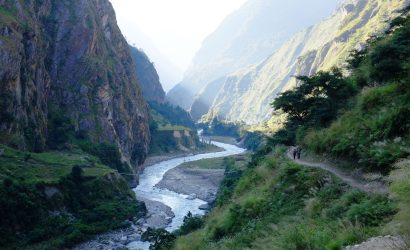
Leaving Dunai, the trail follows the Suli Gad and Thuli Bheri river valleys, crossing several suspension bridges and passing through forested terrain that feels noticeably different from the more arid landscapes typically associated with Dolpo.
The path winds through pine and fir forest, with the river's steady presence accompanying much of the walk, and small, scattered settlements offering glimpses of daily life in this sparsely populated region. Chhepka, a small village set within the boundaries of Shey Phoksundo National Park, offers a quiet, forested overnight stop as the trail begins its gradual climb toward higher terrain.
The trail continues to follow the Suli Gad River, weaving in and out of dense forest and crossing the river multiple times on wooden and suspension bridges as the valley narrows in places and widens in others.
This stretch of the trek passes through some of the most pristine, least-disturbed forest in the national park, home to the possibility of spotting Himalayan wildlife including musk deer or, for the fortunate, signs of the elusive snow leopard that gives the wider region much of its ecological significance. Rechi, a small settlement along the river, provides a peaceful overnight stop deep within the park's protected forest zone.
The trail begins to climb more noticeably today, gaining elevation steadily as the forest starts to thin and the terrain shifts toward higher, more exposed mountain landscape. The Suli Gad valley narrows into a steeper gorge in sections, with the trail cut into the hillside above the rushing river, and the increasing elevation brings a subtle but perceptible change in temperature and vegetation.
Palam, a small high-altitude settlement, sits closer to the tree line, offering a sense of the more rugged, remote terrain that defines the final approach to Phoksundo Lake.
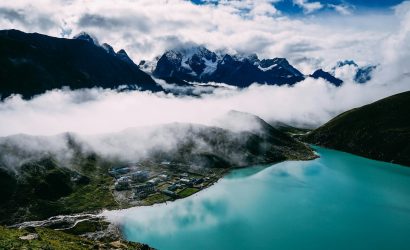
Today delivers the trek's signature reward. The trail climbs beyond Palam through increasingly open, high-altitude terrain, with the surrounding peaks of the Dolpo region beginning to dominate the skyline. As the path crests toward the lake basin, Phoksundo Lake comes into view — a vast, strikingly turquoise glacial lake set against a backdrop of barren cliffs and snow-capped peaks, its color shifting through shades of deep blue and jade depending on the light.
Ringmo Village, a traditional Tibetan Buddhist settlement perched above the lake's shore, offers a fascinating cultural stop in its own right, with its old monastery, chortens, and stone houses reflecting the strong Bon and Buddhist heritage of the wider Dolpo region.
A full day dedicated to soaking in the surroundings of Nepal's deepest lake and the village that overlooks it. Time can be spent walking along the lakeshore, taking in the interplay of color and light across the water, or visiting Ringmo's monastery to learn more about the Bon religion, an ancient spiritual tradition that predates Buddhism in Tibet and remains actively practiced in this part of Dolpo.
For those with energy to spare, a hike to a nearby viewpoint above the lake offers a sweeping perspective over the entire basin, framed by the surrounding peaks. The dramatic waterfall cascading from the lake's outlet, one of Nepal's tallest, is another highlight worth the short walk to see up close.
With the lake and village explored, the return journey begins, retracing the trail back down through Palam and Rechi before reaching Chhepka. Covering more ground in a single day than the outbound journey, this stretch benefits from the gradual loss of elevation and the increasingly familiar terrain, the forested lower valley offering a gentler, more sheltered walk compared to the exposed high terrain around the lake.
The final trekking day retraces the route back through the Suli Gad valley to Dunai and onward to Juphal, closing the loop on the trail first walked on Day 2. From Juphal, a short flight returns to Nepalgunj, connecting shortly after with the onward flight back to Kathmandu.
Landing back in the capital brings the trip full circle, the memory of Phoksundo Lake's striking turquoise waters and the remote, Bon-influenced villages of Dolpo standing out as a highlight from one of Nepal's most untouched trekking regions.