-
Hotel, Lodge
-
Spring, Autumn
-
Guided
-
3,840m
-
BLD
-
Drive, Flight
Upper Mustang is one of the last places on earth where 12th-century Tibetan Buddhist civilization remains genuinely intact. Tucked behind the Annapurna and Dhaulagiri ranges in Nepal’s far northwest, this former independent kingdom receives fewer than 4,000 trekkers per year, not because it lacks appeal, but because Nepal’s government deliberately limits access through a restricted area permit system. That limitation is precisely what makes it worth going.
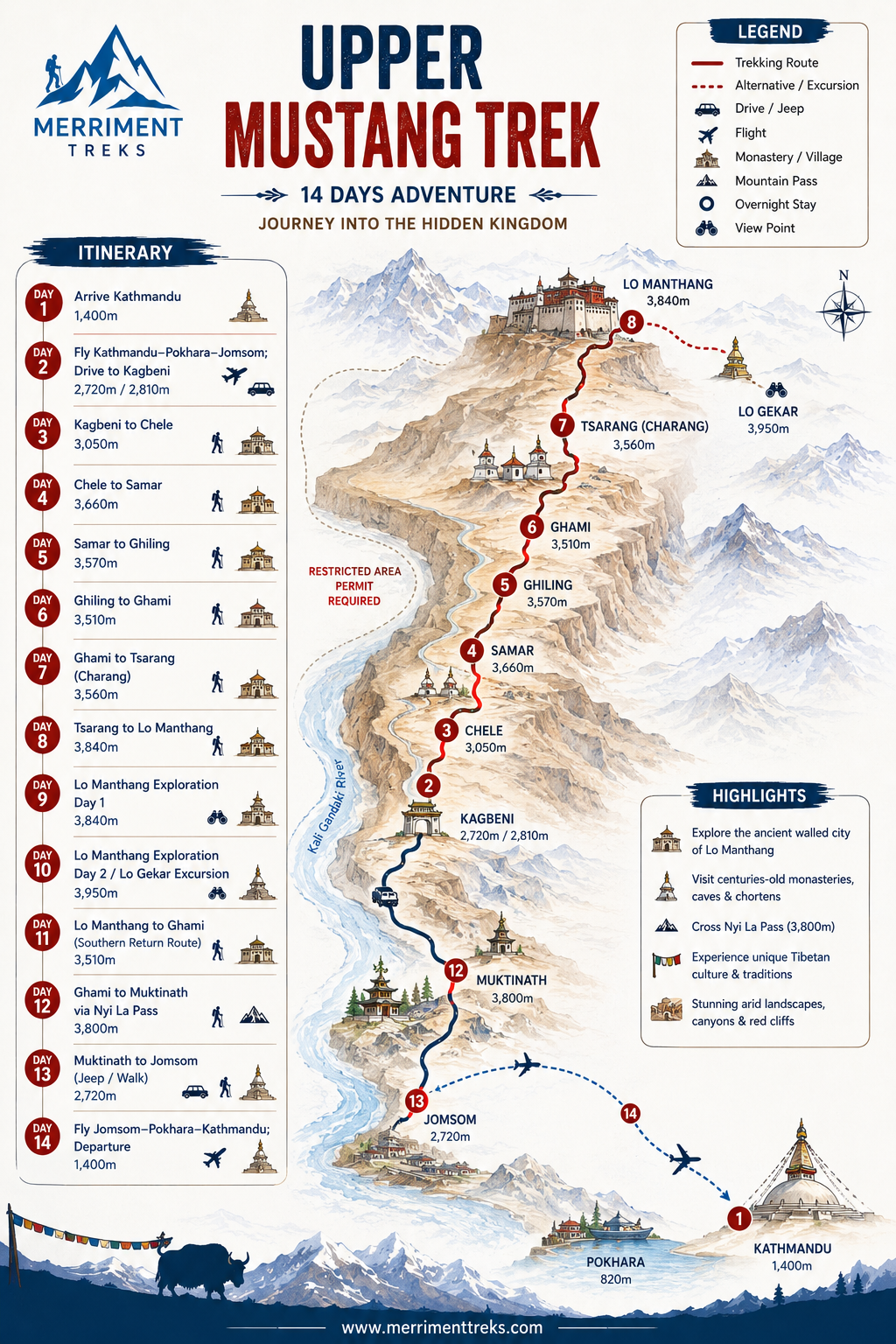
This 14-day Upper Mustang Trek package covers everything from your arrival in Kathmandu to your return from Jomsom: restricted area permits, domestic flights, jeep transfers, teahouse accommodation, all meals on the trail, and an experienced local guide with deep knowledge of Mustang’s history and culture. What follows is the complete, honest information you need to decide whether this is the right trek for you.
Upper Mustang Trek Facts
| Detail | Information |
|---|---|
| Duration | 14 Days |
| Maximum Altitude | 3,840m (Lo Manthang) |
| Trek Difficulty | Moderate |
| Trek Style | Teahouse Trek with Jeep Support Sections |
| Region | Upper Mustang, Mustang District, Gandaki Province |
| Starting Point | Kathmandu → Pokhara → Jomsom (by flight) |
| Ending Point | Jomsom → Pokhara → Kathmandu |
| Restricted Area Permit | USD 500 per person (10 days) |
| Package Cost | USD 1,850 per person |
| Best Season | March–May and September–November |
| Group Size | 2–12 trekkers |
| Accommodation | Teahouses and basic guesthouses |
| Meals | Full board during trekking days |
| Minimum Age | 12 years (with guardian) |
Upper Mustang Trek Overview
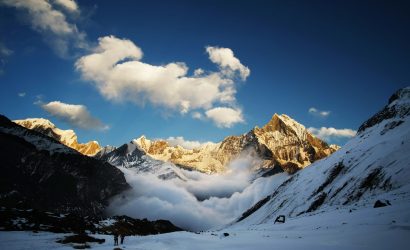
The Upper Mustang Trek follows the ancient trade route between Nepal and Tibet, passing through a landscape that looks and feels nothing like the rest of Nepal. The Kali Gandaki River has carved one of the world’s deepest gorges here, and the terrain north of Kagbeni shifts abruptly from green Himalayan foothills into a vast, wind-scoured plateau of ochre cliffs, eroded canyons, and sky caves that predate recorded history.
The route moves north from Kagbeni through the villages of Chele, Samar, Ghiling, and Ghami before reaching Lo Manthang, the walled capital of the old Kingdom of Lo. You spend two full days in Lo Manthang exploring its palace, monasteries, and the surrounding countryside, including optional rides to Nyphu Monastery and the ancient cave complex of Lo Gekar, one of the oldest Buddhist sites in Nepal.
The return route follows a different southern path through Tsarang, allowing you to see more of the region rather than retracing your steps. Throughout, your guide provides cultural and historical context that transforms what might otherwise be a long desert walk into something genuinely educational.
Why Choose the Upper Mustang Trek
Upper Mustang is not comparable to the Annapurna Circuit or Everest Base Camp. The appeal is different, and it suits a specific type of traveler.
The restricted area keeps it uncrowded. The USD 500 permit requirement and 10-day cap on trekking days within the restricted zone limits annual visitor numbers to a small fraction of Nepal’s more popular routes. On the trail between Ghami and Lo Manthang, you may go hours without seeing another trekking group.
The cultural experience is unmatched in Nepal. Upper Mustang’s geography isolated it from the Tibetan Cultural Revolution of the 1960s, which destroyed thousands of monasteries across the border. The gompas here, including Thubchen Gompa and Champa Gompa in Lo Manthang, survived intact. Their 15th-century murals are considered among the finest surviving examples of Tibetan Buddhist art in the world.
The landscape is unlike anything else in Nepal. The monsoon barely reaches Upper Mustang, so the region stays trekable during the June–August period when most other Nepal routes become wet and difficult. The red, white, and yellow layered cliffs, cave-riddled hillsides, and vast empty valleys create a photographic environment with no equivalent in South Asia.
Altitude is manageable. Lo Manthang sits at 3,840 meters. Unlike Everest Base Camp (5,364m) or the Annapurna Circuit’s Thorong La (5,416m), the maximum altitude here allows most reasonably fit trekkers to acclimatize without significant difficulty, provided they ascend gradually.
Upper Mustang Trek Itinerary Overview
| Day | Route | Altitude | Walking Hours |
|---|---|---|---|
| Day 1 | Arrive Kathmandu | 1,400m | — |
| Day 2 | Fly Kathmandu–Pokhara–Jomsom; drive to Kagbeni | 2,720m / 2,810m | 1–2 hrs walk |
| Day 3 | Kagbeni to Chele | 3,050m | 5–6 hours |
| Day 4 | Chele to Samar | 3,660m | 5–6 hours |
| Day 5 | Samar to Ghiling | 3,570m | 5–6 hours |
| Day 6 | Ghiling to Ghami | 3,510m | 5–6 hours |
| Day 7 | Ghami to Tsarang (Charang) | 3,560m | 4–5 hours |
| Day 8 | Tsarang to Lo Manthang | 3,840m | 4–5 hours |
| Day 9 | Lo Manthang Exploration Day 1 | 3,840m | Optional hikes |
| Day 10 | Lo Manthang Exploration Day 2 / Lo Gekar excursion | 3,950m | 4–5 hours round trip |
| Day 11 | Lo Manthang to Ghami (southern return route) | 3,510m | 5–6 hours |
| Day 12 | Ghami to Muktinath via Nyi La Pass | 3,800m | 6–7 hours |
| Day 13 | Muktinath to Jomsom (jeep / walk) | 2,720m | 2–3 hours |
| Day 14 | Fly Jomsom–Pokhara–Kathmandu; departure | 1,400m | — |
Altitude Profile
| Location | Altitude |
|---|---|
| Kathmandu | 1,400m |
| Pokhara | 820m |
| Jomsom | 2,720m |
| Kagbeni | 2,810m |
| Chele | 3,050m |
| Samar | 3,660m |
| Ghiling | 3,570m |
| Ghami | 3,510m |
| Tsarang | 3,560m |
| Lo Manthang | 3,840m |
| Nyi La Pass (return) | 4,010m |
| Muktinath | 3,800m |
The altitude gain is gradual and well-distributed across the itinerary. The two rest days in Lo Manthang serve a dual purpose: exploration and acclimatization before the higher-altitude return via Nyi La.
Difficulty Level
Overall Rating: Moderate
Upper Mustang is not a technically difficult trek, but it has specific challenges that differ from most Nepal routes:
- Wind: The Kali Gandaki corridor is one of the windiest valleys in the Himalayas. Afternoon winds of 40–60 km/h are routine between late morning and sunset, particularly between March and May. Starting each day before 8:00 AM is not optional — it is essential.
- Terrain: The trail mixes rocky paths, sandy riverbeds, narrow cliff-edge tracks, and eroded gullies. It is rarely flat for long. Trekking poles are strongly recommended.
- Distance: Daily stages average 15–20 km. This is not extreme, but the combination of wind, altitude, and exposed terrain makes the effort feel greater than the distance suggests.
- Remoteness: Medical facilities do not exist north of Jomsom. Your guide carries a first-aid kit and a pulse oximeter, and helicopter evacuation from Lo Manthang is possible in emergencies, but response times are longer than in more accessible regions.
Fitness Requirements
| Fitness Level | Suitable? |
|---|---|
| No prior trekking experience | Not recommended |
| Occasional hiker (weekend day hikes) | Manageable with preparation |
| Regular hiker (6–8 hours, 2–3 times per week) | Well-suited |
| Experienced trekker with high-altitude experience | Ideal |
Begin preparing at least 6–8 weeks before departure with sustained cardiovascular training: long-distance hiking, cycling, or running. Leg strength and ankle stability matter more than raw cardiovascular fitness on this terrain. Anyone with controlled blood pressure, mild asthma, or joint concerns should consult a doctor and discuss the altitude profile in advance.
Permits and Restricted Area Regulations
Upper Mustang requires more documentation than any standard Nepal trek. Both permits are mandatory and must be obtained before entering Kagbeni.
| Permit | Cost | Validity | Notes |
|---|---|---|---|
| Upper Mustang Restricted Area Permit (RAP) | USD 500 per person | 10 days in restricted zone | Must be obtained in Kathmandu; requires registered trekking agency |
| Annapurna Conservation Area Permit (ACAP) | NPR 3,000 (~USD 22) | Duration of trek | Required for the Jomsom–Kagbeni section |
| TIMS Card | NPR 2,000 (~USD 15) | Duration of trek | Mandatory for all foreign trekkers |
Key regulations you must know:
- The restricted area permit is valid for exactly 10 days inside the Upper Mustang zone, starting from Kagbeni. Days are counted strictly.
- Solo trekking without a registered Nepali guide is not permitted in Upper Mustang. This is enforced at checkposts.
- Permits cannot be extended inside the restricted zone. Overstaying results in significant daily fines.
- Drone operation requires a separate permit from the Civil Aviation Authority of Nepal and is prohibited near monasteries and military checkposts.
- All permits must be carried at all times and presented at multiple checkposts along the route.
Merriment Treks processes all permits on your behalf. You provide passport copies and photographs; we handle the applications and coordinate with the Department of Immigration in Kathmandu.
Culture and Heritage of Upper Mustang
Upper Mustang was an independent kingdom called Lo until 2008, when Nepal abolished its monarchy system. The royal family remains resident in Lo Manthang, and the current king, Jigme Dorje Palbar Bista, still maintains ceremonial significance within the community, though his political authority ended with the constitutional changes.
The Loba people of Upper Mustang are ethnically Tibetan and speak a Tibetan dialect distinct from standard Lhasa Tibetan. Their religious practice follows the Sakya school of Tibetan Buddhism, and the monastery at Lo Manthang was founded under Sakya patronage in the 15th century. Agriculture is limited to the lower valleys where irrigation allows barley, buckwheat, and apples to grow. The apple orchards of Marpha, just south of Jomsom, produce some of Nepal’s best apple products including brandy, juice, and dried fruit.
Cultural etiquette on this trek:
- Always walk clockwise around chortens, mani walls, and monasteries
- Ask permission before photographing local residents, particularly monks and elderly people
- Remove footwear before entering any monastery or sacred space
- Do not touch or remove any religious artifacts, wall paintings, or stones
- Dress modestly; shoulders and knees should be covered when visiting gompas
- The monasteries in Lo Manthang charge a small entry fee that goes directly to their restoration funds — pay it without negotiation
The sky caves visible in the cliffs throughout Upper Mustang are ancient man-made chambers carved into the rock face at extraordinary heights. Some were used as burial chambers, others as meditation retreats. Archaeological research conducted since the 1990s has found remains and artifacts dating back 2,000–3,000 years. These caves are not accessible to tourists without specialist equipment, but they are visible from the trail and provide a compelling subject for photography and reflection.
Best Time to Visit Upper Mustang
Upper Mustang’s position in the Himalayan rain shadow creates a climate that operates almost independently of the monsoon affecting the rest of Nepal. This is one of the few trekking regions in Nepal that is genuinely viable during June, July, and August.
Season Comparison for Upper Mustang Trek
| Season | Months | Weather | Trail Conditions | Crowds | Notes |
|---|---|---|---|---|---|
| Spring | March–May | Clear, cool mornings; strong afternoon winds | Excellent | Moderate | Best for Tiji Festival (May); windiest period |
| Pre-Monsoon | June | Warm, some cloud | Very good | Low | Excellent value; green lower valleys |
| Monsoon | July–August | Dry in Upper Mustang; rain in Pokhara/Jomsom | Good on plateau | Very low | Flight disruptions possible at Jomsom |
| Autumn | September–November | Stable, clear, mild winds | Excellent | Moderate–High | October is peak month; best visibility |
| Winter | December–February | Cold (-15°C at night); snowfall possible | Difficult above 3,500m | Very low | Some teahouses close; not recommended |
The Tiji Festival deserves specific mention. Held annually in Lo Manthang over three days in late April or early May (exact dates follow the Tibetan lunar calendar), Tiji is a ritualistic dance ceremony re-enacting the legend of Dorje Jono, who drove away a demon threatening to destroy Mustang. It is one of the most visually extraordinary religious festivals in the Himalayan world. Booking for Tiji dates fills months in advance; inquire early if this is your target.
Weather Overview
| Month | Temperature Range | Wind | Precipitation | Trekking Suitability |
|---|---|---|---|---|
| March | -2°C to 14°C | Strong | Low | Good |
| April | 2°C to 18°C | Very Strong | Low | Very Good (Tiji) |
| May | 5°C to 20°C | Strong | Low | Very Good |
| June | 8°C to 22°C | Moderate | Very Low | Excellent |
| July | 10°C to 23°C | Light | Very Low | Good (flight risk) |
| August | 10°C to 22°C | Light | Very Low | Good (flight risk) |
| September | 5°C to 18°C | Moderate | Low | Excellent |
| October | 0°C to 15°C | Light–Moderate | Very Low | Best Month |
| November | -5°C to 10°C | Moderate | Very Low | Very Good |
| December | -15°C to 2°C | Strong | Possible snow | Poor |
Night temperatures in Lo Manthang drop below freezing from October onward. Even in May, nights at altitude are cold. A sleeping bag rated to -10°C is required, not optional.
Lo Manthang Experience
Lo Manthang is the destination the entire trek builds toward, and it earns that status. The walled city contains roughly 150 households within its perimeter walls, along with the royal palace, four major monasteries, and a network of lanes that have changed little in five centuries.
Thubchen Gompa is the largest monastery in Lo Manthang, featuring a single vast hall with original 15th-century murals covering every wall. The scale and condition of these paintings are remarkable. Restoration work supported by the American Himalayan Foundation has stabilized the murals and the building structure, and the results are visible.
Champa Gompa sits opposite Thubchen and houses a three-story clay statue of Maitreya (the future Buddha) that predates the monastery building itself. The statue was installed before the walls were built around it.
The Royal Palace is a multi-story structure that has partially collapsed but remains visually imposing. The royal family occasionally grants private audiences — this can sometimes be arranged through your guide for a respectful visit.
Lo Gekar Monastery, accessible on Day 10 via a half-day excursion, is believed to be the oldest Buddhist monastery in Nepal, predating even Samye Monastery in Tibet. The main hall contains a thangka said to have been painted by Guru Rinpoche’s personal artists. The hike there crosses a high ridge and offers panoramic views of the Himalayan barrier to the south.
Two full days in Lo Manthang is the minimum that does the place justice. The included itinerary allows unhurried exploration rather than the rushed single-day visits that some shorter packages attempt.
Accommodation
Teahouses in Upper Mustang range from very basic to reasonably comfortable by mountain trekking standards. Expect twin-sharing rooms with simple beds, foam mattresses, and shared bathrooms throughout most of the route. Lo Manthang has a small number of lodges that offer better facilities than the mid-route villages, including attached bathrooms in some establishments.
| Location | Accommodation Type | Bathroom | Hot Shower | Electricity |
|---|---|---|---|---|
| Kagbeni | Comfortable guesthouses | Shared / Some private | Available (fee) | Reliable |
| Chele / Samar | Basic teahouses | Shared | Cold or bucket | Solar / limited |
| Ghiling / Ghami | Basic teahouses | Shared | Cold or bucket | Solar / limited |
| Tsarang | Basic to moderate | Shared | Bucket (fee) | Solar |
| Lo Manthang | Best available guesthouses | Shared / Some private | Available (fee) | Reliable solar |
| Muktinath | Comfortable guesthouses | Shared / Some private | Available (fee) | Reliable |
Hot showers at mid-route villages typically mean solar-heated bucket showers for a fee of NPR 200–500. Do not expect hot running water outside Kagbeni and Lo Manthang. Charging phones and camera batteries is possible at most teahouses, but often for a small fee and at limited times. Carry a power bank with at least 20,000 mAh capacity.
Meals
All meals are included from Day 2 dinner through Day 13 breakfast. The teahouse menu in Upper Mustang is simpler and less varied than on the Annapurna Circuit, reflecting the remoteness of the supply chain.
Common menu items:
- Dal bhat (the standard and most reliable choice for sustained energy)
- Tsampa porridge (roasted barley flour — the traditional Tibetan staple)
- Thukpa (Tibetan noodle soup)
- Momos (steamed or fried dumplings)
- Fried rice and fried noodles
- Tibetan bread with honey or jam
- Potato dishes in various preparations
Meat is available in some teahouses but the supply chain makes freshness uncertain in remote villages. Most experienced guides recommend vegetarian or egg-based meals beyond Chele. Dal bhat is always the safest, most nutritious, and most energy-efficient option for active trekking days.
Drinking water: Do not drink tap or stream water anywhere on this route. Purchase bottled water (available throughout but increasingly expensive with altitude) or carry a quality water filter or purification tablets. Merriment Treks recommends a SteriPen or Sawyer Squeeze filter as a cost-effective and environmentally responsible alternative to single-use plastic bottles.
Transportation
| Segment | Mode | Notes |
|---|---|---|
| Kathmandu–Pokhara | Domestic flight (~25 min) or tourist bus (7–8 hrs) | Flight preferred for time efficiency |
| Pokhara–Jomsom | Domestic flight (~20 min) | Essential; road is rough and unreliable |
| Jomsom–Kagbeni | Jeep (~45 min) or walk (2 hrs) | Jeep included; allows energy conservation |
| Trekking route (Kagbeni–Lo Manthang–Muktinath) | On foot | Core trekking section |
| Muktinath–Jomsom | Jeep (~1.5 hrs) or walk (3–4 hrs) | Jeep included on return |
| Jomsom–Pokhara | Domestic flight (~20 min) | Weather dependent; morning flights more reliable |
| Pokhara–Kathmandu | Domestic flight or tourist bus | As per preference |
A critical note about Jomsom flights: The Jomsom airstrip is one of the most weather-sensitive in Nepal. Flights operate only in the morning, before the daily Kali Gandaki winds make landing unsafe. Afternoon flights are virtually never possible. Build at least one buffer day into your international departure schedule from Kathmandu to account for potential Jomsom flight delays.
Packing Checklist for Upper Mustang Trek
(especially afternoons), and dry, dusty conditions.
Documents & Money
- Passport + photocopies, passport photos
- Restricted Area Permit (RAP) + ACAP permit
- Travel insurance (with high-altitude/evacuation coverage)
- Nepali cash (no ATMs beyond Jomsom)
Upper Body
- 2-3 moisture-wicking base layers (short & long sleeve)
- 1-2 fleece or light down mid-layers
- Insulated down jacket (essential — nights get very cold)
- Windproof/waterproof shell jacket (wind is intense here)
Lower Body
- 2-3 trekking pants (quick-dry)
- Thermal leggings for camp/night
- Fleece pants for cold mornings/evenings
- Underwear (moisture-wicking)
Headwear & Accessories
- Warm wool/fleece hat
- Sun hat or cap (strong UV exposure)
- Buff/neck gaiter (critical — protects against dust and wind)
- Sunglasses (UV protection, glacier-style ideal)
- Warm gloves + thin liner gloves
Footwear
- Broken-in waterproof trekking boots
- Camp shoes/sandals
- Wool trekking socks (4-5 pairs)
- Liner socks
- Gaiters (optional, for dust/sand)
Sleep & Comfort
- 4-season sleeping bag (rated to at least -10°C/14°F)
- Sleeping bag liner (added warmth + hygiene)
- Inflatable pillow (optional)
Health & Hygiene
- Personal first-aid kit
- Diamox (altitude sickness, consult doctor)
- Water purification tablets/filter/SteriPEN
- Hand sanitizer, wet wipes
- Sunscreen (high SPF) + lip balm with SPF
- Basic toiletries, quick-dry towel
- Toilet paper
Gear
- 40-50L duffel bag (for porter) + daypack (25-35L)
- Trekking poles (highly recommended — windy, uneven terrain)
- Headlamp + extra batteries
- Reusable water bottles or hydration bladder
- Dry bags/packing cubes (for dust protection)
- Power bank
Extras
- Camera
- Book/journal, cards
- Snacks/energy bars
- Basic Nepali phrasebook
Cost Breakdown of Upper Mustang Trek
| Item | Cost (USD) |
|---|---|
| Package Base Price (per person, twin sharing) | 1,575 |
| Upper Mustang Restricted Area Permit | Included |
| ACAP Permit | Included |
| TIMS Card | Included |
| Domestic Flights (Kathmandu–Pokhara–Jomsom–Pokhara–Kathmandu) | Included |
| Jeep transfers (Jomsom–Kagbeni and Muktinath–Jomsom) | Included |
| Accommodation (twin sharing, 13 nights) | Included |
| All meals during trekking days | Included |
| Licensed English-speaking guide | Included |
| Porter (1 per 2 trekkers) | Included |
| Government taxes | Included |
| Additional Costs to Budget Separately | Estimated Cost |
|---|---|
| Nepal visa (on arrival) | USD 50 (30 days) |
| Travel and evacuation insurance | USD 80–150 |
| Personal expenses and snacks | USD 100–200 |
| Hot showers on route | USD 20–40 |
| Wi-Fi and device charging fees | USD 15–30 |
| Guide and porter tips (recommended) | USD 150–250 total |
| Optional Lo Gekar excursion | Included |
| Tiji Festival premium (if applicable) | USD 50–100 supplement |
| Single room supplement | USD 150 |
Optional Add-ons
- Tiji Festival dates: Book specifically during the festival period (late April/early May). A small supplement applies for peak-period logistics. Inquire for exact annual dates.
- Muktinath Temple extended visit: Add a half-day for the full temple circuit if your flight schedule permits.
- Marpha apple brandy village walk: A 1-hour detour through Nepal’s apple orchard town on the return from Muktinath.
- Solo room supplement: USD 150 for private room throughout the trek (subject to availability at mid-route teahouses).
- Extended permit (beyond 10 days): If you wish to explore further or move more slowly, additional restricted area permit days can be arranged in advance (USD 50 per additional day).
Responsible Trekking Practices
Upper Mustang is an exceptionally fragile environment in both ecological and cultural terms. The plateau receives minimal rainfall, meaning vegetation regenerates very slowly. The monasteries and their contents are irreplaceable. The Loba community is small and their traditional economy is under significant pressure from modernization and climate change.
- Carry out all non-biodegradable waste. Do not leave plastic, batteries, or packaging anywhere on the route.
- Use a water filter rather than purchasing single-use plastic bottles to reduce the significant plastic accumulation problem in Mustang.
- Purchase locally produced goods where available, including Mustang apples, thangka paintings from local artists, and handwoven textiles.
- Do not give sweets, money, or gifts to children. It creates dependency and disrupts community dynamics.
- Negotiate fairly for local products. Aggressive bargaining at local markets is culturally inappropriate and economically harmful to small producers.
- Camp or stay only in designated teahouses; do not set up tents in or near monastery grounds.
Photography in Upper Mustang
The light in Upper Mustang is extraordinary. The clear high-altitude atmosphere, the red and white cliff faces, the ochre mud-walled buildings, and the deep blue sky create conditions that reward photographers of all experience levels.
- Best light hours: 6:00–9:00 AM and 4:00–6:00 PM. Midday light is flat and harsh.
- Dust protection: Wind-driven sand and fine dust will damage sensor equipment. Carry your camera in a dustproof bag between shooting sessions. Lens cleaning equipment is essential.
- Battery management: Cold nights drain batteries fast. Keep spare batteries in an inner jacket pocket overnight to maintain their charge.
- Monastery photography: Always ask your guide to confirm whether photography is permitted in a specific hall or in front of specific statues. Some objects are considered too sacred for photography and the prohibition is genuine, not performative.
- Portrait photography: The Loba people are generally warm toward respectful visitors. A genuine smile, a greeting in Nepali (“Namaste”) or Tibetan (“Tashi Delek”), and explicit permission before photographing will almost always result in a positive interaction.
Practical Travel Tips
- Book early for Tiji Festival dates. Teahouse space in Lo Manthang is genuinely limited during the festival. Groups that book 6+ months ahead have significantly more flexibility.
- Carry sufficient Nepali Rupees from Kathmandu. ATMs exist in Jomsom but are frequently out of service. There are no banking facilities north of Jomsom. Budget for the full trekking period in cash before you leave.
- Start each trekking day early. The wind issue in the Kali Gandaki is not exaggerated. Trekkers who leave after 9:00 AM regularly struggle with head-on winds that make hiking deeply uncomfortable. Your guide will set an early schedule; follow it.
- Do not overpack your porter’s bag. The weight limit is 15kg per porter for good reason. Porters working above 3,500m in windy conditions deserve reasonable loads. Use the opportunity to travel light and keep essential items in your daypack.
- Discuss medical history with your guide before departure. Your guide needs to know about any conditions that altitude, cold, or sustained exertion might affect. This is not paperwork; it is practical safety information.
- Drink tea, not coffee, at altitude. Tea hydrates; excessive coffee is a mild diuretic. Tibetan butter tea is an acquired taste but genuinely warming and energizing at altitude.
Book Your Upper Mustang Trek
Upper Mustang trek requires more planning than a standard Nepal trek. Restricted area permits must be processed in advance, domestic flight seats need to be secured early, and the best teahouses in Lo Manthang fill up during peak periods and around the Tiji Festival.
To begin your Upper Mustang trek booking process:
- Contact our team with your preferred travel dates and group size
- We confirm availability and walk you through the permit process
- A 25% deposit secures your booking and initiates permit applications
- Final payment is due 30 days before departure
We respond to all inquiries within 24 hours. If you have specific questions about fitness, medical considerations, photography access, or combining Upper Mustang with other Nepal destinations, include those in your message and we will give you an honest, detailed answer.
This is a place that rewards careful planning. The trekkers who get the most out of Upper Mustang are those who understand what they are going into, have prepared physically, and have set aside enough time to move unhurriedly through one of the most culturally significant landscapes remaining in the Himalayan world.
We look forward to helping you get there.
Upper Mustang Trek Highlights
- Fly into Jomsom (2,720m) over the Annapurna range — one of the most scenic domestic flights in Nepal
- Trek through Kagbeni, the gateway to the restricted zone, with its medieval architecture and fortress
- Walk ancient caravan paths used for centuries by Tibetan salt traders
- Enter the walled city of Lo Manthang, the 15th-century capital of the Kingdom of Lo
- Visit Thubchen Gompa and Champa Gompa, featuring priceless original murals and statues
- Explore sky caves at Chungsi Cave and the area around Tsarang
- Witness the ruined palace of Lo Manthang and meet the local Loba community
- Optional excursion to Lo Gekar Monastery, one of Nepal's oldest Buddhist temples
- Cross high passes including Nyi La (4,010m) on the return southern route
- Descend to Muktinath Temple (3,800m), sacred to both Hindus and Buddhists