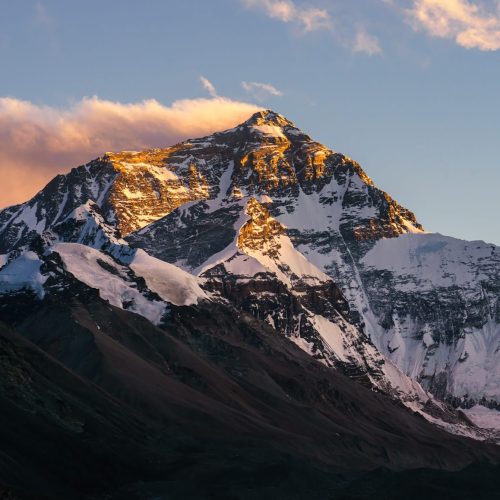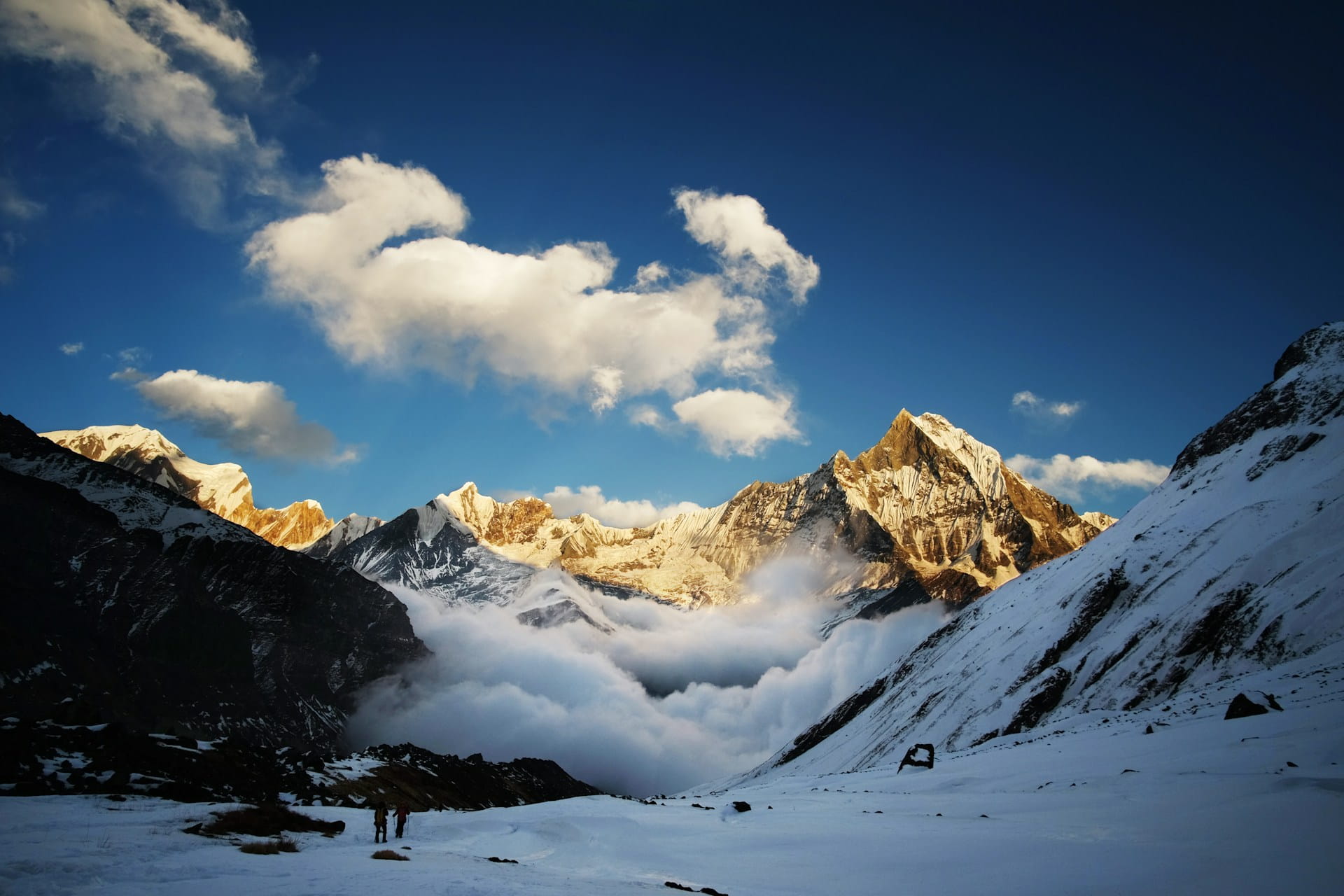
The Short Annapurna Circuit Trek compresses the core section of the classic Annapurna Circuit into 9 days by starting the walk further along the route, at a point the classic circuit itself now reaches partly by road. This isn’t a watered-down version of the trek — it covers the same high-altitude terrain, the same villages through the Marshyangdi Valley, and the same crossing of Thorong La Pass at 5,416 meters. What’s removed is the lower-altitude road-adjacent walking that the original circuit included before jeep roads were built into the valley over the past decade.
This package suits trekkers who have 9 to 11 days available, including travel days in and out of Nepal, and who want the high-altitude Annapurna experience without committing three weeks to it. It also suits those who’ve researched the classic 15–21 day circuit and found the road sections in the lower Marshyangdi Valley a deterrent, since recent years of road construction have reduced how much of that lower section still qualifies as genuine trail walking.
Quick Facts about Short Annapurna Circuit Trek
| Detail | Information |
|---|---|
| Trek Name | Short Annapurna Circuit Trek |
| Duration | 9 Days (Kathmandu to Kathmandu) |
| Price | US$975 per person |
| Max Altitude | Thorong La Pass – 5,416 m |
| Trek Region | Annapurna Conservation Area, Marshyangdi & Kali Gandaki Valleys |
| Difficulty | Moderate to Challenging |
| Group Size | 2–12 trekkers (private departures available) |
| Accommodation | Tea houses/lodges |
| Meals | Breakfast, lunch, dinner during trek |
| Best Season | March–May, September–November |
| Starts/Ends | Kathmandu |
| Permits Required | ACAP, TIMS |
Trip Overview
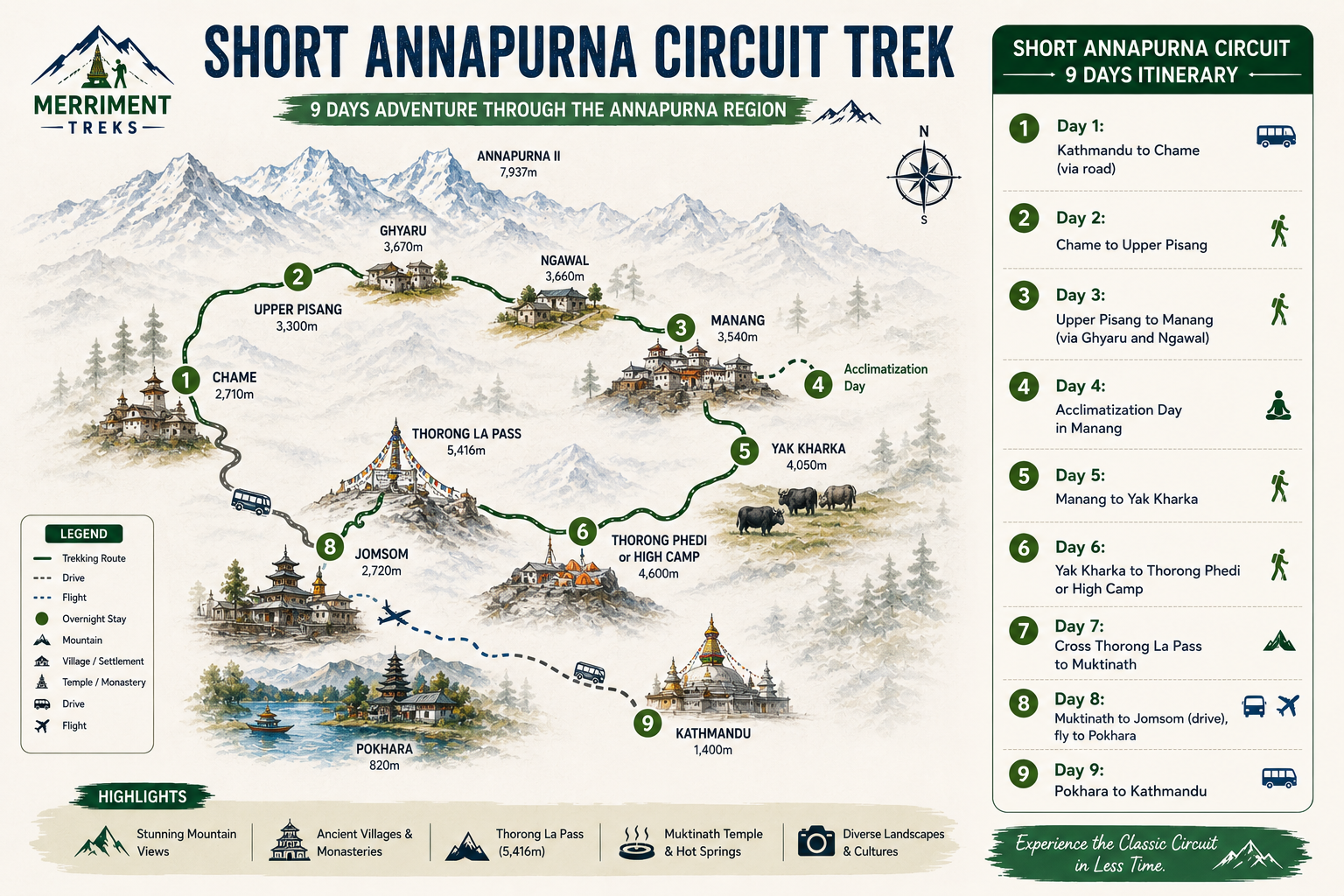
The Short Annapurna Circuit Trek follows the upper half of the classic Annapurna Circuit route, starting the trek at Chame or Koto depending on road conditions and seasonal access, rather than at the traditional lower starting points like Besisahar or Bhulbhule. A private vehicle handles the road section, which now covers ground that trekkers used to walk on foot before the road network expanded into the Marshyangdi Valley.
From the starting village, the route climbs steadily through Upper Pisang, Manang, Yak Kharka, and Thorong Phedi or High Camp, before crossing Thorong La Pass into the Kali Gandaki Valley and descending to Muktinath. From Muktinath, a drive to Jomsom and a short flight to Pokhara closes the loop. This structure keeps the trek focused on the section most trekkers actually come for — the high-altitude villages, the pass crossing, and the dramatic shift in landscape from the green Marshyangdi side to the arid Kali Gandaki side.
Why Choose the Short Annapurna Circuit Trek
- Same high-altitude experience, shorter commitment. The pass crossing, the acclimatization days in Manang, and the highest-altitude villages are all included — this route removes lower-valley walking, not the demanding part of the trek.
- Avoids sections increasingly affected by road construction. Ongoing road-building in the lower Marshyangdi Valley has reduced how much of that stretch still feels like a trekking trail rather than a vehicle track. Starting further up the valley sidesteps this.
- Realistic for travelers with limited time. At 9 days total, this fits within a two-week Nepal trip alongside a few days in Kathmandu or Pokhara, which the full 15–21 day circuit generally doesn’t allow.
- Still crosses Thorong La Pass. This is the section most trekkers associate with the Annapurna Circuit’s reputation, and it’s fully included, not substituted with a lower alternative route.
Why Book with Merriment Treks
Merriment Treks operates this itinerary with a fixed daily walking structure built around realistic acclimatization needs rather than the fastest possible pass crossing. Guides are trained in altitude sickness recognition and carry the judgment to adjust the schedule, including holding a group at a lower altitude for an extra day, if early symptoms appear.
Permits, tea house bookings during peak season, and the road transportation segments are arranged in advance, which matters most in October and November when Manang and the villages near the pass can fill up quickly. Pricing is quoted upfront with a clear breakdown of what’s included, rather than a low headline price that requires costly add-ons once the trek is underway.
Short Annapurna Circuit Trek Highlights
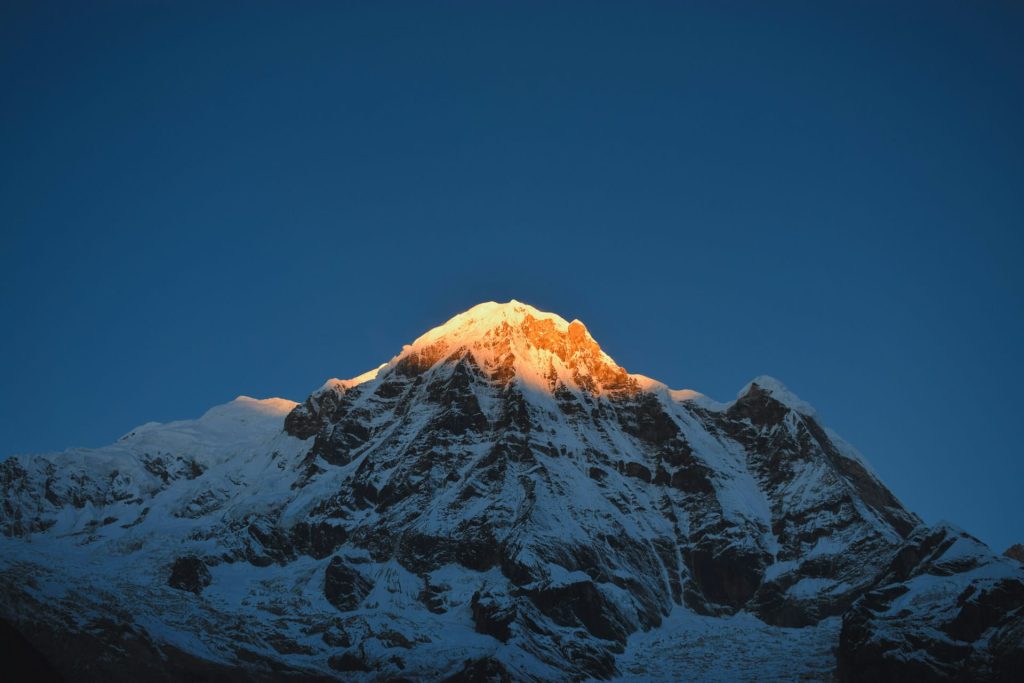
- Crossing of Thorong La Pass at 5,416 meters, the trek’s highest point
- Two nights in Manang (3,540m) with a built-in acclimatization day
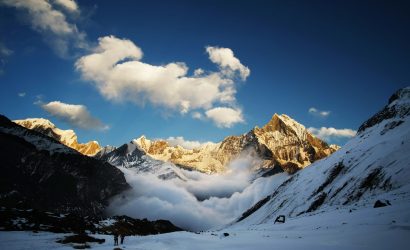
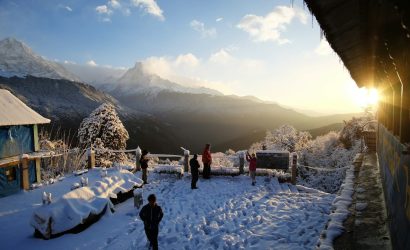
- Walk through Upper Pisang, with views of Annapurna II, Annapurna III, and Gangapurna
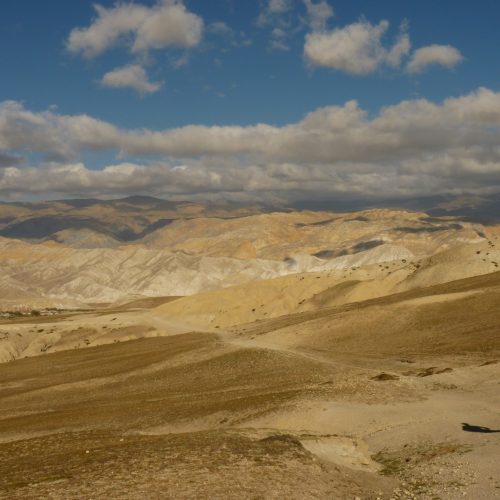
- Descent through the arid Kali Gandaki Valley to Muktinath, a significant Hindu and Buddhist pilgrimage site
- Overland and short flight return via Jomsom and Pokhara
- Daily encounters with mani walls, chortens, and prayer flags along traditional trekking routes
- Tea house accommodation throughout, with basic but functional facilities at higher altitudes
Short Annapurna Circuit Trek Itinerary Overview
Day 1: Kathmandu to Chame (via road)
Day 2: Chame to Upper Pisang
Day 3: Upper Pisang to Manang (via Ghyaru and Ngawal)
Day 4: Acclimatization Day in Manang
Day 5: Manang to Yak Kharka
Day 6: Yak Kharka to Thorong Phedi or High Camp
Day 7: Cross Thorong La Pass to Muktinath
Day 8: Muktinath to Jomsom (drive), fly to Pokhara
Day 9: Pokhara to Kathmandu
Route Overview
| Stage | Region | Key Feature |
|---|---|---|
| Kathmandu to Chame | Road access | Enters the Annapurna Conservation Area |
| Chame to Manang | Marshyangdi Valley | Pine forest to alpine terrain, first Himalayan views |
| Manang | Acclimatization hub | Rest day, monastery visit, lake viewpoint |
| Manang to High Camp | Upper Marshyangdi | Sparse vegetation, high-altitude villages |
| Thorong La Pass | Pass crossing | 5,416m, highest point of the trek |
| Muktinath to Pokhara | Kali Gandaki Valley | Descent, pilgrimage site, arid landscape |
Daily Walking Distance & Hours
| Day | Route | Walking Time | Altitude Change |
|---|---|---|---|
| 1 | Kathmandu to Chame (drive) | 7–9 hrs (vehicle) | 1,400m to 2,710m |
| 2 | Chame to Upper Pisang | 5–6 hrs | 2,710m to 3,300m |
| 3 | Upper Pisang to Manang | 6–7 hrs | 3,300m to 3,540m |
| 4 | Acclimatization day (Manang) | 2–3 hrs (optional hike) | 3,540m + day hike |
| 5 | Manang to Yak Kharka | 3–4 hrs | 3,540m to 4,050m |
| 6 | Yak Kharka to Thorong Phedi/High Camp | 3–5 hrs | 4,050m to 4,450–4,850m |
| 7 | Cross Thorong La to Muktinath | 7–9 hrs | Up to 5,416m, down to 3,760m |
| 8 | Muktinath to Jomsom (drive), fly to Pokhara | 1–2 hrs walk + flight | 3,760m to 2,850m (Pokhara 820m) |
| 9 | Pokhara to Kathmandu | 6–7 hrs (road) | 820m to 1,400m |
Altitude Profile
| Location | Altitude |
|---|---|
| Kathmandu | 1,400 m |
| Chame | 2,710 m |
| Upper Pisang | 3,300 m |
| Manang | 3,540 m |
| Yak Kharka | 4,050 m |
| Thorong Phedi | 4,450 m |
| High Camp | 4,850 m |
| Thorong La Pass | 5,416 m |
| Muktinath | 3,760 m |
| Pokhara | 820 m |
Trail Difficulty
This trek is rated Moderate to Challenging. The main difficulty isn’t technical — there’s no climbing or exposed scrambling — but sustained altitude gain over a short period, particularly between Manang and the pass crossing, requires reasonable cardiovascular fitness and genuine respect for acclimatization protocols. The pass-crossing day is long, cold at the start, and physically demanding regardless of fitness level, simply due to the altitude and duration.
Fitness Requirements
Trekkers should be able to walk 5–7 hours per day on uneven terrain, sometimes with a daypack of 4–6 kg. Prior high-altitude experience isn’t required, but some multi-day hiking experience is genuinely useful preparation. Regular cardiovascular exercise in the 2–3 months before the trek — hiking, running, or stair climbing — meaningfully improves the experience, particularly on the pass-crossing day.
Altitude & Acclimatization
Altitude sickness risk is real above 3,000 meters and increases with elevation gain, which is why this itinerary retains Manang’s acclimatization day even though the trek’s overall duration is shortened. The daily altitude gain schedule follows widely accepted high-altitude trekking guidelines rather than compressing the ascent further to save time.
Guides are trained to recognize early symptoms of Acute Mountain Sickness (headache, nausea, dizziness, loss of appetite) and carry the authority to adjust the day’s plan, including descent, if symptoms don’t improve with rest. Trekkers are encouraged to communicate symptoms honestly rather than push through them, since early intervention is straightforward while advanced altitude sickness is a genuine medical emergency.
Thorong La Pass Crossing
Thorong La Pass, at 5,416 meters, is the trek’s highest point and its most demanding single day. The early departure time exists specifically to cross before afternoon winds intensify, a pattern that holds consistently on this route regardless of season. Temperatures at the pass are well below freezing even in trekking season, so appropriate cold-weather layers are not optional.
The pass is not technically difficult — no ropes or climbing gear are required — but the combination of altitude, distance, and early cold makes it physically demanding. Trekkers in reasonable fitness who’ve acclimatized properly typically manage the crossing without serious difficulty, though the day is long by any standard.
Best Time to Trek

Spring (March–May) and autumn (September–November) offer the most stable weather and clearest mountain views, and are the seasons this itinerary is primarily designed around. Autumn tends to have the most reliable weather overall, while spring adds rhododendron blooms at lower elevations, visible mainly on the drive in rather than on the high-altitude trail itself.
Winter trekking (December–February) is possible but the pass can close temporarily after heavy snowfall, and cold at high camp becomes a more serious factor. Monsoon season (June–August) is generally not recommended for this route, since poor visibility and the risk of landslides affecting the road-access sections make the trip both less rewarding and less predictable.
Season Comparison
| Season | Months | Conditions | Recommendation |
|---|---|---|---|
| Spring | Mar–May | Mild days, cold nights, rhododendrons at lower elevation | Recommended |
| Summer/Monsoon | Jun–Aug | Rain, landslide risk on access roads, poor visibility | Not recommended |
| Autumn | Sep–Nov | Clear skies, stable weather, busiest season | Highly recommended |
| Winter | Dec–Feb | Very cold at altitude, possible pass closure after snowfall | Experienced trekkers only |
Weather Overview
| Location | Season | Day Temp | Night Temp |
|---|---|---|---|
| Manang (3,540m) | Autumn/Spring | 10–15°C | -5 to 0°C |
| Thorong Phedi (4,450m) | Autumn/Spring | 5–10°C | -10 to -5°C |
| Thorong La Pass (5,416m) | Crossing day | -5 to 0°C | N/A (day crossing only) |
| Muktinath (3,760m) | Autumn/Spring | 8–13°C | -5 to 0°C |
Transportation
The package includes private vehicle transport from Kathmandu to Chame at the start and a domestic flight from Jomsom to Pokhara midway through, followed by tourist coach transport from Pokhara back to Kathmandu. Road conditions on the Kathmandu-to-Chame drive can vary, particularly after monsoon season when landslides occasionally affect sections of the route — this is communicated honestly rather than downplayed, since it’s a realistic factor on this road.
Accommodation
Tea houses and trekking lodges are used throughout the route. Facilities are more basic at higher altitudes — expect simple twin-sharing rooms, shared bathrooms at higher elevations, and charging or hot shower services that may cost extra as altitude increases. In Pokhara, a standard tourist-category hotel is used instead of a tea house.
| Location | Accommodation Type | Facilities |
|---|---|---|
| Chame to Manang | Tea house | Twin rooms, shared bathroom common |
| Yak Kharka to High Camp | Basic tea house | Shared bathroom, limited hot water, extra charges likely |
| Muktinath | Tea house | Twin rooms, shared bathroom |
| Pokhara | Tourist hotel | Private bathroom, standard amenities |
Meals & Drinking Water
Breakfast, lunch, and dinner are included throughout the trekking days, typically served at the tea house where the group is staying. Menus are simple but varied — dal bhat (rice, lentils, vegetables), noodle and pasta dishes, soups, and basic breakfast items like porridge, eggs, and pancakes. Menu variety decreases somewhat at higher altitudes, where supply logistics are more limited.
Bottled water is available for purchase at tea houses but becomes more expensive at higher altitudes; boiled water and water purification tablets are more economical and environmentally preferable alternatives, and both are commonly used by trekkers on this route.
Permits
Two permits are required for this trek, both included in the package cost.
| Permit | Purpose |
|---|---|
| ACAP (Annapurna Conservation Area Permit) | Required for entry into the Annapurna Conservation Area |
| TIMS Card (Trekkers’ Information Management System) | Tracks trekker movement for safety purposes |
Both permits are arranged by Merriment Treks in advance of the trek starting, and physical copies are checked at checkpoints along the route.
Packing Checklist for Short Annapurna Circuit Trek
| Category | Items |
|---|---|
| Upper Body | Base layers, fleece or insulating layer, waterproof/windproof jacket |
| Lower Body | Trekking pants, thermal leggings, waterproof shell pants |
| Footwear | Broken-in trekking boots, warm socks, camp shoes/sandals |
| Headwear | Warm hat, sun hat, buff or scarf |
| Hands | Warm gloves, liner gloves |
| Sleeping | Sleeping bag rated to at least -15°C |
| Health | Personal first-aid kit, diamox (consult doctor), water purification tablets |
| Other | Headlamp, trekking poles, sunglasses (UV protection), reusable water bottle |
Price and Cost Breakdown
Package Price: US$975 per person
This price reflects the route’s shorter road-transport requirement compared to the classic circuit, combined with standard tea house-based logistics rather than luxury lodge upgrades. The price includes a licensed guide, permits, road and flight transport as specified in the itinerary, and full board (breakfast, lunch, dinner) during the trekking days.
| Item | Included in US$975 |
|---|---|
| Guide (licensed, English-speaking) | Yes |
| Porter | Optional add-on |
| ACAP and TIMS permits | Yes |
| Kathmandu–Chame transport | Yes |
| Jomsom–Pokhara flight | Yes |
| Pokhara–Kathmandu transport | Yes |
| Tea house accommodation | Yes |
| Meals during trek (breakfast, lunch, dinner) | Yes |
| Kathmandu hotel nights | Not included |
| Personal trekking gear | Not included |
| Travel insurance | Not included |
| Tips | Not included |
Optional Services
- Porter service (carries up to 12–15 kg, shared between two trekkers typically)
- Additional acclimatization day in Manang
- Kathmandu–Pokhara domestic flight instead of road transport on Day 9
- Extended stay in Pokhara before or after the trek
- Pre-trek Kathmandu hotel booking
Travel Tips
- Break in trekking boots well before arrival — new boots on a multi-day trek are a common and avoidable cause of foot problems
- Carry cash (Nepali rupees) for tea house extras like hot showers, charging, and bottled drinks, since card payment isn’t available on the trail
- Pack layers rather than one heavy jacket — temperature swings between daytime sun and early morning cold are significant at altitude
- Discuss diamox and altitude sickness prevention with a doctor before departure, particularly if you have any cardiovascular or respiratory history
- Keep valuables and essential medication in your daypack, not in a porter-carried duffel, in case bags are separated during the day
Responsible Trekking
The Annapurna Conservation Area is a managed conservation zone, and trekkers are expected to follow standard low-impact practices: carrying out non-biodegradable waste, avoiding single-use plastic where possible by using water purification instead of bottled water, and respecting local customs in villages along the route, including modest dress and asking before photographing people. Guides brief groups on these practices at the start of the trek rather than assuming prior knowledge.
Frequently Asked Questions about Short Annapurna Circuit Trek
1. What is the Short Annapurna Circuit Trek?
It’s a 9-day version of the classic Annapurna Circuit that starts the trekking route further up the Marshyangdi Valley, using road transport to skip lower sections that have increasingly been affected by road construction.
2. How is it different from the classic Annapurna Circuit?
The classic circuit is typically 15–21 days and includes more lower-valley walking. This version keeps the high-altitude core of the route, including Thorong La Pass, while removing lower sections now largely accessible by road.
3. Who is this trek suitable for?
Trekkers with reasonable fitness, some multi-day hiking experience, and 9–11 days available including international travel. It’s not recommended as a first-ever multi-day hike.
4. What makes the 9-day itinerary possible?
Starting the trek at Chame via private vehicle instead of walking from lower trailheads like Besisahar, combined with a flight segment from Jomsom to Pokhara on the return.
5. How difficult is the trek?
Moderate to challenging. There’s no technical climbing, but sustained altitude gain and one long, high-altitude pass-crossing day require solid fitness and acclimatization discipline.
6. What is the highest altitude?
Thorong La Pass, at 5,416 meters, is the highest point of the trek.
7. How long do I walk each day?
Between 2 and 9 hours depending on the day, with the Thorong La Pass crossing being the longest at 7–9 hours.
8. What accommodation is provided?
Tea houses and trekking lodges throughout the route, with a standard hotel in Pokhara. Facilities are more basic at higher altitudes.
9. What meals are available?
Breakfast, lunch, and dinner are included during trekking days, typically dal bhat, noodle dishes, soups, and simple breakfast items.
10. What permits are required?
An ACAP (Annapurna Conservation Area Permit) and a TIMS card, both arranged and included by Merriment Treks.
11. How much does it cost?
US$975 per person, which includes guide, permits, specified transport, accommodation, and meals during the trek.
12. Why is the price US$975?
The price reflects standard tea house logistics and the reduced transport distance of the shorter route, without cutting corners on guiding or safety standards.
13. What is included?
Guide, permits, Kathmandu-to-Chame transport, Jomsom-to-Pokhara flight, Pokhara-to-Kathmandu transport, tea house accommodation, and full board during trekking days.
14. What is excluded?
Kathmandu hotel nights, visa fees, travel insurance, personal gear, porter service, and tips.
15. What should I pack?
Layered clothing for temperature swings, a sleeping bag rated to at least -15°C, broken-in trekking boots, and basic altitude medication after consulting a doctor.
16. When is the best season?
March to May and September to November, for the most stable weather and clearest mountain views.
17. How should I prepare physically?
Regular cardiovascular exercise for 2–3 months beforehand — hiking, running, or stair climbing — along with some multi-day hiking experience if possible.
18. How does acclimatization work?
The itinerary includes a dedicated rest day in Manang with an optional acclimatization hike, following the standard practice of gaining altitude during the day and sleeping lower at night.
19. What transportation is included?
Private vehicle from Kathmandu to Chame, a domestic flight from Jomsom to Pokhara, and tourist coach transport from Pokhara back to Kathmandu.
20. Is Thorong La Pass safe?
With proper acclimatization, appropriate gear, and a guide monitoring the group’s condition, the pass crossing is manageable for most reasonably fit trekkers, though it remains the most physically demanding day of the trek.
21. Why book with Merriment Treks?
Merriment Treks builds this itinerary around realistic acclimatization needs, arranges permits and tea house bookings in advance during peak season, and provides transparent pricing without hidden add-on costs.
22. Is a porter included in the price?
No, porter service is available as an optional add-on rather than included in the base US$975 price.
23. Can the acclimatization schedule be extended?
Yes, an additional acclimatization day in Manang can be added for trekkers who want extra buffer, which extends the total trip duration.
24. Is travel insurance required?
It’s not required by Merriment Treks but is strongly recommended, particularly insurance that covers high-altitude trekking and emergency evacuation.
25. What happens if Thorong La Pass is closed due to weather?
In rare cases of heavy snowfall, the pass may close temporarily. Guides will advise on alternative timing or, if necessary, adjust the itinerary in consultation with the group.
Book the Short Annapurna Circuit Trek
This itinerary gives you the defining section of the Annapurna Circuit — the high villages, the pass crossing, the shift from green valley to arid highland — without the extended lower-valley walking that’s increasingly shared with vehicle traffic.
Contact Merriment Treks with your preferred dates and group size to check availability and confirm your booking.
-
Hotel, Lodge
-
Spring, Autumn
-
Guided
-
BLD
-
5,416 m
-
Drive, Flight
Short Annapurna Circuit Trek Itinerary
Early morning departure from Kathmandu by private vehicle, driving via Besisahar and up the Marshyangdi Valley road to Chame (2,710m), the administrative headquarters of the Manang district. This drive takes 7–9 hours depending on road conditions, which can vary significantly after monsoon season. Overnight in Chame.
The trail leaves the road here and becomes a genuine walking route. This section passes through pine forest and offers the first clear views of Annapurna II and Lamjung Himal. Upper Pisang, rather than Lower Pisang, is chosen for the overnight stop since it sits on the route toward Manang via Ghyaru and Ngawal, a higher and more scenic alternative to the direct lower trail. Walking time: 5–6 hours.
This is the longer and more demanding walking day in the itinerary, taken via the upper route through Ghyaru and Ngawal rather than the shorter, lower direct trail, since the upper route offers better acclimatization value and significantly better mountain views, including Gangapurna and Annapurna III. Walking time: 6–7 hours.
A rest day built into the schedule at 3,540 meters, one of the most important acclimatization points on the route. Rather than a full rest, the day typically includes a short acclimatization hike to a higher point nearby, such as Gangapurna Lake viewpoint or the Praken Gompa monastery, following the standard high-altitude trekking principle of walking higher during the day and sleeping lower at night.
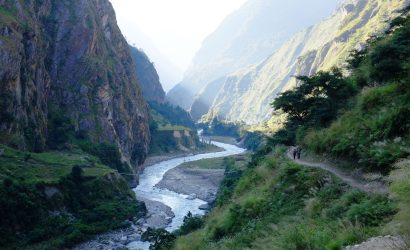
A shorter, easier walking day by design, allowing the body to continue adjusting gradually before the altitude gain accelerates over the following two days. The trail follows the Marshyangdi River upstream through increasingly sparse vegetation. Walking time: 3–4 hours.
Trekkers can choose to stop at Thorong Phedi (4,450m) or continue to High Camp (4,850m), which shortens the following day's pass crossing but adds altitude gain a day earlier. Merriment Treks' guides make this call based on how the group is acclimatizing, rather than defaulting to one option regardless of condition. Walking time: 3–5 hours depending on stopping point.
The main event of the trek. Departure is typically before dawn, often around 4:00–5:00 AM, to cross the pass before afternoon winds pick up, which is standard practice on this route rather than an unusual precaution. The climb to the pass takes 4–5 hours, and the descent to Muktinath (3,760m) on the other side takes a further 3–4 hours. Total walking time: 7–9 hours, the longest and highest day of the trek.
A short walk or drive down to Jomsom, followed by a scenic short flight to Pokhara. This flight is subject to morning weather conditions, which is standard for Jomsom's airstrip, and occasional delays are a realistic possibility rather than an edge case. Overnight in Pokhara.
Return to Kathmandu by tourist coach or domestic flight (flight available at additional cost). Trek concludes on arrival in Kathmandu.