-
6,119m (Lobuche East)
-
B in Kathmandu; B, L, D on trek
-
Flight (Lukla) / Private vehicle
-
Spring & Autumn
-
Hotel, Teahouse, Tented camp
-
NMA-licensed climbing guide
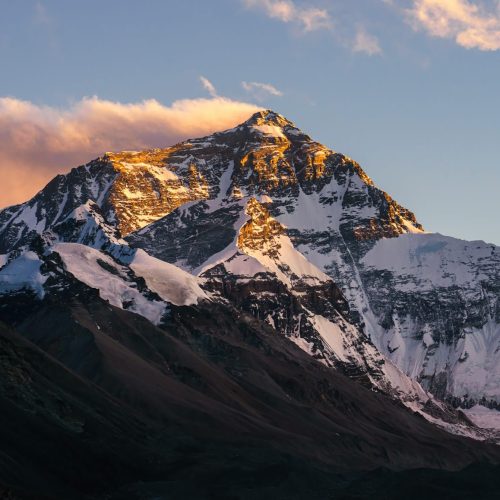
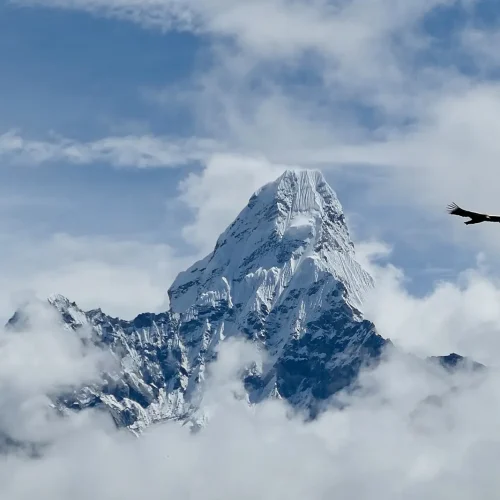
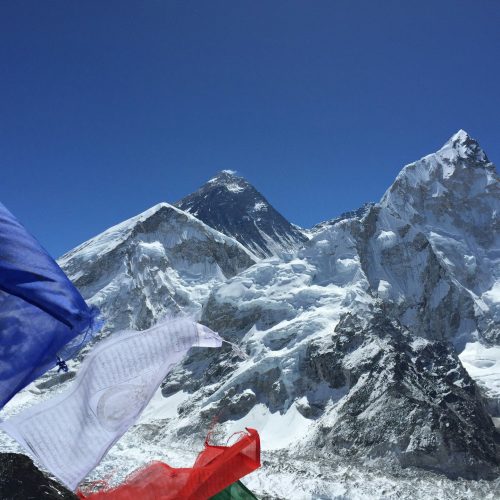
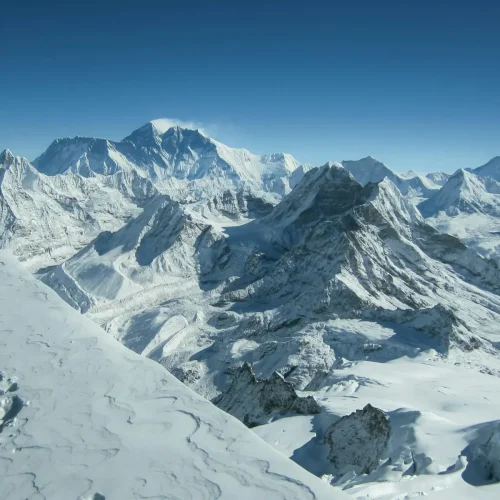
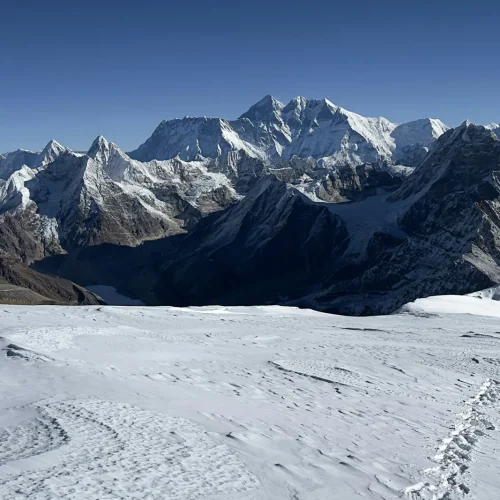
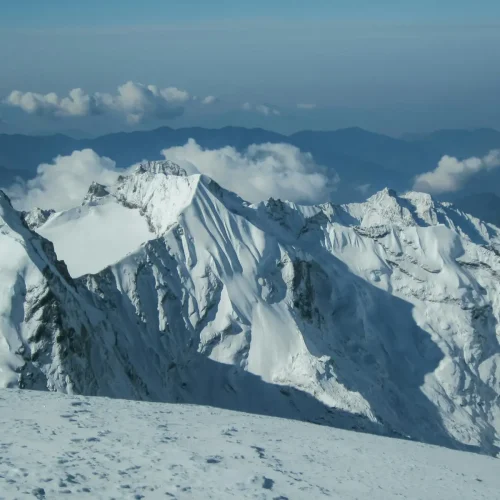
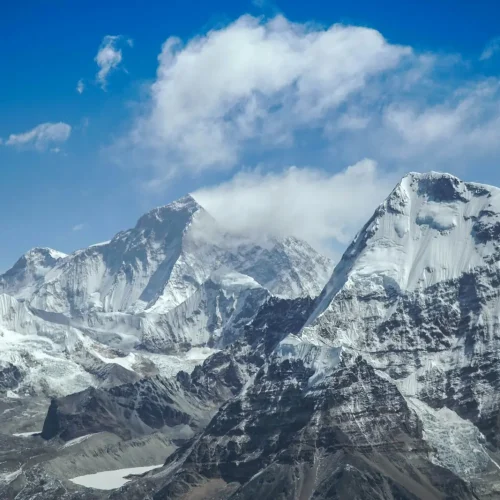
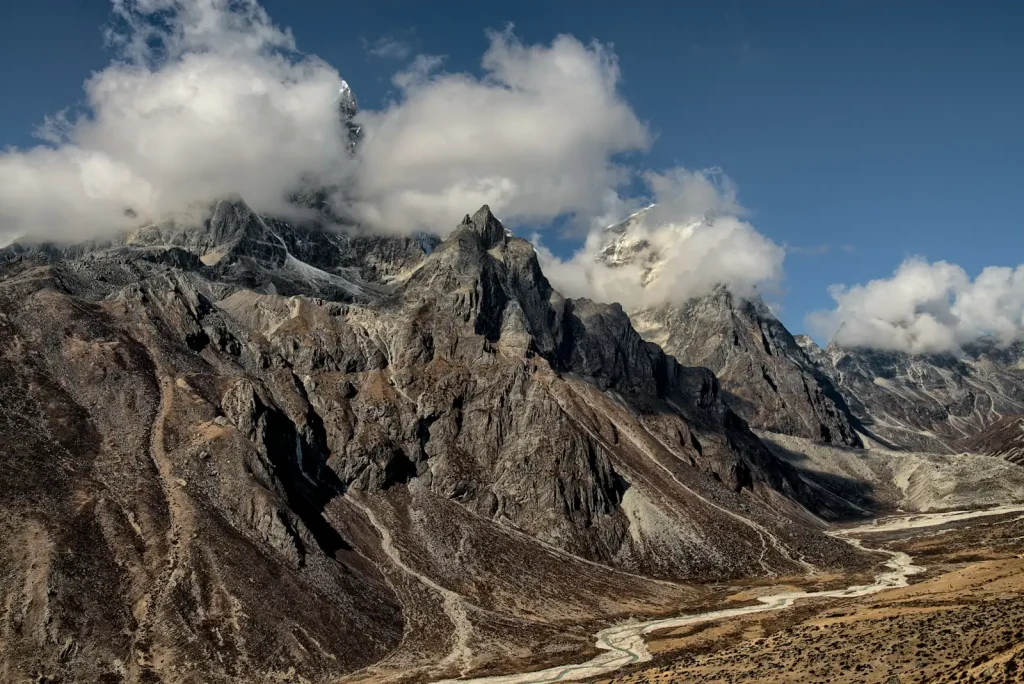
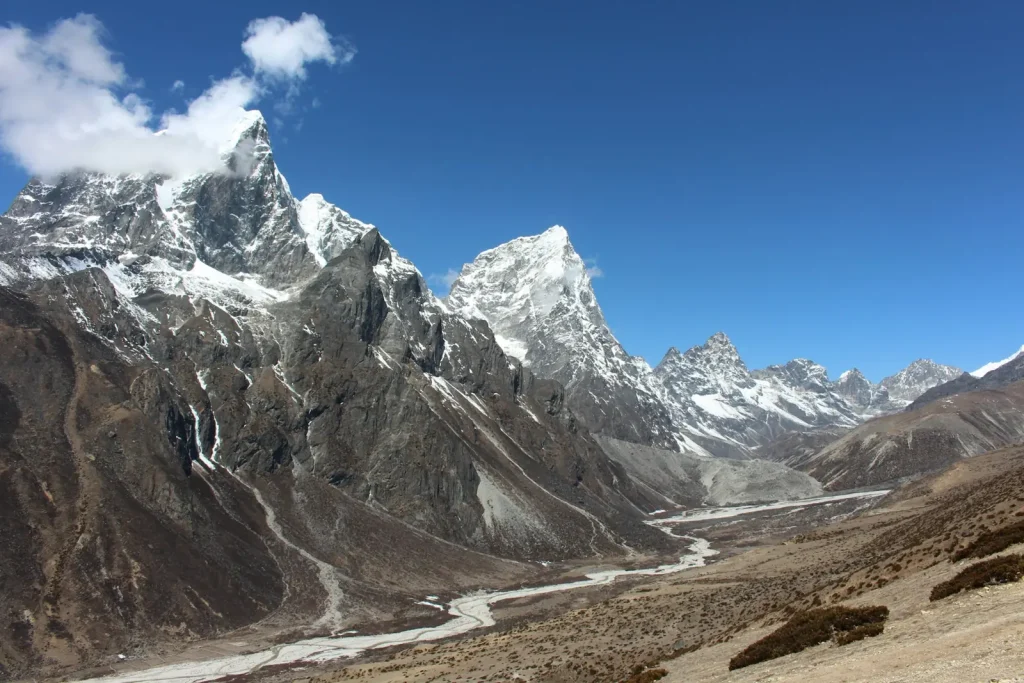
Lobuche East Peak Climbing combines the full Everest Base Camp trek with a technical summit at 6,119m. Lobuche East rises directly above the EBC trail near the village of Lobuche, between the Khumbu Glacier and the Chola valley. From its upper ridge you look straight across at Everest, Lhotse, Nuptse, Pumori and Ama Dablam, and down onto the Khumbu Icefall.
Among the popular trekking peaks, this is the one that feels most like real mountaineering. The route mixes rock slabs, a crevassed glacier, a fixed-rope snow slope of 45–50 degrees, and an exposed ridge. Many climbers use it as preparation for bigger 7,000m and 8,000m objectives. You don’t need previous climbing experience, but you do need to be fit, steady on exposed ground and willing to learn rope skills properly.
This 20-day package treks to Everest Base Camp and Kala Patthar first, so you are fully acclimatised before you climb. Below you’ll find the itinerary, an honest look at the false summit question, current permit fees, costs and FAQs. For a less technical first climb, compare Island Peak Climbing.
Lobuche East at a Glance
| Detail | Information |
|---|---|
| Summit altitude | 6,119m / 20,075ft (Lobuche East true summit) |
| Region | Khumbu (Everest region), Sagarmatha National Park |
| Duration | 20 days Kathmandu to Kathmandu |
| Route | Lukla – Namche – Dingboche – Lobuche – Gorak Shep (EBC & Kala Patthar) – Lobuche East Base Camp – High Camp |
| Climbing route | Southeast ridge (normal route) |
| Grade | Alpine PD+ to AD− (rock slabs, glacier, 45–50° fixed-rope slope, exposed ridge) |
| Experience needed | None required; good fitness and head for heights essential |
| Camps | Base Camp about 5,000m; High Camp about 5,400m |
| Accommodation | Hotel in Kathmandu, teahouse lodges, tents at Base Camp and High Camp |
| Best seasons | Late March–May and late September–November |
| Group size | 1–10 climbers |
| Permits | NMA Lobuche East permit, Sagarmatha National Park, Khumbu Pasang Lhamu Rural Municipality |
| Price | From USD 2,850 per person |
Package Highlights
- Summit a technical 6,000m peak right above the Everest Base Camp trail
- Look down on the Khumbu Icefall, with Everest, Lhotse, Nuptse, Pumori and Ama Dablam in view
- Trek to Everest Base Camp and climb Kala Patthar at sunrise as part of your acclimatisation
- Learn real mountaineering skills: crampons, roped glacier travel, jumaring and abseiling
- High Camp on a rock shelf with sunset over the Nuptse wall
- Spare summit day for weather
- All permits, Lukla flights, NMA-licensed climbing guides and group climbing gear included
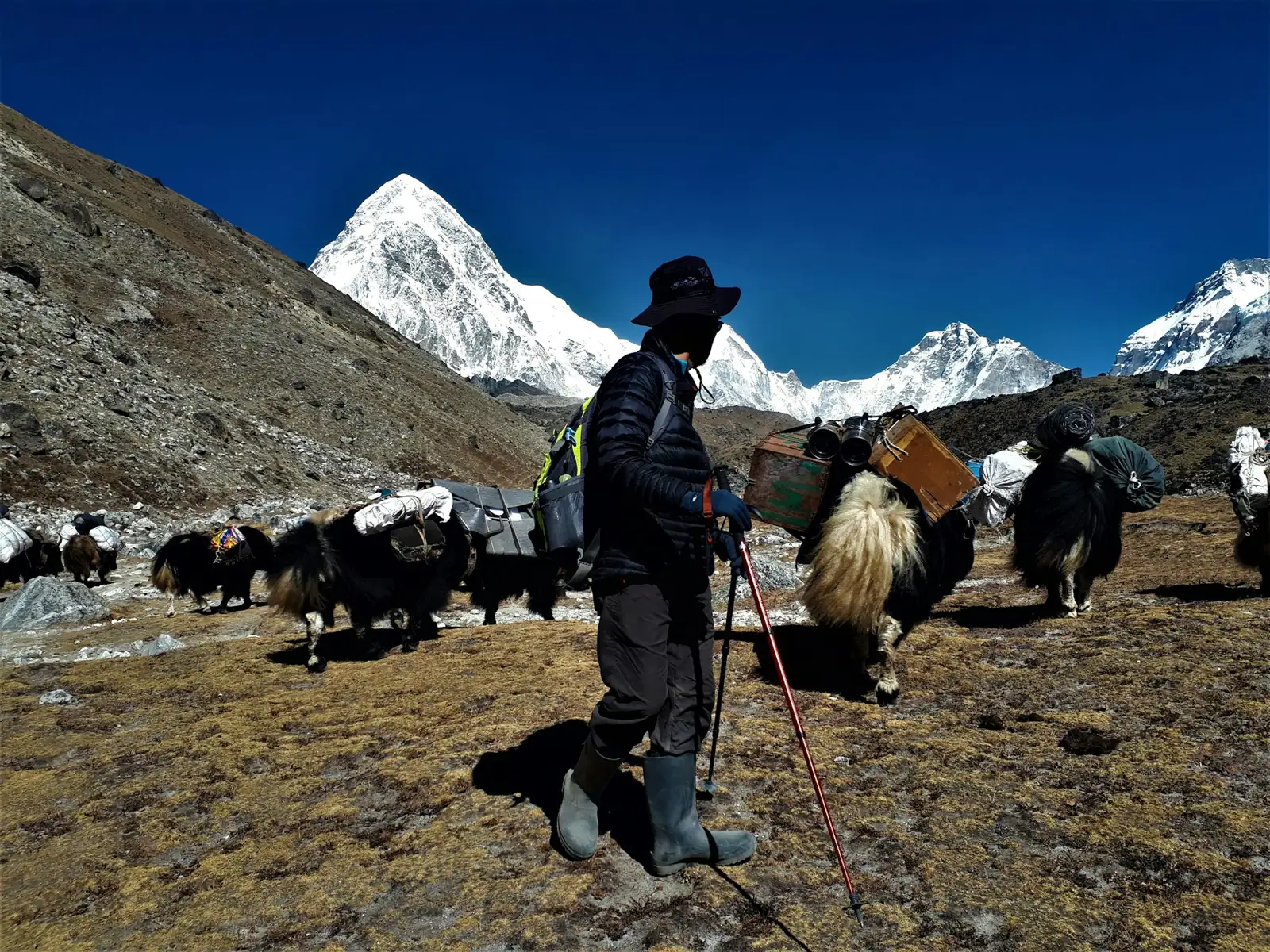
Why Choose This Lobuche East Package
Lobuche East is the best stepping stone in the Khumbu from trekking to proper alpine climbing. It’s harder than Island Peak and a better test of whether you’d enjoy bigger mountains.
What we do differently:
- EBC and Kala Patthar first. You sleep at Gorak Shep (5,164m) and stand at about 5,545m on Kala Patthar before moving to Lobuche East Base Camp. That acclimatisation is the single biggest factor in a safe summit.
- A night at High Camp. Climbing from Base Camp in one push adds hours to an already long summit day.
- Honest summit expectations. We explain the false summit below and decide on the true summit on the day, based on conditions, not on the brochure.
- Small rope teams: a maximum of two climbers per climbing guide on summit day, and smaller groups than on our other climbs (maximum 10).
- A spare day for weather, wind or recovery.
The False Summit: What You Should Know
The southeast ridge leads first to a subsidiary high point, usually called the false summit. The true summit (6,119m) lies further along the ridge, beyond a notch that requires descending and re-ascending exposed, often corniced snow. Wikipedia and many climbing reports note that most climbers on Lobuche East turn around at the false summit.
Our approach: the fixed-rope climb to the summit ridge is the main objective, and it’s a serious summit in its own right. Continuing to the true summit depends on snow conditions, cornices, time, weather and how the team is moving. Your climbing guide makes that call on the mountain. We’d rather tell you this now than let you discover it at 6,000m.
Route Overview
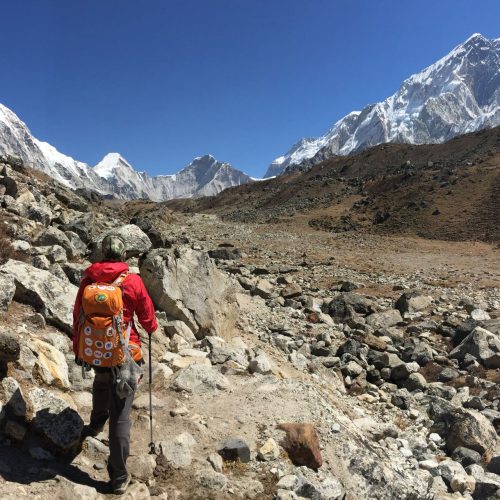
The route follows the standard Everest Base Camp trail from Lukla through Namche Bazaar, Tengboche and Dingboche to Lobuche (4,940m), with acclimatisation days in Namche and Dingboche. You continue to Gorak Shep and Everest Base Camp, then climb Kala Patthar at sunrise and return to Lobuche.
Lobuche East Base Camp (about 5,000m) sits a short walk from the village, at the foot of the peak. From there a rocky trail and slabs climb to High Camp at about 5,400m. On summit day you scramble over rock to Crampon Point, cross a short glacier section roped together, then climb a 45–50 degree snow and ice slope on fixed lines to the summit ridge. The descent follows the same route, with abseils on the steepest sections, back to Base Camp.
You return via Pangboche and Namche to Lukla.
Distance & Walking Hours
| Stage | Approx. distance | Walking time |
|---|---|---|
| Lukla → Phakding | 8 km | 3–4 hrs |
| Phakding → Namche | 10 km | 5–6 hrs |
| Namche → Tengboche | 10 km | 5–6 hrs |
| Tengboche → Dingboche | 11 km | 5–6 hrs |
| Dingboche → Lobuche | 8 km | 5–6 hrs |
| Lobuche → Gorak Shep → EBC → Gorak Shep | 13 km | 7–8 hrs |
| Kala Patthar → Lobuche | 7 km | 5–6 hrs |
| Lobuche → Lobuche East Base Camp | 3 km | 2–3 hrs |
| Base Camp → High Camp | 2 km | 3–4 hrs |
| High Camp → Summit → Base Camp | about 6 km | 9–12 hrs |
| Base Camp → Pangboche | 15 km | 6–7 hrs |
| Pangboche → Namche | 13 km | 5–6 hrs |
| Namche → Lukla | 18 km | 6–7 hrs |
Altitude Table
| Day | Overnight | Altitude |
|---|---|---|
| 1–2 | Kathmandu | 1,400m |
| 3 | Phakding | 2,610m |
| 4–5 | Namche Bazaar | 3,440m |
| 6 | Tengboche | 3,860m |
| 7–8 | Dingboche | 4,410m |
| 9 | Lobuche | 4,940m |
| 10 | Gorak Shep (EBC 5,364m) | 5,164m |
| 11 | Lobuche (Kala Patthar 5,545m) | 4,940m |
| 12 | Lobuche East Base Camp | about 5,000m |
| 13 | High Camp | about 5,400m |
| 14 | Base Camp (summit 6,119m) | about 5,000m |
| 15 | Spare day | about 5,000m |
| 16 | Pangboche | 3,985m |
| 17 | Namche Bazaar | 3,440m |
| 18 | Lukla | 2,860m |
| 19 | Kathmandu | 1,400m |
Map Overview
The route follows the Dudh Koshi and then the Khumbu valley north from Lukla, the same line as the Everest Base Camp trek. Lobuche East stands on the west side of the Khumbu valley, directly above the village of Lobuche, with the Chola valley and Cholatse to its south-west and the Khumbu Glacier and Everest Base Camp to its north-east. Base Camp and High Camp are on the peak’s south side, facing the trail.
Lobuche East Difficulty Level
Lobuche East is graded PD+, with some guides rating sections closer to AD−. It is clearly harder than Island Peak or Mera Peak. What makes it challenging:
- Rock slabs above High Camp, climbed in the dark before you reach Crampon Point. They are easy-angled but can be icy.
- The fixed-rope slope: a long section of snow and ice at roughly 45–50 degrees, climbed with a jumar on fixed lines. This is the crux for most people.
- Exposure: the summit ridge is narrow, with big drops on both sides. A head for heights matters.
- Summit day length: usually a 1–2am start and 9–12 hours back to Base Camp.
- Altitude and cold: at over 6,000m, every move takes effort, and pre-dawn temperatures are well below −15°C.
Who it suits: fit trekkers who are comfortable on steep, exposed ground, and climbers using it as a step toward 7,000m peaks. If you’re nervous about exposure, Island Peak is a gentler first climb.
Fitness Requirements
You’ll walk 5–7 hours a day for about two weeks, then face a 9–12 hour summit day. A good benchmark: hike 18–20km with 1,000m+ of ascent carrying 7–8kg, then do it again the next day.
Train for at least 12 weeks:
- Endurance (4 sessions a week): hill walking, stairs, incline treadmill, cycling or running, plus one long weekend hike of 5–7 hours.
- Strength (2 sessions a week): legs, core and upper body. You’ll be pulling on a jumar.
- Pack training: back-to-back hilly days with 10–12kg in the final month.
- Skills: an indoor climbing or rope course using an ascender and abseil device is strongly recommended for Lobuche East.
Our Everest Base Camp training guide covers the trekking side of preparation.
Altitude Sickness & Acclimatisation
AMS symptoms (headache, nausea, loss of appetite, dizziness, poor sleep) are common above 3,500m. AMS can progress to HAPE or HACE, which are life-threatening. Descent is the cure for worsening symptoms.
Your acclimatisation on this trip:
- Namche and Dingboche rest days with hikes to about 3,880m and 5,080m.
- Everest Base Camp and Kala Patthar before the climb, including a night at Gorak Shep (5,164m), the highest you sleep apart from High Camp.
- A gradual final ascent: Lobuche (4,940m) → Base Camp (about 5,000m) → High Camp (about 5,400m).
- Daily oximeter checks, with helicopter evacuation available through your insurance.
Drink 3–4 litres a day, avoid alcohol and talk to your doctor about acetazolamide (Diamox) before you travel.
Best Time for Lobuche East Peak Climbing
- Spring (late March–May): the busiest climbing season, with warmer summit mornings and good snow. Everest expeditions use Lobuche East for acclimatisation, so expect company.
- Autumn (late September–November): clear skies and the best views. Nights are colder, especially in November.
- Winter (December–February): very cold and often icy on the slabs. Only for experienced climbers.
- Monsoon (June–August): not recommended, because of cloud, rain, avalanche-prone fresh snow and Lukla flight disruption.
Weather by Season
| Season | Lobuche (4,940m) day / night | High Camp & summit | Conditions |
|---|---|---|---|
| Spring (Mar–May) | 4–12°C / −10 to −5°C | −10 to −20°C | Stable, afternoon cloud |
| Monsoon (Jun–Aug) | 8–14°C / −2 to 3°C | −5 to −10°C | Cloud, rain, fresh snow |
| Autumn (Sep–Nov) | 2–10°C / −15 to −8°C | −15 to −25°C | Clearest views, cold |
| Winter (Dec–Feb) | −4 to 4°C / −22 to −15°C | −20 to −30°C | Severe cold, icy slabs |
Temperatures are approximate; wind on the ridge makes it feel much colder.
Transportation Details
- Kathmandu airport transfers included.
- Lukla flights (about 25–35 minutes) leave from Ramechhap (Manthali) in the main seasons, a 4–5 hour early-morning drive from Kathmandu, which we arrange by private vehicle. See our Lukla flight guide.
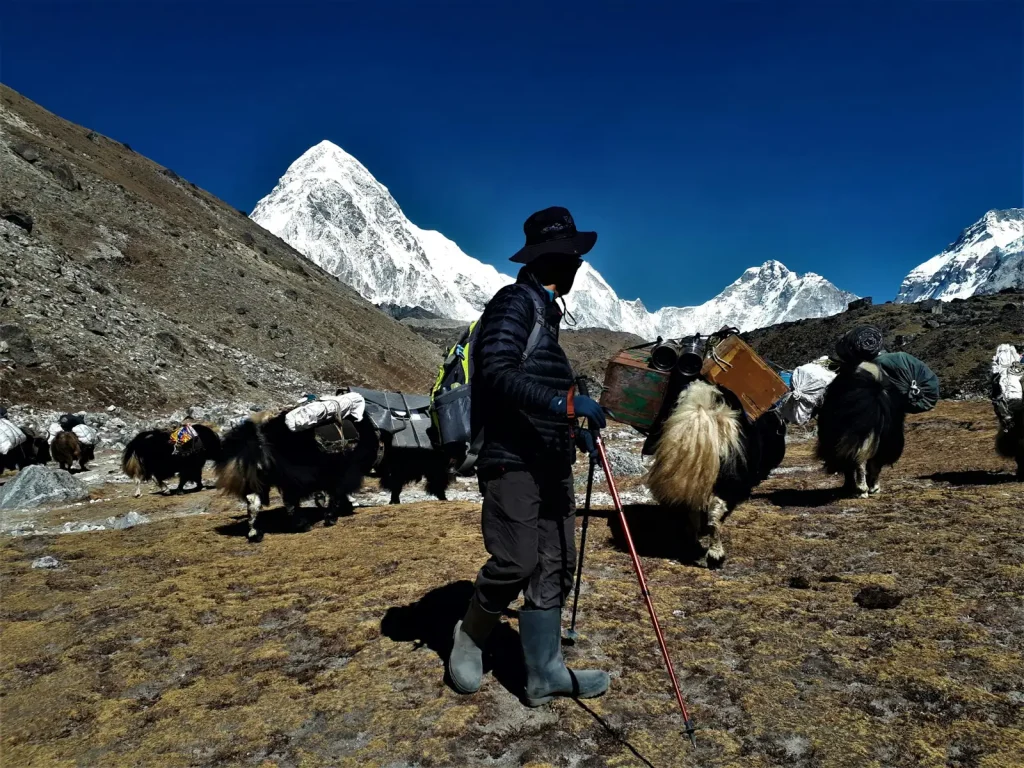
- Porters carry your main bag (up to 15kg). Above Lobuche, our team carries camping and climbing gear.
- Leave 1–2 days after the trip before your international flight.
Accommodation
- Kathmandu (3 nights): tourist-standard hotel, twin-share, breakfast included.
- Teahouse lodges (12 nights): comfortable lodges in Namche and Lukla; basic twin rooms with shared facilities at Lobuche and Gorak Shep.
- Base Camp and High Camp (4 nights): mountain tents, insulated mats, dining and toilet tents set up by our crew.
Meals & Drinking Water
All meals are included on the trek and climb, and breakfast in Kathmandu. Expect lodge staples like dal bhat, noodle soups, pasta, potatoes and eggs, with meals cooked by our camp crew at Base Camp and High Camp. Avoid meat above Namche, and purify all water with tablets or a filter, or buy boiled water.
Internet, Mobile Network & Charging
- 4G works in Namche and many lower villages; it’s unreliable above Dingboche.
- Wi-Fi is sold at most lodges, often via Everest Link cards, and is slow.
- Charging is paid per device in lodges. There’s none at the climbing camps, so bring a 20,000mAh power bank.
Lobuche East Permits & Fees (2026)
All permits and the garbage deposit are included in this package.
| Permit | Cost for foreign climbers |
|---|---|
| NMA Lobuche East climbing permit | USD 350 spring (Mar–May); USD 175 autumn, winter & summer |
| Sagarmatha National Park entry permit | NPR 3,000 + 13% VAT (about USD 25) |
| Khumbu Pasang Lhamu Rural Municipality fee | NPR 3,000 (about USD 22) |
| Garbage deposit | USD 500 per team, refundable |
These royalties apply from 1 September 2025. No TIMS card is required in the Khumbu. NMA peaks must be climbed with a licensed climbing guide, and foreign trekkers must have a licensed guide in national parks. More in our trekking permits in Nepal guide.
Packing List
Group gear (fixed ropes, anchors, tents) is provided. Personal climbing gear can be rented in Kathmandu for about USD 100–150. We check everything on Day 2.
| Category | Items | Bring or rent? |
|---|---|---|
| Climbing gear | Harness, jumar, figure-8 or ATC, 4 carabiners (2 locking), slings/prusik, ice axe, crampons, helmet | Rent or bring |
| Footwear | Insulated mountaineering boots (crampon compatible), broken-in trekking boots, camp shoes, wool socks | Mountaineering boots rentable |
| Insulation | Down jacket (about −20°C), fleece or synthetic mid-layer, thermals | Down jacket rentable |
| Shell | Waterproof jacket and trousers | Bring |
| Hands & head | Liner gloves, insulated climbing gloves, mitts, warm hat, buff, sun hat | Bring |
| Sleeping | Sleeping bag rated −20°C | Rentable |
| Sun & eyes | Category 4 glacier glasses, goggles, SPF 50, lip balm | Bring |
| Packs | 35–45L climbing daypack (porter duffel provided) | Bring |
| Water & health | 2 insulated bottles, purification, first-aid kit, medicines | Bring |
| Electronics | Headlamp with spare batteries, power bank | Bring |
| Documents | Passport (6+ months), 2 photos, insurance details, NPR cash | Bring |
See also our Everest Base Camp gear guide.
Lobuche East Climbing Cost Breakdown
Our price is from USD 2,850 per person. A realistic total budget:
| Expense | Estimated cost (USD) | Included? |
|---|---|---|
| Lobuche East Peak Climbing package (20 days) | 2,850 | — |
| Permits, park & municipality fees, garbage deposit | — | Included |
| Lukla return flights | — | Included |
| Nepal tourist visa (30 days) | 50 | Not included |
| Insurance with helicopter evacuation to 6,500m | 150–400 | Not included |
| Climbing gear rental (if needed) | 100–150 | Not included |
| Kathmandu lunches and dinners | 40–80 | Not included |
| Showers, charging, Wi-Fi, snacks and drinks | 120–220 | Not included |
| Tips for guides, porters and crew | 180–280 | Not included |
| Realistic total (excluding international flights) | about 3,490–4,030 |
When comparing quotes, check whether the trip includes EBC and Kala Patthar for acclimatisation, a night at High Camp, a spare day and a low guide ratio. These are the usual cuts in cheaper packages.
What’s Included
- Airport pickup and drop-off in Kathmandu
- 3 nights’ hotel in Kathmandu with breakfast (twin-share)
- Private transfer to Ramechhap (Manthali) airport when Lukla flights operate from there
- Kathmandu/Ramechhap – Lukla – Kathmandu/Ramechhap flights for you and your guide
- 12 nights in teahouse lodges (twin-share)
- 4 nights’ camping at Lobuche East Base Camp and High Camp (tents, mats, kitchen)
- Breakfast, lunch and dinner throughout the trek and climb
- NMA-licensed climbing guide (maximum two climbers per guide on summit day) and English-speaking trekking guide
- Porters (one porter for two climbers, up to 15kg each)
- Camp cook and kitchen staff
- NMA Lobuche East permit, Sagarmatha National Park permit and Khumbu Pasang Lhamu Rural Municipality fee
- Garbage deposit and waste management
- Group climbing gear: fixed rope, anchors, ice screws and snow stakes
- Rope training at Base Camp
- Salary, meals, accommodation, insurance and equipment for all staff
- First-aid kit and pulse oximeter
- Trek duffel bag
- NMA summit certificate
- All government taxes and service charges
What’s Excluded
- International flights and Nepal visa fee
- Travel insurance (must cover climbing to 6,500m and helicopter evacuation)
- Lunch and dinner in Kathmandu
- Personal climbing gear and clothing (rental available)
- Showers, charging, Wi-Fi, bottled drinks, alcohol and snacks
- Extra nights caused by flight delays, early return or personal reasons
- Helicopter rescue (billed to your insurance)
- Tips for guides, porters and crew
- Anything not listed under What’s Included
Optional Add-ons
- Lobuche East + Island Peak: add a second summit. See Everest Base Camp and Island Peak and ask us for a two-peak plan.
- Gokyo Lakes via Cho La: cross into the Gokyo valley after the climb. See Gokyo Lakes Trek and our Cho La Pass guide.
- Helicopter return from Lobuche or Pheriche after the climb (price on request).
- Private climb on your own dates.
- Kathmandu sightseeing with our Kathmandu Valley Tour.
Travel Tips
- Practise jumaring before you go if you possibly can. It makes the fixed-rope section much less tiring.
- Climbing gloves matter. You need dexterity on the rope and warmth on the ridge, so bring both gloves and mitts.
- Trust the turnaround time. Your guide will set one. Getting down safely is the real summit.
- Carry cash from Kathmandu. There are no reliable ATMs above Namche.
- Book flights home 1–2 days after Day 20 to allow for Lukla weather.
Photography Spots
- Tengboche Monastery with Everest and Ama Dablam behind.
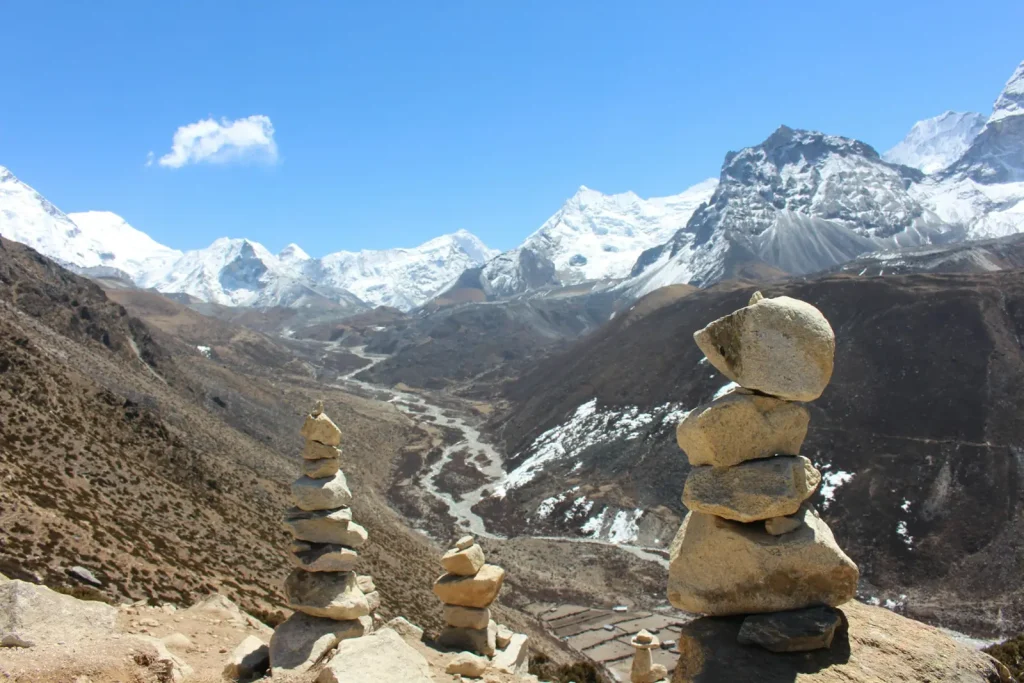
- The Thukla memorials on the climb to Lobuche.
- Kala Patthar at sunrise: Everest’s summit and the Khumbu Icefall.
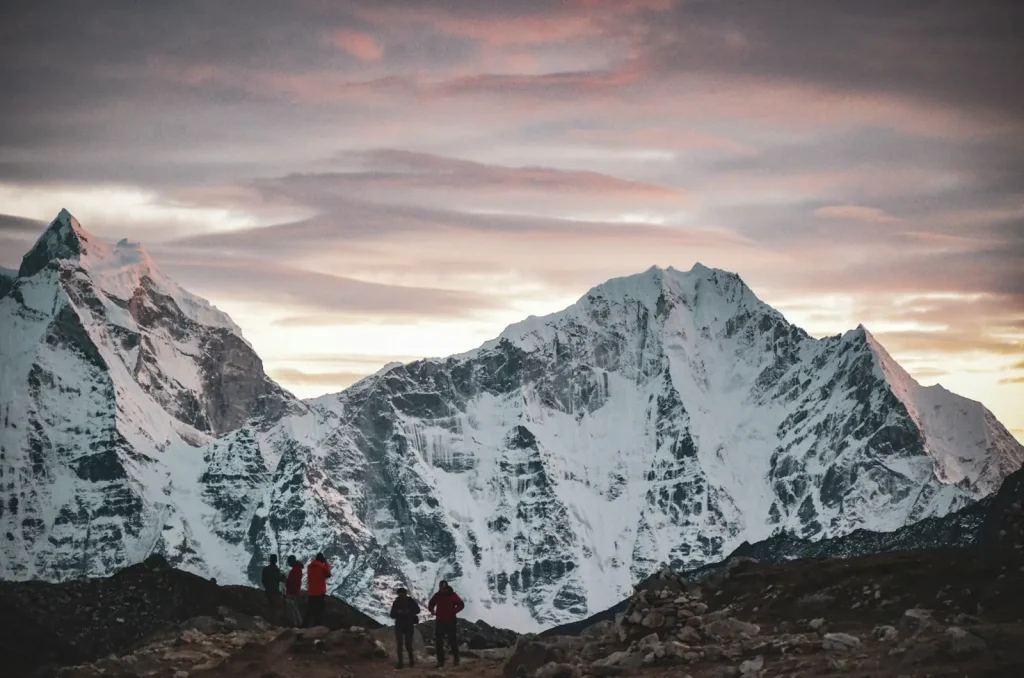
- High Camp at sunset: the Nuptse wall turning red.
- The summit ridge: Everest, Lhotse, Makalu, Pumori and Ama Dablam, with the Khumbu Icefall below.
Responsible Trekking
- Carry out all waste from Base Camp and High Camp.
- Purify water instead of buying plastic bottles.
- Respect Sherpa culture: walk clockwise around stupas and mani walls, and ask before taking photos of people.
- Fair porter loads: a maximum of 15kg each, with proper clothing and insurance.
- Spend locally in the villages you pass through.
Why Book With Merriment Treks
- Acclimatisation done properly: EBC, Kala Patthar and High Camp before summit night.
- NMA-licensed climbing guides, small rope teams and a camp crew.
- Honest advice, including on the false summit.
- Transparent pricing: permits, flights and the garbage deposit are included.
- Gear checked in Kathmandu with rental support. Browse all our peak climbing trips, including Mera Peak.
Cancellation & Refund Policy
Deposit, payment and cancellation terms are set out in our terms and conditions, and we confirm them in writing with every booking. Weather delays, a turned-back summit attempt or leaving the trek early are not refundable, so make sure your travel insurance covers cancellation and curtailment. Questions? Contact our team.
Ready for Lobuche East Peak Climbing?
Lobuche East Peak Climbing is for trekkers ready to take a real step into mountaineering, with Everest Base Camp included along the way. Prepare properly, choose a team that puts acclimatisation first, and it’s an achievable and rewarding summit.
Tell us your dates and experience, and we’ll reply with honest advice and a clear quote. Contact us or use the booking form on this page.