How to Train for Annapurna Base Camp Trek
The Annapurna Base Camp trek is rated moderate, but how to Train for Annapurna Base Camp Trek matters because “moderate” can be misleading. You’ll typically walk 5–7 hours a day for about a week to ten days, reaching 4,130 meters, with no technical climbing. The real challenge is the relentless stone staircases, sustained walking, and accumulated fatigue over consecutive days.
Here’s the good news: you don’t need to be an athlete. The ABC trek is achievable by any reasonably fit person who prepares properly. Most days involve 5 to 7 hours on the trail, with the hardest sections being the 3,300 stone steps to Ulleri and the long descents from ABC that strain knees more than lungs.
This guide gives you exactly what you need: an 8–12 week training plan, exercise specifics, flat-city alternatives, mental preparation, and a realistic self-assessment to know when you’re ready.
What the ABC Trek Actually Demands
Before you start training, understand what you’re preparing for.
Walking duration: 5–7 hours per day for 7–10 days
Total distance: Approximately 110 km round trip
Total elevation gain: Around 3,600 meters, with 3,000 meters of descent
Key sections that demand specific preparation:
-
Ulleri climb: 3,300 stone steps in approximately 2 kilometers, the most famous staircase on the route
-
Chhomrong to Bamboo: Steep descent and re-ascent crossing a 400-meter deep gorge
-
Deurali to MBC: 920 meters of altitude gain, the longest single climb in the sanctuary
-
ABC to Bamboo descent: 1,820 meters of downhill over 6–7 hours
What you’ll actually need is endurance for sustained uphill, strength for the relentless stairs, knee resilience for the descents, and the ability to keep going on consecutive days with limited recovery.
The #1 Mistake: Confusing Fitness with Altitude Protection
One of the most dangerous misconceptions is that being fit protects against altitude sickness. It doesn’t. Physical fitness improves your ability to walk and carry weight, but it does not predict or prevent AMS.
At 4,130 meters, Annapurna Base Camp is high enough for mild altitude effects, though well below levels where serious AMS is common. The standard itinerary gains height gradually, and most healthy adults can acclimatize without serious complications. But symptoms like headache, nausea, and fatigue can still affect anyone, regardless of fitness.
The training you do in the gym prepares your muscles, lungs, and cardiovascular system. Acclimatization comes from gradual ascent, rest days, and being willing to turn back. You train to ensure that when altitude becomes a factor, your body isn’t already exhausted from the effort of walking.
How Fit Do You Really Need to Be?
Quick answer: You should be able to walk 5–6 hours over hilly ground with a light daypack and recover overnight.
More specifically, by the time you reach Nepal, aim to be able to:
-
Walk 15–20 km per day on uneven terrain
-
Climb stairs for 30–40 minutes total spread throughout a day
-
Wake up the next morning feeling tired but ready to go again
-
Carry a 5–7 kg daypack without significant strain
If you’re sedentary, give yourself 10–12 weeks. If you already hike or exercise 2–3 times a week, 6–8 weeks is enough. If you’re a regular weekend hiker with good fitness, you can be ready in 6 weeks.
How Long Should You Train?
| Starting Point | Recommended Training Duration | Likely Success with Consistent Training |
|---|---|---|
| Sedentary (little exercise) | 10–12 weeks | ~80-85% |
| Weekend walker (hikes occasionally) | 6–8 weeks | ~90-95% |
| Regular trekker (active, hikes often) | 4–6 weeks | ~95%+ |
Source: Trekking operator data 2026/2027
The 8-12 Week ABC Training Plan
This plan builds gradually, protecting against injury while preparing your body for the specific demands of the trail. Train 4–5 days per week, with one dedicated long hike or stair session.
Weeks 1-3: Foundation
This phase builds your aerobic base and introduces the strength exercises you’ll need. The goal is to establish habits without injury.
Cardio (3 sessions per week):
-
Brisk walking, jogging, or cycling for 30–45 minutes
-
Maintain a conversational pace—you should be able to talk in sentences
Strength (2 sessions per week):
-
Bodyweight squats: 3 sets of 12-15 reps
-
Lunges: 3 sets of 10 reps per leg
-
Step-ups: 3 sets of 10 reps per leg (low step height, 20-30 cm)
-
Planks: 3 sets of 30 seconds
-
Glute bridges: 3 sets of 15 reps
Long session (1 per week):
-
2-3 hour walk on varied terrain if available, or a stair session if you’re in a flat city
Important: Start every strength session with a few minutes of warm-up and include 5-10 minutes of stretching after.
Weeks 4-7: Build
This phase adds specificity. Stairs and hills become the focus, and you start training with a pack.
Cardio (3 sessions per week):
-
Increase duration to 45–60 minutes
-
Incorporate stairs or hills into at least one session
-
Stair machine or actual stairs: 20–30 minutes, maintaining steady effort
Strength (2 sessions per week):
-
Progress squats to goblet squats with light weight (5-8 kg)
-
Increase step-up height to 30-40 cm
-
Add weighted lunges (5-8 kg)
-
Introduce calf raises: 3 sets of 15 reps per leg, slow lowering phase
-
Include side steps with resistance band for glute and IT band prep
Pack training (1-2 sessions per week):
-
Start with 3–5 kg in your actual daypack
-
Include both ascents and descents in these sessions
-
Descend at a controlled pace—this builds protective eccentric strength
Long session (1 per week):
-
4-5 hour hike with 4-5 kg pack
-
If no hills, do a long stair session or incline treadmill
Weeks 8-10/12: Peak and Taper
This is where you build to the highest volume before easing off in the final week.
Cardio (2-3 sessions per week):
-
Maintain 45–60 minute sessions
-
Keep one session as stairs with pack
Strength (2 sessions per week):
-
Maintain exercises but don’t increase weight
-
Focus on form and controlled movements
Back-to-back days (critical):
-
Do a long hike on Saturday (5-6 hours with 6-8 kg pack)
-
Follow with a moderate hike on Sunday (3-4 hours with 5-6 kg pack)
-
This simulates the consecutive-day demands of the trek
Taper (Final 7-10 days):
-
Reduce volume by 40–50%
-
3-4 light sessions: easy walks, gentle cycling, stretching
-
One short hike (60-90 minutes) with full daypack to confirm boot comfort
-
Prioritize 7-9 hours of sleep nightly
Why Stairs and Hills Are Your Most Important Training
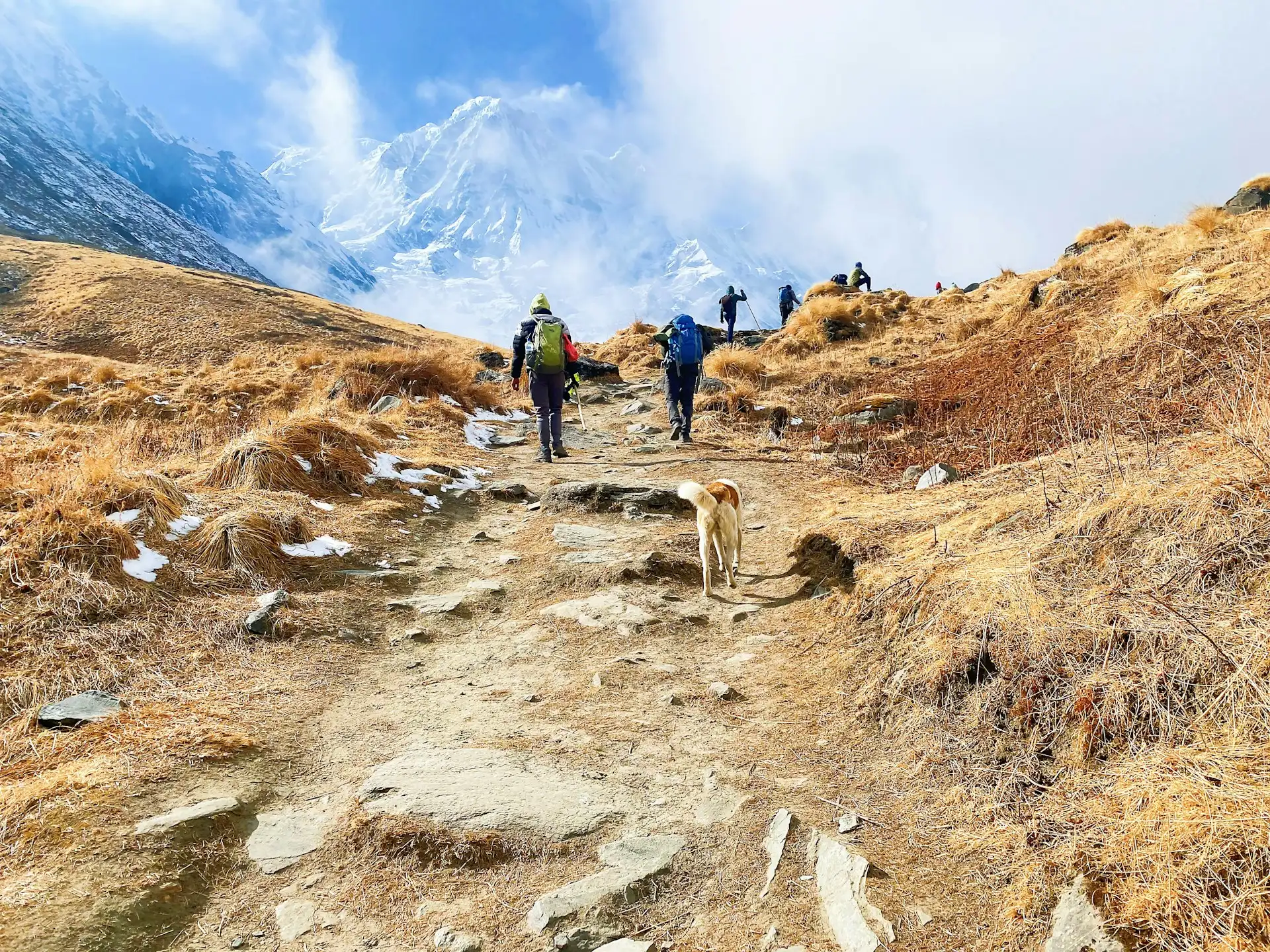
The ABC route is essentially a staircase—one that keeps going for days. The climb to Ulleri alone has 3,300 stone steps over 2 kilometers. Stair training is the most specific thing you can do for this trek.
How to train stairs:
-
Start with 20 minutes of bodyweight stair climbs
-
Build to 45 minutes with a 5 kg pack
-
Include descents in every session—descending is where knees suffer most
-
Use a stair machine if you have access
If you have hills instead:
-
Do 45–60 minute hill repeats
-
Walk up at a steady pace, descend slowly
-
Gradually add pack weight
The most commonly skipped exercise: step-downs. Step off a 30–40 cm box slowly, taking 3-4 seconds to lower. This builds the eccentric quad strength that protects your knees on the 1,820-meter descent from ABC.
Strength Training for the ABC Route
The goal is muscular endurance, not maximum strength. You’re preparing for sustained effort over 5-7 hours, not a 15-minute sprint.
Focus on these exercises:
| Exercise | Why It Matters | How to Progress |
|---|---|---|
| Squats (slow descent) | Sustained quad demand across consecutive days | Bodyweight → goblet → barbell. 3-second lowering phase |
| Step-ups (loaded) | Directly mimics Ulleri and Sanctuary stair climbs | Start 20 cm box → 50 cm. Add weight progressively |
| Lunges | Builds stability and balances quad/glute strength | Add weight once bodyweight is comfortable |
| Glute bridges (loaded) | Protects knees on descents by stabilizing hips | Bodyweight → single-leg → weighted |
| Calf raises | Prevents fatigue that shifts load to knees | Both legs → single leg → weighted |
| Romanian deadlifts | Builds hamstring and lower back endurance for long descents | Light load, slow controlled movement |
Core work (2 sessions weekly):
-
Planks: 3 sets of 45-60 seconds
-
Bird dogs: 3 sets of 10 per side
-
Dead bugs: 3 sets of 10 per side
Protecting Your Knees: The Descent Training You Can’t Skip
Many beginners think they have knee problems when the real issue is weak glutes and underprepared quads for eccentric loading. The downhills of ABC are longer than the uphills (3,000 meters of descent total), and that’s where most injuries happen.
Essential knee prep exercises:
-
Step-downs: Lower slowly off a 30-40 cm step, 3-4 seconds controlled descent
-
Split squats with slow lowering: Focus on the lowering phase, not the push up
-
Single-leg glute bridges: Activates glutes that protect knee tracking
-
Side steps with resistance band: Strengthens IT band and hip stabilizers
Do these twice a week. They are the most important protection you can build for your knees and are frequently skipped in generic training advice.
Training with Your Pack
You’ll carry a daypack weighing 5–7 kg every step of the trek. Porters carry your main duffel, but your daypack will contain water, a down jacket, rain shell, snacks, camera, first aid kit, and headtorch.
How to progress:
-
Week 1-3: 3 kg, 30-45 minute walks
-
Week 4-7: 4-5 kg, 2-4 hour hikes
-
Week 8-10: 6-7 kg, 4-6 hour hikes
Key gear checks during training:
-
Hike in your actual ABC boots with your planned socks
-
Practice with your actual trekking poles—they reduce knee load by 25% on descents
-
Test how the pack sits on your hips and shoulders
Consecutive-Day Endurance (The Game Changer)
The ABC trek involves 7-10 consecutive days of walking. Being able to do one long hike is not enough—you need to be able to do it again the next day.
Training approach:
-
From weeks 6-8, introduce back-to-back weekend days
-
Saturday: 5-6 hour hike
-
Sunday: 3-4 hour hike (continue even if tired)
-
This is non-negotiable. The fatigue of consecutive days is the largest training variable
If You Live Somewhere Flat
Lack of hills is a common worry, but you can still train effectively.
Alternatives:
-
Stair machine: 45-60 minutes, 2-3 times weekly with a 4-5 kg pack
-
High-incline treadmill: Set to maximum incline (12-15%) for 30-45 minutes
-
Building stairs: Find a tall building and walk up and down repeatedly
-
Parking garages: Often overlooked but offer consistent inclined walking
-
Step-ups: Do 30-60 minutes of continuous step-ups on a low platform at home
The key: Whatever you do, include descents. Descending is where your eccentric strength is built. If you only do stair machines (which typically don’t include descent), add a separate session of step-downs to compensate.
Nutrition and Hydration During Training
Proper nutrition and hydration are essential during your training, acting as fuel for your workouts and preparation for the trek itself.
Training nutrition:
-
Focus on a balanced intake of carbohydrates and protein
-
Carbs from whole grains, fruits, and starchy vegetables provide sustained energy
-
Protein from lean meats, eggs, legumes, and dairy is crucial for muscle repair
-
Avoid extreme or crash diets, which can deplete energy and muscle mass
Hydration:
-
Drink consistently throughout the day, aiming for 2-3 liters of fluids
-
Develop the habit of drinking before you feel thirsty
-
For activities longer than an hour, consider an electrolyte supplement
Practice what you’ll eat:
-
Eat some of the same foods you’ll encounter on the trail, like dal bhat (lentils and rice) or simple soups
-
Get used to eating when you’re tired and not hungry—this is common at altitude
Mental Preparation
Preparing mentally is as crucial as physical training for Annapurna Base Camp. The trek tests your resilience through long days, variable conditions, and high altitude.
Mental strategies:
-
Set mini-goals on training hikes: Break long hikes into manageable segments
-
Practice positive self-talk: Replace negative thoughts with encouraging phrases
-
Train in conditions you’d normally avoid: Walk in rain, cold mornings, or early starts—you’ll encounter all of these on the trail
-
Embrace discomfort: Accept that some parts will be challenging, then shift focus to the surroundings or camaraderie
The trekkers who succeed are not necessarily the fastest—they’re the ones who are patient, adaptable, and mentally prepared.
The Taper: Your Final Week Before Departure
Your fitness is locked in by the final week. More training now won’t improve results—it will increase fatigue. The goal is to rest and arrive fresh.
Taper protocol:
-
7-10 days before departure: reduce volume by 40-50%
-
3-4 light sessions: easy walks, gentle stretching, foam rolling
-
One short hike (60-90 minutes) with full daypack to confirm gear fits
-
Prioritize sleep (7-9 hours nightly)
-
No new exercises, no high intensity
-
Complete gear checks now—boot problems or pack fit issues are manageable at home, not at Deurali
ABC Readiness Self-Assessment
Answer honestly. A “kind of” or “almost” counts as No.
Cardiovascular Readiness
-
Can you walk for 5 hours at a moderate pace without needing more than 10-minute rest? (Yes/No)
-
Can you hold a conversation while doing steady cardio? (Yes/No)
-
Have you completed at least 3 cardio sessions weekly for the last 4 weeks? (Yes/No)
Trail-Specific Strength
-
Can you climb 30-40 floors of stairs (or equivalent step-ups) without your legs failing before your lungs do? (Yes/No)
-
Have you done dedicated downhill or eccentric leg work (eccentric squats, reverse lunges, downhill hiking) at least once per week? (Yes/No)
-
Can you walk downhill for 45 minutes the day after a long hike without sharp knee pain? (Yes/No)
Load and Gear Readiness
-
Have you logged at least 30 hours of walking in your actual ABC boots? (Yes/No)
-
Have you carried a 7-10 kg pack on a hike of 4+ hours? (Yes/No)
-
Have you used your trekking poles enough to feel natural on both ascents and descents? (Yes/No)
Back-to-Back Endurance
-
Have you completed at least two back-to-back weekend hikes (long Saturday, moderate Sunday) within the last month? (Yes/No)
Mental and Lifestyle Readiness
-
Are you comfortable with the idea of cold, unheated rooms, shared bathrooms, and a repetitive menu for 7-10 days straight? (Yes/No)
-
Have you trained in conditions you would normally skip (rain, cold mornings, early starts) at least three times? (Yes/No)
Scoring
-
0-2 No answers: You are ready. Confirm your gear, taper for the final week, and book with confidence
-
3-5 No answers: Add 2-3 weeks to your training. Focus specifically on the categories where you answered No
-
6+ No answers: Add 4-6 weeks before booking. This is not a failing score—it means you’re honest about where you are, which is the best predictor of a successful trek
Common Training Mistakes to Avoid
-
Training only on flat surfaces: Flat ground won’t build the specific muscle patterns you need. Use stairs, hill repeats, or step-ups
-
Neglecting descents: The ABC route has more descent than ascent (3,000m down vs 3,600m up). Train eccentric strength
-
Skipping consecutive-day training: One long hike isn’t enough. You need to be able to do it again the next day
-
Overdoing it too quickly: Increase training volume gradually (no more than 10-20% per week) to avoid injury
-
Forgetting to test gear: Training in your actual boots, socks, and pack is non-negotiable. 30 hours of walking in your boots is a minimum target
-
Training only cardio without strength: A strong aerobic base is essential, but without leg strength, the stairs will defeat you
-
Treating a headache as something to hide: If you get headaches during training, address them. This is a habit that will protect you at altitude
Final Thoughts on How to Train for Annapurna Base Camp Trek
The ABC trek is accessible to any reasonably fit person who prepares properly. The key is consistent, gradual preparation that targets the specific demands of the trail: long walking days, relentless stairs, sustained descents, and consecutive-day endurance.
Your training should build the physical capacity to walk 5-7 hours daily while protecting your knees and building cardiovascular endurance. But preparation isn’t just physical—it’s also mental. The trekkers who succeed are patient, honest about their symptoms, and willing to make safe decisions on the trail.
If you’re planning a well-paced, guided Annapurna Base Camp trek, companies like Merriment Treks offer itineraries designed with proper acclimatization and experienced guides who support your journey. Their focus on safety and client preparedness ensures that when you arrive, you’re not just physically ready—you’re supported by a team that knows the mountain and its rhythms.
The training you do now is the difference between fighting the trail and enjoying it. Start early, build gradually, and trust the preparation. The ABC route has been rewarding trekkers for decades—with the right training, it can reward you too.
FAQs about how to Train for Annapurna Base Camp Trek
1. How long should I train for the Annapurna Base Camp Trek?
Most people need 6–12 weeks. Sedentary trekkers should give themselves 10–12 weeks; active people who already hike or exercise regularly can be ready in 6–8 weeks.
2. Can a beginner do the Annapurna Base Camp Trek?
Yes. The ABC trek is one of Nepal’s most beginner-friendly high-altitude treks. With 6–8 weeks of preparation, beginners complete it regularly.
3. How fit do I need to be for ABC?
You should be able to comfortably walk 15–20 km per day on uneven terrain. More specifically, 5–7 hours of hiking with a 5–7 kg daypack, plus climbing stairs for 30–40 minutes, should feel manageable.
4. What is the hardest physical day on ABC?
Most trekkers report either the Ulleri climb (3,300 stone steps) or the 1,820-meter descent from ABC to Bamboo as the hardest section. The descent is particularly challenging on knees.
5. Does being fit prevent altitude sickness?
No. Physical fitness does not predict or prevent AMS. Acclimatization occurs through gradual ascent, not through pre-trip training. You train to make the walking easier, not to protect against altitude.
6. What exercises should I do for ABC?
Focus on cardio, stair climbing, leg strength (squats, lunges, step-ups), eccentric knee prep (step-downs, slow descents), and core strength. Train with a pack once a week.
7. How do I train for ABC if I live in a flat city?
Use a stair machine, high-incline treadmill, parking garages, or building stairs. Do 45-60 minutes of step-ups at home. Include descents and step-downs regularly to build eccentric strength.
8. How much should my daypack weigh on the trek?
Your daypack should be 5–7 kg when fully loaded with water, layers, snacks, and essentials. Train with this weight in the final weeks.
9. What are back-to-back training days, and why are they important?
Back-to-back days involve a long training session on Saturday followed by a moderate session on Sunday. The ABC trek involves 7–10 consecutive walking days—you need to train your body to perform when tired.
10. How much should I train each week?
Aim for 4-5 sessions per week: 3 cardio sessions, 2 strength sessions, and 1 long hike or stair session. As you progress, combine some sessions (e.g., long hike with pack).
11. What should I do in the final week before the trek?
Reduce training volume by 40-50%, prioritize sleep, do only gentle activities, and complete gear checks. Your fitness is already built—focus on rest and recovery.
12. Is running necessary for ABC training?
No. Walking, hiking, and stair climbing are more specific. Running can help with cardiovascular fitness but isn’t required.
13. How do I know when I’m ready for ABC?
Complete the readiness self-assessment in the article. The key indicators are: walking 5+ hours, climbing 30-40 floors of stairs, back-to-back weekend hikes, and no knee pain on descents.
14. Will a porter help if I’m not fit enough?
A porter carries your main bag (15-20 kg), leaving you with only a 5–7 kg daypack. This reduces fatigue, especially on the stone stairs, and can make the difference between completing and turning back.
15. Do I need a guide for the ABC trek?
A guide is highly recommended for beginners. They monitor for altitude symptoms, enforce proper pace, handle logistics, and provide cultural context. In 2026, many operators require booking through a licensed agency with a native Sherpa guide.