Mountaineering in Nepal doesn’t mean the same thing to every person who types that phrase into a search bar. For some, it’s the idea of standing on a 6,000‑metre trekking peak after a week of gradual acclimatisation. For others, it’s a multi‑month expedition to an 8,000‑metre giant. And for a lot of people, it’s a dream they’re still sizing up—wondering if they have the fitness, the budget, or the nerve to try.
This guide starts from the assumption that you want honest, current, and practical information. It covers the entire spectrum of climbing in Nepal: from the “starter” peaks that blur the line between trekking and mountaineering, through the classic 6,000‑metre objectives, to the realities of a full‑scale 8,000‑metre expedition. It explains permits, costs, seasons, and safety in real terms, not marketing language. And it helps you decide what’s actually right for you—before you commit a year of training and a significant sum of money.
Why Nepal Defines High‑Altitude Mountaineering
Nepal’s section of the Himalaya contains eight of the world’s fourteen 8,000‑metre peaks, including Everest (Sagarmatha). But what matters more to most climbers is the sheer density of accessible, well‑serviced climbing objectives between 5,500 and 7,000 metres. Nowhere else on Earth offers such a combination of infrastructure, local expertise, and permitted access to high‑altitude terrain.
The country’s mountaineering framework is managed by two main bodies: the Department of Tourism for major expedition peaks (generally those above 6,500 m, plus all 8,000 m peaks), and the Nepal Mountaineering Association (NMA) for a designated list of “trekking peaks” (more accurately called NMA peaks) between roughly 5,500 m and 6,600 m. This two‑tier system is the key to understanding your options.
Types of Mountaineering in Nepal
1. Trekking Peaks (NMA Peaks)
These are the entry points. The NMA currently classifies around 30 peaks into Group A and Group B, with royalty fees ranging from about USD 250 to USD 600 per climber depending on the peak and season. Despite the name “trekking peak”, many require rope‑work, crampons, ice‑axe arrest skills, and good altitude tolerance.
Popular NMA peaks include:
-
Island Peak (Imja Tse, 6,189 m) – the most climbed “first Himalayan peak”.
-
Mera Peak (6,476 m) – the highest trekking peak; technically straightforward but physically demanding.
-
Lobuche East (6,119 m) – steep snow/ice final slopes; more technical than Island Peak.
-
Pisang Peak (6,091 m) – in the Annapurna region, good for those wanting less‑crowded routes.
These peaks typically require 18‑24 days from Kathmandu, including the approach trek and acclimatisation. They are perfectly suited to a climber who has solid trekking experience, basic alpine skills, and wants to experience Himalayan altitude with ropes and crampons for the first time.
2. Expedition Peaks (6,500 m – 8,000 m)
Once you move above the NMA list, you’re applying for a full expedition permit through the Department of Tourism. This includes mountains like:
-
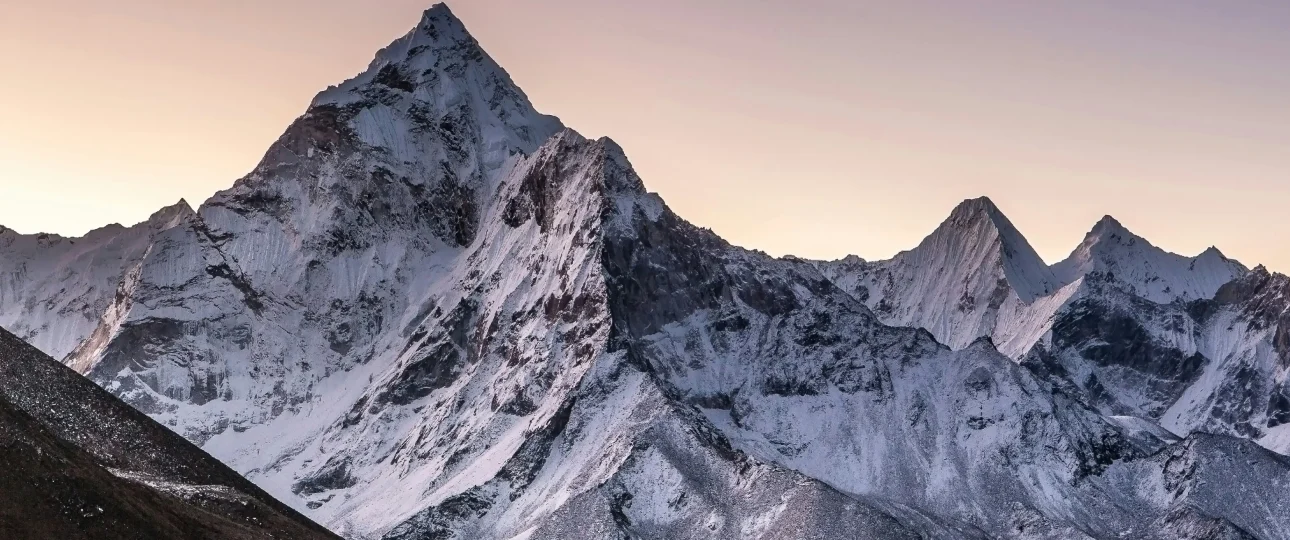
Ama Dablam (6,812 m) – a world‑class technical climb on steep snow, ice, and rock. Not a “big peak” by elevation, but enormously respected.
-
Baruntse (7,129 m) – a high‑altitude expedition with significant objective hazards.
-
Himlung Himal (7,126 m) – often used as a stepping stone to 8,000 m.
-
Manaslu (8,163 m) – the most popular “first 8,000‑metre peak” after Everest.
-
Cho Oyu (8,188 m) – historically the easiest 8,000 m peak, but recent route changes have increased difficulty.
Expedition peaks demand extensive high‑altitude experience, advanced technical capability, and a much larger budget (permits alone run from USD 5,000 to over USD 11,000 per climber). The support infrastructure changes completely: you’ll usually work with a dedicated expedition outfitter, rely on a team of Sherpa and kitchen staff, and spend six to eight weeks in the mountains.
3. The 8,000‑Metre Giants
Nepal is home to eight 8,000 m peaks: Everest, Kanchenjunga, Lhotse, Makalu, Cho Oyu, Dhaulagiri, Manaslu, and Annapurna. These are serious mountaineering undertakings that require years of progressive experience. For most people, the relevant question is not “How do I climb Everest?” but “Which intermediate peaks prepare me for 8,000 m?”. That progression is something we’ll cover later.
Mountain Comparison: Where Do You Fit?
| Peak | Altitude | Grade/Technical Difficulty | Typical Duration | Royalty (approx, spring) | Best Season | Fit For… |
|---|---|---|---|---|---|---|
| Island Peak | 6,189 m | PD+ (steep snow/ice) | 18-20 days | $250-400 | Oct-Nov, Apr-May | 1st Himalayan climb; basic crampon/ice axe skills |
| Mera Peak | 6,476 m | F (easy snow plod) | 18-21 days | $250-400 | Oct-Nov, Apr-May | Strong trekkers wanting first 6000m; low technical demand |
| Lobuche East | 6,119 m | AD- (sustained steep sections) | 18-20 days | $250-400 | Oct-Nov, Apr-May | Those with some alpine experience wanting a step up |
| Ama Dablam | 6,812 m | D (sustained technical rock/ice) | 30-35 days | $2,000-3,000 | Oct-Nov, Apr-May | Experienced alpine climbers; not a stepping stone |
| Baruntse | 7,129 m | AD-D (objective hazards) | 35-42 days | $4,000-5,000 | Oct-Nov | Climbers preparing for 8000m |
| Manaslu | 8,163 m | AD-D (high altitude, avalanche risk) | 45-52 days | $11,000 | Sept-Oct | Experienced 7000m climbers ready for first 8000m |
Note: Royalty fees are per climber and subject to annual revision. Operator service costs are additional and vary widely.
The message is clear: mountaineering in Nepal is not a single product. You don’t choose “mountaineering”; you choose a specific objective that matches your current skill level and ambitions.
Permits, Regulations & the Two‑Tier System
Understanding the bureaucracy is part of planning. Here’s how it works as of early 2025 (always verify with your operator before booking).
NMA Peaks (Trekking Peaks)
Managed by the Nepal Mountaineering Association under authority from the government. You need:
-
NMA Peak Permit (royalty): varies by group and season. For example, Group A (Island Peak, Mera Peak) spring royalty is around USD 250 per climber; autumn may be slightly less. Group B peaks (e.g., Lobuche East) may be USD 400 in spring and USD 200 in autumn. Check the NMA’s current schedule.
-
National Park/Conservation Area entry fee: e.g., Sagarmatha National Park (Everest region) NPR 3,000 (~USD 25).
-
Local municipality fee (where applicable, like Khumbu Pasang Lhamu Rural Municipality permit).
-
TIMS card is not required for Khumbu but may be needed in other regions. Your operator will know.
Expedition Peaks (Department of Tourism)
Peaks above 6,500 m and some special cases like Ama Dablam fall under the Expedition Regulation. The permit process involves:
-
Application through a registered trekking/expedition agency.
-
Royalty fee set by the government, varying by altitude: 6,501-7,000 m ~USD 4,000; 7,001-7,500 m ~USD 6,000; 7,501-8,000 m ~USD 8,000; Everest (spring) USD 11,000. Autumn and winter fees are lower for many peaks.
-
Garbage deposit (refundable): usually USD 4,000 per expedition (higher for Everest).
-
Liaison officer provided by the government, whose expenses the expedition covers.
-
Insurance requirements: you must show proof of medical/evacuation insurance covering mountaineering up to the relevant altitude.
Mandatory Guide/Staff Rules
Nepal has been tightening rules around independent climbing. As of 2025, for NMA peaks, you are effectively required to climb through a registered agency and have at least a licensed climbing guide. For expedition peaks, the agency must supply a full support team. Attempting a peak without proper permits or outside an agency is illegal and can result in heavy fines, climbing bans, and invalidated insurance.
The Real Cost of Mountaineering in Nepal
The royalty fee is only a fraction of what you’ll spend. Here’s a realistic breakdown for a guided climb with a Kathmandu‑based operator like Merriment Treks, using Island Peak as a benchmark.
| Expense Category | Island Peak (guided, 20 days) | Ama Dablam (expedition, 35 days) |
|---|---|---|
| Peak permit (royalty) | $250-400 | $2,500-3,000 |
| National park & local fees | $40-60 | $100-150 |
| Guide & porter support (incl. wages, insurance) | $1,200-1,800 | $8,000-15,000 (team Sherpa, cooks) |
| Climbing equipment (personal/group) | $300-600 (rental) | $2,000-5,000 (oxygen, fixed ropes, etc.) |
| Flights (Kathmandu‑Lukla) | $360-400 | $360-400 (plus cargo flights) |
| Food & accommodation (on trek/climb) | $400-600 | $1,500-2,500 |
| Insurance (high‑altitude rescue) | $200-400 | $1,000-2,000 |
| Contingency & tips | $200-300 | $1,000-2,000 |
| Total approximate | $3,000-4,500 | $16,000-30,000+ |
For a commercial Everest expedition, costs can easily exceed USD 40,000-80,000 per climber. These numbers are not meant to scare; they’re meant to help you plan realistically. Merriment Treks offers transparent costing for all NMA peaks and can facilitate expeditions up to 7,000 m with itemised quotes—no hidden add‑ons.
How to Choose the Right Peak for Your Experience
This is the question that too many articles skip. Use this framework, not just summit height:
-
Altitude ceiling: If your previous high point is 4,000 m from trekking, don’t make a 6,400 m peak your first high altitude. Mera or Island Peak are sensible next steps.
-
Technical difficulty: Be honest about your snow and ice skills. Lobuche East requires real front‑pointing and ice‑axe arrest competence; Island Peak has a steep headwall that’s often fixed‑rope but demands confidence on crampons.
-
Duration and isolation: A 20‑day trip with a trek in and out is very different from a 40‑day expedition with multiple camps. Longer expeditions amplify stress, weather risk, and mental fatigue.
-
Guide and support structure: For NMA peaks, a small team of 1-2 guides and a porter is fine. For expedition peaks, you need a qualified IFMGA or Khumbu Climbing Center‑trained guide and a Sherpa team experienced in high‑altitude logistics.
-
Weather windows: Some peaks have short, reliable windows; others are fickle. For example, pre‑monsoon Ama Dablam often sees unstable weather in late May.
A good operator will assess your resume honestly and suggest a progression—maybe Island Peak first, then a 7,000 m objective two years later. Merriment Treks’ senior guides do exactly this; they won’t push you onto a peak you’re not ready for because their reputation depends on safe, successful climbs.
Best Seasons for Climbing
| Season | Months | Characteristics | Suitable For |
|---|---|---|---|
| Pre‑monsoon (spring) | March–May | Warming temperatures, some afternoon cloud; the main season for Everest expeditions. High camps on 8000m peaks occupied in May. | All peaks; highest chance of good weather on 8000m |
| Post‑monsoon (autumn) | Late September–November | Crisp, clear skies after monsoon; colder, especially at night. Less crowded than spring on trekking peaks. | NMA peaks, 6000-7000m expeditions; reliable for Ama Dablam |
| Monsoon | June–mid‑September | Heavy rain, leeches at low elevation, avalanche risk. Climbing generally not recommended. | Not advised |
| Winter | December–February | Extreme cold, deep snow, high avalanche hazard; short days. Only for experienced teams on specific peaks (e.g., some 8000m winter attempts). | Highly specialised; not for beginners |
For first‑time Himalayan climbers, the post‑monsoon season is often the smartest choice: stable weather, lower traffic, and strong incentive to train over the summer.
Physical and Mental Preparation
Mountaineering in Nepal is fundamentally an endurance sport conducted in thin air. Key training elements:
-
Aerobic base: hiking 8‑10 hours back‑to‑back with a pack. Stair‑climbing with a weighted pack is excellent.
-
Strength: legs, core, and lower back—not gym‑heavy muscle, but the strength to kick steps for hours.
-
Altitude experience: prior trekking above 4,000 m is essential. For a 6,000 m peak, ideally you’ve slept at 4,500 m without issues.
-
Technical skills: for PD+ and above, take a formal alpine skills course (glacier travel, crevasse rescue, ice‑axe self‑arrest, fixed‑rope ascending/descending). Many people arrive under‑prepared technically and waste precious summit days learning.
-
Mental resilience: the ability to endure cold, discomfort, and fear while making sound decisions.
One mistake we often see: climbers assume that a marathon runner’s fitness translates directly. It doesn’t. Altitude and sustained step‑kicking require different adaptations. Prepare specifically, not generally.
Safety, Rescue, and High‑Altitude Risk
Climbing in Nepal carries objective hazards you cannot eliminate: serac fall, crevasses, altitude illness, unpredictable weather. Mitigation lies in:
-
Choosing a competent operator with a strong safety record.
-
Carrying proper insurance that explicitly covers mountaineering up to your peak’s altitude, including helicopter evacuation and medical treatment. Standard trekking policies won’t cover technical climbing.
-
Never descending alone if unwell; your guide must have the authority to send you down.
-
Accepting that turning around is a success if it keeps you alive. The summit is secondary.
The Himalayan Rescue Association operates aid posts in the Khumbu and other regions during peak seasons, but they cannot replace your own team’s vigilance. Helicopter evacuation is possible from many high camps but is weather‑dependent and expensive (USD 5,000‑15,000+). Good insurance makes this viable.
Choosing an Expedition Operator: Questions to Ask
Whether you’re hiring a guide for Island Peak or an expedition outfitter for Manaslu, you need to vet them properly. Ask these questions before you pay a deposit:
-
Are you a registered company with the Nepal Tourism Board? Demand the license number.
-
What specific training do your climbing guides have? Look for IFMGA certification, Khumbu Climbing Center graduation, or equivalent recognised training. “Experienced” is not a qualification.
-
How many times have you personally guided this peak, and in what conditions?
-
What is your client‑to‑guide ratio on summit day? For technical peaks, 2:1 or lower is safer.
-
Do you provide insurance for your staff? Ethical treatment of Sherpa, guides, and porters is non‑negotiable.
-
What is your contingency plan for flight delays, weather days, or altitude sickness?
-
Can you provide a detailed, itemised cost breakdown and a list of what’s included?
-
Can I speak to previous clients? A confident operator will say yes.
Merriment Treks meets all these standards. They’re a government‑registered Nepali operator with a strong emphasis on staff welfare and transparent itineraries. Their mountaineering division handles NMA peaks up to Ama Dablam‑level and can coordinate full expedition logistics for higher objectives through their network of experienced guides.
Environmental and Cultural Responsibility
Mountaineering leaves a footprint. In Nepal, that footprint falls on fragile high‑alpine ecosystems and on Sherpa, Tamang, and other mountain communities. Practical steps that go beyond slogans:
-
Carry out all non‑biodegradable waste (batteries, wrappers, empty oxygen canisters on big peaks). Your operator should facilitate this.
-
Use boiled or filtered water instead of plastic bottles above Namche—bottled water is unrecyclable in the Khumbu.
-
Respect prayer flags, mani walls, and monasteries; always walk clockwise around religious structures.
-
Acknowledge that your climbing Sherpa and kitchen staff are professionals—pay them fairly, and tip appropriately at the expedition’s end.
A good operator will integrate these principles naturally. At Merriment Treks, environmental compliance and cultural respect are part of every pre‑trek briefing, not an afterthought.
Common Mistakes That Ruin Himalayan Climbing Trips
-
Choosing a peak by altitude, not by skill match. A 6,400 m walk‑up is easier than a 6,100 m steep ice climb.
-
Underestimating the toll of the approach trek. By the time you reach base camp, you’re already fatigued.
-
Relying on Diamox to fix bad planning. Acclimatisation days are not optional.
-
Not training with the boots and pack you’ll use. Blisters and strap rub at high altitude are miserable and can become dangerous.
-
Booking the cheapest operator. A USD 2,000 full‑service Island Peak climb is likely cutting corners on safety and staff welfare.
-
Ignoring the importance of a rest‑day buffer. Bad weather can trap you; a tight flight schedule out of Lukla can unravel everything.
Taking the Next Step
Mountaineering in Nepal is one of the great human experiences—but it rewards thorough preparation, humility, and the right partner. Whether you’re eyeing your first 6,000‑metre peak or building the resume for something bigger, start by talking to a team that knows the mountains and the regulations inside out.
Merriment Treks specialises in guided ascents of Nepal’s most rewarding trekking peaks and supports expeditions up to 7,000 m. Their guides are trained, their pricing transparent, and their safety approach thorough. If you have a peak in mind—or are still deciding—reach out for an honest, obligation‑free conversation about what it would take to make it happen.
Contact Merriment Treks today to discuss your mountaineering objective, request a sample itinerary, or get a detailed cost breakdown. The mountain will still be there—make sure you’re properly prepared when you stand at its base.
Frequently Asked Questions about Mountaineering in Nepal
-
What is the difference between a trekking peak and an expedition peak in Nepal?
Trekking peaks (NMA peaks) are typically between 5,500 m and 6,600 m with lower permit fees and simpler logistics. Expedition peaks require a Department of Tourism permit, higher royalties, and full expedition support. -
Which is the easiest 6,000‑metre peak to climb in Nepal?
Mera Peak (6,476 m) is considered technically easiest because it involves glacial walking and little steep ice; however, altitude is the main challenge. -
Do I need a guide to climb a trekking peak in Nepal?
Yes. Current regulations require you to climb through a registered Nepali agency and have at least a licensed climbing guide for NMA peaks. Independent climbing is not permitted. -
How much does it cost to climb Island Peak?
A full‑service guided climb typically costs between USD 3,000 and USD 4,500 including permits, internal flights, guide, porter, accommodation, and meals. Royalty alone is around USD 250‑400. -
What permits do I need for mountaineering in Nepal?
For NMA peaks: a peak royalty permit, the relevant national park or conservation area entry fee, and any local municipality fee. For expedition peaks: a Department of Tourism expedition permit, liaison officer, garbage deposit, and insurance proof. -
When is the best time for mountaineering in Nepal?
The main seasons are pre‑monsoon (March–May) and post‑monsoon (late September–November). Autumn offers stable, clear weather and is less crowded on trekking peaks. -
Can a beginner climb a mountain in Nepal?
Yes, if you have strong trekking fitness, basic alpine skills training, and choose an appropriate NMA peak like Mera or Island Peak with a professional guide. -
How long does it take to climb Island Peak?
The typical expedition from Kathmandu takes 18‑20 days, including the trek to base camp, acclimatisation, summit day, and return. -
What kind of insurance do I need for mountaineering in Nepal?
You need a policy that explicitly covers high‑altitude mountaineering (up to your peak’s altitude), helicopter evacuation, and medical treatment. Standard travel insurance is not sufficient. -
How physically fit do I need to be for a 6,000‑metre peak?
You should be comfortable hiking 6‑8 hours per day with a loaded pack for multiple days, have done a high‑altitude trek above 4,000 m, and trained specifically for stair/ hill climbing. -
What is the role of a climbing Sherpa?
Climbing Sherpas fix ropes, carry loads, establish high camps, and guide clients on summit day. They are technical professionals, not just porters. Fair treatment and proper insurance for them are critical. -
Is Ama Dablam harder than Everest?
Technically, Ama Dablam is steeper and more sustained; it requires solid rock‑climbing and steep‑ice skills. Everest is higher and logistically more complex, but much of the terrain is less technical. They are different challenges. -
How do I prepare for altitude on a mountaineering expedition?
Include at least two acclimatisation rotations (“climb high, sleep low”) in your itinerary, stay hydrated, ascend gradually, and consider Diamox after consulting a physician. Prior high‑altitude trekking experience is essential. -
Are there any weight limits for gear on a climbing trip?
On the Lukla flight, checked baggage is limited to 10‑15 kg. For climbing peaks, you may need to fly additional cargo or use porters to carry group gear. Pack strategically. -
How do I choose a reliable mountaineering operator in Nepal?
Look for government registration, guides with recognised training (IFMGA/Khumbu Climbing Center), transparent pricing, a clear safety protocol, and the willingness to let you speak with past clients. Merriment Treks exemplifies these qualities.