Langtang Valley Trek distance is often listed as a single, clean number, but the reality of the trail is far more nuanced. If you are planning this trek, you have likely seen totals ranging from 60 km to 90 km, and you are rightfully confused.
How many km is Langtang Trek? The most accurate answer, based on the standard teahouse route from Syabrubesi to Kyanjin Gompa and back, is 65 to 70 kilometers (40 to 43 miles) . This excludes the optional summit climbs, which can add another 10 to 14 km.
At Merriment Treks, we believe in transparency. We do not just tell you the number; we tell you how that number feels under your boots. Here is the definitive 2026 breakdown of the Langtang Valley Trek distance.
The Quick Answer: Total Distance Overview
Langtang trek total distance varies based on whether you are counting pure “base route” walking or including exploration at the top. Before we dive into the daily breakdown, understand these three key figures:
Why Is the “Langtang Valley Trek Distance” Different on Every Website?
You are not bad at math, and neither are the trekking agencies—the discrepancy comes down to three specific variables.
1. The Starting Point (Roadhead Variations)
Langtang Valley Trek distance is significantly affected by the condition of the road from Kathmandu to Syabrubesi. In 2026, road construction has pushed further than the official bus stop. Some groups start walking at the bridge just outside Syabrubesi, while others drive an extra 20–30 minutes up the valley to a smaller village, skipping a few kilometers of dusty road walking.
2. The “Hidden” Return Distance
Many blogs list the outing distance because it sounds more manageable. They say “Langtang is a 32 km trek.” That is false for a round trip. You must walk back out the same valley (unless you arrange a helicopter). Always assume the distance listed is one-way unless they explicitly state “return” or “total.”
3. The Side Trip Accounting
How far is Langtang Trek with Kyanjin Ri? The base trek is 65 km. But if you climb Kyanjin Ri (4,773m) on your rest day, you are adding roughly 7 km of steep vertical. If you tackle Tserko Ri (4,984m), you are adding up to 14 km. A trekker who summits both has walked nearly 80 km, while a trekker who rested at the teahouse has walked 65 km. Both are “correct.”
Daily Distance Breakdown: The Standard Itinerary
“How many km per day is the Langtang Trek?” This is the most common question we receive at Merriment Treks. The answer is: surprisingly manageable, except for the final return day.
Here is the standard 8-day itinerary we run to ensure proper acclimatization. We believe in short days on the way up, and longer days on the way down.
Note: The distances above are standard GPS tracking for the main trail. “Walking Time” includes lunch and photo stops.
How Much Walking Is the Langtang Trek Per Hour?
Langtang trek walking hours are a better measure of difficulty than pure kilometers. On flat ground, a human walks about 5 km per hour. On the Langtang trail, your average speed drops to 2 to 3 km per hour on the uphills.
Why?
-
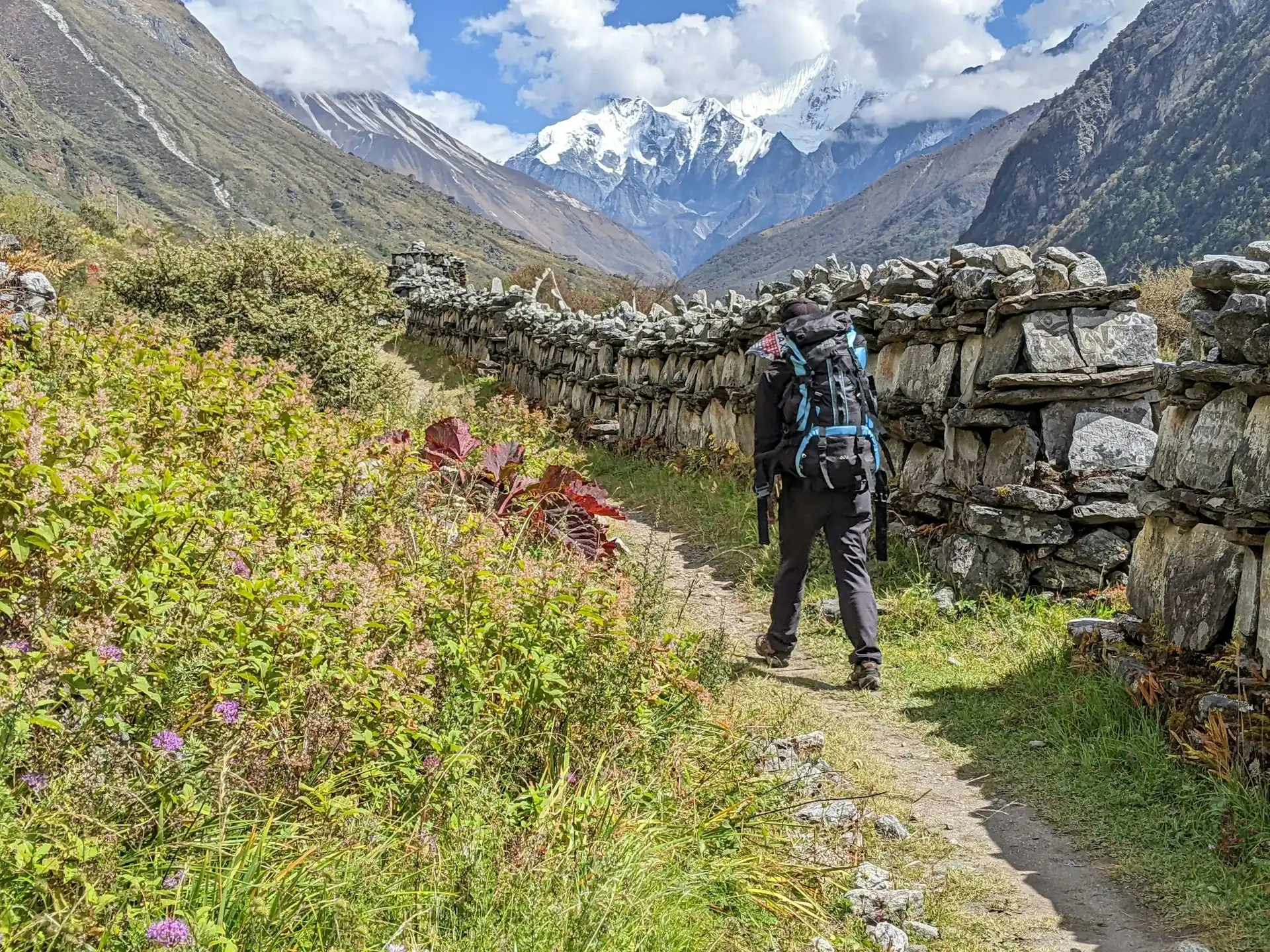
The Stairs: The trail is not a smooth dirt path. It is often cut into the hillside using large, uneven stone steps.
-
The Bridges: You will cross suspension bridges where you must wait your turn and walk single-file.
-
The Mules: You share the trail with mule caravans carrying supplies. Stepping aside for them costs time.
The Breakfast Factor
Langtang trekking hours are also affected by your morning routine. At Merriment Treks, we schedule breakfast at 7:00 AM and hit the trail by 7:45 AM. If you are slow to pack your bag or need multiple bathroom breaks, you will add 30–60 minutes to your walking day. The distance doesn’t change, but the duration does.
Syabrubesi to Kyanjin Gompa Distance: The Outbound Journey
The distance from Syabrubesi to Kyanjin Gompa is approximately 31–32 km (19 miles).
Langtang trek distance per day on the ascent is deliberately low. We call this “vertical distance management.”
On Days 1 and 2, you cover 11 km each day. This doesn’t sound like much, but you are climbing almost 1,000 meters in altitude. For your heart and lungs, this is equivalent to a much longer flat walk.
The hardest part of the outbound distance is the stretch between Ghodatabela and Langtang Village. While the distance drops to 9 km, the exposure to the sun is high, and the altitude begins to affect your breathing. You will notice you need more breaks here than you did in the forest.
The Rebuilt Valley
One thing that makes Langtang unique is the emotional weight of the landscape. The 2015 earthquake destroyed Langtang Village. The current village is rebuilt slightly off the original site. As you walk the final kilometers toward Langtang Village, the distance feels shorter because the landscape tells a story. You see prayer flags, memorial stones, and new guesthouses. It is a powerful reminder that the Langtang trekking distance is not just a number—it is a journey through a community’s resilience.
Kyanjin Gompa to Syabrubesi Distance: The Return Journey
How far is the walk back? It is the same distance (roughly 32 km), but it is completed in 2 days instead of 5.
Kyanjin Gompa to Syabrubesi distance is broken down into two large chunks:
This is where your physical preparation shows. Walking 20 km downhill is brutal on your toes and knees. If you have not trimmed your toenails properly, you will lose them. If you do not use trekking poles, your knees will swell. At Merriment Treks, we always advise trekkers that the descent is where injuries happen, not the ascent.
The “Toe Crunch” Phenomenon
What does the Langtang Valley Trek distance feel like on the way down? Imagine pressing your toes against the front of your boot for six hours straight. Now imagine doing that while stepping down stone stairs. This is the reality of the 20 km descent from Kyanjin Gompa to Lama Hotel. The distance is covered faster than the ascent, but the physical toll is concentrated in your feet, ankles, and knees.
How to Protect Yourself:
-
Tighten your boot laces around the ankle to prevent your foot from sliding forward.
-
Stop every 2 hours to air out your feet and retighten laces.
-
Use trekking poles to absorb 20% of the impact.
-
Cut your toenails straight across before Day 1 of the trek.
How Much Distance Do Kyanjin Ri and Tserko Ri Add?
If you are trying to calculate your total walking distance for the week, you must decide your side hikes in advance.
1. The Kyanjin Ri Hike (The Viewpoint)
-
Distance: 6–7 km round trip.
-
Altitude: 3,870m to 4,773m.
-
Effort: 3 hours up, 1.5 hours down.
-
Note: This is a very steep, gravelly climb. It is not a “rest day” activity; it is a workout.
2. The Tserko Ri Hike (The Summit)
-
Distance: 12–14 km round trip.
-
Altitude: 3,870m to 4,984m.
-
Effort: 5–6 hours up, 2–3 hours down.
-
Note: This is a full expedition day. It starts before sunrise. The distance alone is manageable, but the lack of oxygen makes it one of the hardest days on the standard Langtang itinerary.
Which Should You Choose?
How many km is Langtang Trek if I add Tserko Ri? Your total would be roughly 78–80 km.
How many km is Langtang Trek if I add Kyanjin Ri only? Your total would be roughly 71–72 km.
At Merriment Treks, we recommend Kyanjin Ri for most trekkers. It offers similar panoramic views for roughly half the distance and half the altitude gain. Save Tserko Ri for a second visit or if you are specifically training for higher peaks.
Is the Langtang Trekking Distance Difficult for Beginners?
“Is the Langtang trek hard for beginners?” This is the hidden question behind the distance query.
The honest answer from our guides: Yes, if you are sedentary. No, if you are an active weekend walker.
The Langtang Valley Trek distance is not the barrier. The elevation is.
If you have never walked 15 km in a single day at home, you will struggle on Day 1 and Day 7. If you regularly hike on weekends and can climb stairs without getting winded, you will find the daily distances very manageable.
The Beginner’s Advantage
Unlike the Annapurna Circuit or Everest Base Camp, the Langtang trek total km is forgiving. There are no 20+ km days on the ascent. You have time to recover each afternoon. You are not racing against a flight out of Lukla. The valley is short, which means the exit is always within reach.
Distance vs. Elevation: Why Kilometers Lie in the Himalayas
To understand the Langtang Valley Trek distance, you must understand “effort distance.”
A kilometer on a treadmill is flat. A kilometer in Langtang is often vertical.
Consider Day 3 (Ghodatabela to Langtang Village). It is only 9 km.
But you are gaining roughly 400 meters of elevation. Your heart rate rises. Your leg muscles strain. The 9 km takes you 4–5 hours.
On flat ground, you would cover 9 km in under 2 hours.
The Thin Air Factor:
At Kyanjin Gompa (3,870m), the air pressure is about 60% of sea level. Your muscles are being starved of oxygen. This makes even a short 2 km walk to the bakery across the valley feel like a marathon.
The Formula We Use:
At Merriment Treks, we calculate “Effective Distance” for our clients.
Effective Distance = Actual Distance + (Elevation Gain / 100)
So, a 11 km day with 500m of elevation gain feels like a 16 km flat walk.
This is why we laugh when people say “Oh, 11 km is easy.” Not in the Himalayas, it isn’t.
How to Train for the Langtang Trek Distance
If you want to enjoy the Langtang Valley Trek distance rather than suffer through it, you must train.
The 3-Month Plan:
-
Month 1: Walk 5 km, 3 times per week. Focus on building the habit.
-
Month 2: Walk 8–10 km, 3 times per week. Add a backpack with 5 kg of weight.
-
Month 3: Walk 12–15 km, 2 times per week. Include at least one hike with significant elevation gain (stairs or a hill).
The Stair Test:
If you can climb 50 flights of stairs without stopping, you are ready for the ascent.
If you can walk down 50 flights of stairs without your knees hurting, you are ready for the descent.
The “Hiking Boot Break-In” Rule:
Your boots should have at least 50 km of walking on them before you arrive in Nepal. The Langtang Valley Trek distance will destroy your feet if you wear new boots. Blisters on Day 2 will make every subsequent kilometer a misery.
Does Weather Change the Langtang Trekking Distance?
Langtang Valley Trek distance doesn’t change, but the time it takes to cover it does.
-
Monsoon (June-Aug): The trail is muddy. The leeches are out in the lower valleys. You will slip. Your 11 km day becomes a 7-hour slog.
-
Winter (Dec-Feb): Snow and ice near Kyanjin Gompa. The trail can be hidden. You will need micro-spikes. This slows your pace significantly.
-
Spring/Autumn: Dry, crisp, and fast. The distances listed in our table are based on these optimal seasons.
The Monsoon Reality:
If you trek in July, the Langtang trek distance per day might remain the same, but your energy expenditure doubles. You are fighting mud, humidity, and leeches. Your 11 km Day 1 will feel like 20 km. We generally recommend avoiding the monsoon unless you are specifically looking for a lush, wet, and challenging experience.
Teahouse Logistics and Distance Planning
How does the Langtang trekking distance affect where I sleep?
The teahouses in Langtang are positioned at natural resting points. You do not have to worry about walking 15 km to find a bed. The spacing is:
This means you can adjust your Langtang trek distance per day on the fly. If you are exhausted, you can stop early at a tea stall. If you are feeling strong, you can push on to the next village.
The Menu Factor:
One thing that slows people down is the food. Teahouses serve fresh, cooked food, but it takes time to prepare. A lunch stop for dal bhat (rice and lentils) takes 45–60 minutes. If you order pasta or fried rice, it might take even longer. At Merriment Treks, we pre-order lunch at the morning tea break so the food is waiting when you arrive. This saves you 30 minutes of waiting time.
Real-World Scenarios: How Long Does It Take You?
Scenario 1: The Fit Trekker
-
Pace: 4 km/hour uphill.
-
Day 1 Distance: 11 km.
-
Walking Time: 3 hours + 30 mins breaks = 3.5 hours total.
-
Arrival: Early lunch at Lama Hotel, afternoon nap.
Scenario 2: The Average Trekker
-
Pace: 2.5 km/hour uphill.
-
Day 1 Distance: 11 km.
-
Walking Time: 4.5 hours + 1 hour breaks = 5.5 hours total.
-
Arrival: Mid-afternoon, time for tea and a rest.
Scenario 3: The Struggling Trekker
-
Pace: 1.5 km/hour uphill.
-
Day 1 Distance: 11 km.
-
Walking Time: 7 hours + 1.5 hours breaks = 8.5 hours total.
-
Arrival: Late evening, exhausted, potential safety risk.
Which one are you?
If you are Scenario 3, we strongly recommend hiring a porter to carry your main bag. Removing 10 kg of weight will instantly increase your pace and reduce your suffering. At Merriment Treks, we include porter support in our standard packages because we have seen too many trekkers underestimate the Langtang trek distance and overestimate their fitness.
The Psychology of Distance: Managing Your Mind
The Langtang Valley Trek distance is as much a mental challenge as a physical one.
On Day 2, you will wake up sore. You will look at the trail ahead and think, “I have to do another 11 km today, and then I have to do it again tomorrow, and then I have to walk back.”
This is where many trekkers mentally crack.
The “Segment” Strategy:
Break the day into smaller chunks.
-
Morning: Walk 4 km to the tea stop. Have a Snickers bar.
-
Midday: Walk 4 km to lunch. Rest for an hour.
-
Afternoon: Walk 3 km to the teahouse. Done.
You never walk 11 km. You walk 4 km, then 4 km, then 3 km.
The Guide Factor:
A good guide knows how to pace you. At Merriment Treks, our guides are trained to watch your breathing and posture. If you are struggling, they will slow down. If you are chatting easily, they will keep the pace. They understand that the Langtang trek distance is not a race—it is a sustainable rhythm.
How Merriment Treks Approaches Daily Distances
When you book the Langtang Valley Trek with Merriment Treks, we do not look at the distance as a number to defeat. We look at it as a rhythm to respect.
We do not run “express” treks. We intentionally schedule the 8-day itinerary. We have seen too many trekkers get sick trying to do the Langtang trek distance in 6 days. The extra day in Mundu (Day 4) is not filler; it is a medical necessity for altitude adaptation.
We also adjust our morning start times based on the day’s distance. For the long 20 km descent on Day 7, we start early (6:30 AM) so you arrive at Lama Hotel in time for a hot shower and rest before dinner.
The Merriment Treks Difference:
-
Porter Support: Included in every package. Your back will thank you.
-
Teahouse Pre-Booking: We book the best rooms in advance so you don’t have to race other trekkers for a bed.
-
Flexible Scheduling: If you are feeling strong, we can extend the trek. If you are struggling, we can shorten it.
The Verdict: Is the Distance Worth It?
The Langtang Valley Trek distance is a negotiation. You trade 65 km of walking for one of the most dramatic valley views in the Himalayas.
Unlike Everest Base Camp, where the distances are long and the valleys are wide, Langtang is compact. You walk 11 km into a canyon and suddenly the world opens up into a glacial amphitheater.
At Merriment Treks, we believe that if you understand the daily distances, you will enjoy the journey. You will stop fearing the 20 km descent and start looking forward to the bakeries, the yak cheese, and the view of Langtang Lirung.
Ready to measure the distance for yourself? Contact our team to plan your Langtang adventure. We will help you train for the distance and manage the altitude.