Introduction to Animals That Live on Mount Everest
When travelers ask about animals that live on Mount Everest, they often imagine snow leopards prowling icy ridges or yaks standing in deep snow near the summit. The reality is far more nuanced—and far more interesting. Mount Everest itself is not a wildlife sanctuary. The upper slopes are too cold, too dry, and too oxygen-poor to support most complex life. Yet the broader Everest region, including Sagarmatha National Park, the Khumbu Valley, and the approaches to Everest Base Camp, harbors a surprising range of species adapted to extreme conditions.
At Merriment Treks, we have spent years guiding trekkers through this landscape. We have learned that understanding Everest wildlife requires understanding geography first. You cannot discuss animals on Mount Everest accurately without separating the mountain itself from the ecosystems that surround it. This article does exactly that—using scientific evidence, local ecological knowledge, and practical trekking insight to explain what really lives where, and why.
Mount Everest Itself vs. the Everest Region: A Critical Distinction
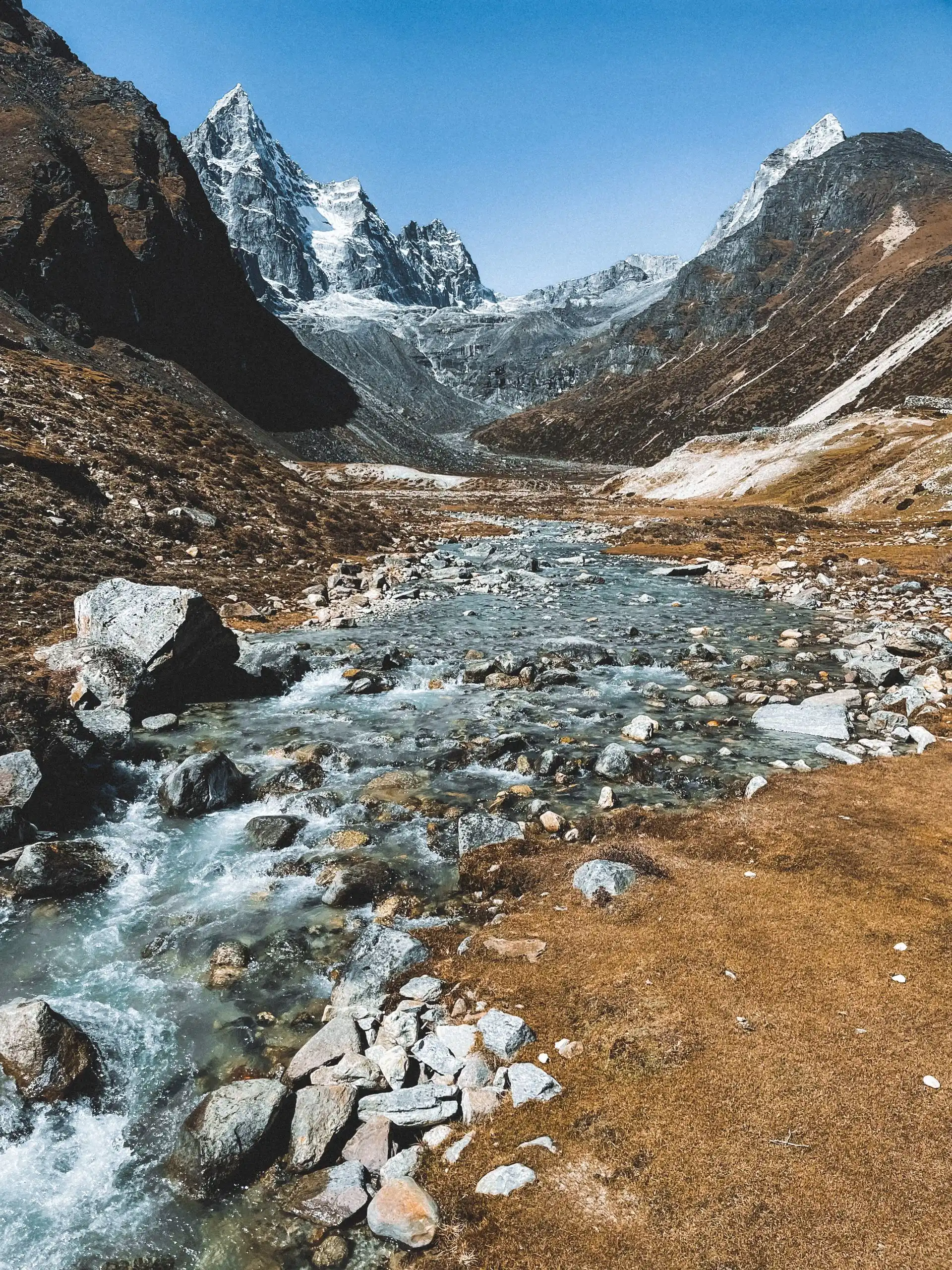
The phrase animals that live on Mount Everest is misleading if taken literally. The mountain’s upper reaches—above approximately 5,500 meters—are not a functioning habitat for vertebrates. There is no vegetation, no permanent water source, and no shelter from extreme winds. The environment is geologically active and biologically impoverished.
What we call Everest wildlife is actually concentrated in:
-
Sagarmatha National Park – a UNESCO World Heritage Site protecting 1,148 square kilometers of diverse habitat.
-
The Khumbu region – the high-altitude valleys and ridges that lead toward Everest.
-
Everest Base Camp – the trekking hub at approximately 5,364 meters on the Khumbu Glacier.
-
Lower and middle altitude forests – home to the richest mammal and bird diversity.
Understanding this distinction is essential. A snow leopard documented near Namche Bazaar at 3,440 meters is not living “on Mount Everest.” It is surviving in the Everest region. A Himalayan marmot sunning itself near Gorak Shep at 5,164 meters is among the highest-dwelling mammals in the area—but it is still below the mountain’s severe upper slopes.
This geographical precision is not pedantry. It is the foundation of responsible wildlife education and accurate search intent satisfaction. When people search for Mount Everest animals, they usually want to know what they might see on the trek, what lives in the national park, and whether anything survives at extreme altitude. The answer requires ecological context.
The Ecological Zones of Sagarmatha National Park
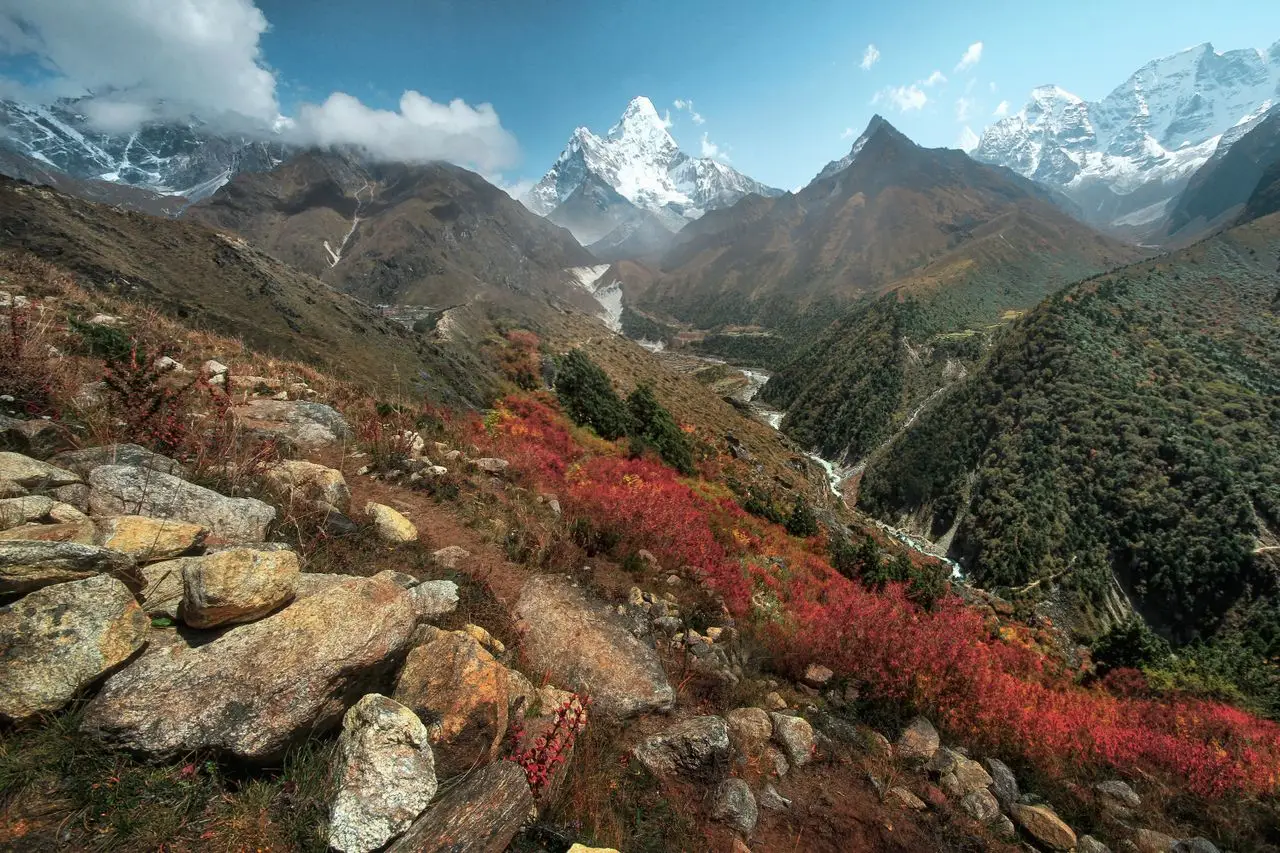
Sagarmatha National Park is not a single habitat. It is a vertical stack of ecological zones, each with its own wildlife community. The park begins below 2,800 meters and rises to the summit of Everest at 8,848.86 meters. Within this gradient, biodiversity decreases sharply with elevation.
| Ecological Zone | Approximate Elevation | Key Habitat Features | Representative Wildlife |
|---|---|---|---|
| Lower Temperate Forest | 2,800–3,500 m | Mixed broadleaf and conifer forest, dense undergrowth, streams | Red panda, Himalayan black bear, musk deer, Himalayan monal |
| Subalpine Forest | 3,500–4,000 m | Birch, rhododendron, juniper, open glades | Himalayan tahr, blood pheasant, yellow-billed chough |
| Alpine Scrub and Meadow | 4,000–5,000 m | Low shrubs, grasses, boulders, seasonal flowers | Himalayan marmot, pika, Himalayan goral |
| High Alpine and Glacial Zone | Above 5,000 m | Bare rock, ice, moraine, extreme temperature fluctuations | Himalayan jumping spider, occasional bird species |
This table explains why animals that live near Mount Everest are not uniformly distributed. A trekker walking from Lukla to Everest Base Camp passes through multiple habitat transitions. The wildlife seen on day one is entirely different from what is possible near Gorak Shep.
Mammals of the Everest Region
Snow Leopard: The Phantom of the High Himalayas
No discussion of Everest region wildlife is complete without the snow leopard. This apex predator is the most iconic of all Himalayan animals, yet it is also among the least seen. Snow leopards do not permanently inhabit Mount Everest’s upper slopes. They prefer rugged terrain between 3,000 and 5,000 meters, where they hunt blue sheep and Himalayan tahr.
In the Everest region, snow leopards are occasionally recorded in remote valleys and along rocky ridgelines. Their presence is confirmed through camera traps, pugmarks, and occasional livestock depredation events. However, a trekker on the standard Everest Base Camp route has virtually no chance of seeing one. These cats are crepuscular, solitary, and highly wary of humans.
The snow leopard’s elusiveness is not an indication of absence. It is an adaptation to survival. With an estimated global population of only a few thousand individuals, the snow leopard is classified as Vulnerable by the IUCN. In Nepal, it is legally protected, and Sagarmatha National Park is part of its potential range.
Himalayan Tahr: The Cliff-Dwelling Ungulate
The Himalayan tahr is arguably the most visible large mammal in the high Everest region. This wild goat relative is built for steep terrain. Its hooves have flexible, rubbery cores that provide exceptional grip on rocky ledges. Tahrs graze on alpine grasses and shrubs, descending to lower elevations during harsh winters.
Trekkers who venture beyond the main trail—particularly on routes toward Gokyo or the Three Passes—may spot tahr on rocky slopes above 4,000 meters. They are most active during early morning and late afternoon. Their reddish-brown coats blend remarkably well with the terrain.
Red Panda: The Forest Dweller
The red panda is often mistakenly listed among animals on Mount Everest. In reality, this species is confined to lower-altitude forests with dense bamboo undergrowth. In the Everest region, red pandas are found primarily between 2,800 and 3,800 meters, where they feed almost exclusively on bamboo.
Red pandas are solitary, arboreal, and highly sensitive to habitat disturbance. They do not venture into the alpine zone. A trekker on the standard EBC route is unlikely to see one, though they exist in protected pockets within Sagarmatha National Park and surrounding community forests. Their presence is far more likely in the forests below Namche Bazaar than near Everest Base Camp.
Musk Deer: The Silent Browser
The Himalayan musk deer is a small, shy ungulate found in forested and subalpine habitats. Unlike other deer species, musk deer lack antlers. Males possess prominent canine teeth used during territorial fights. They are prized for their musk gland, which has made them a target of illegal poaching.
In the Everest region, musk deer inhabit dense undergrowth between 3,000 and 4,000 meters. They are rarely seen by trekkers due to their secretive nature and nocturnal activity patterns. Their presence is often detected through tracks or alarm calls.
Himalayan Marmot: The High-Altitude Survivor
The Himalayan marmot is one of the most commonly observed mammals in the upper Khumbu. These large ground squirrels live in alpine meadows and rocky slopes between 4,000 and 5,200 meters. They are diurnal, highly social, and often seen basking near their burrow entrances.
Trekkers near Lobuche and Gorak Shep frequently encounter marmots. They are curious but cautious, emitting sharp alarm whistles before disappearing underground. Marmots hibernate for six to eight months, surviving on fat reserves accumulated during the brief summer feeding season.
Pika: The Tiny Alpine Forager
Pikas are small lagomorphs related to rabbits. They inhabit rocky alpine terrain above 4,000 meters, where they collect grasses and herbs into haypiles for winter survival. Pikas do not hibernate. Instead, they rely on these stored food caches to sustain themselves through the long Himalayan winter.
Pikas are often heard before they are seen. Their high-pitched calls echo across rocky slopes. They are an important prey species for high-altitude predators, including Himalayan griffons and occasionally snow leopards.
Himalayan Black Bear: The Lower Forest Omnivore
The Himalayan black bear is found primarily below 3,800 meters in forested valleys. It is an opportunistic omnivore, feeding on fruits, insects, small mammals, and carrion. During autumn, bears descend to lower elevations in search of food before winter dormancy.
Trekkers on the standard EBC route are unlikely to encounter black bears, especially if traveling in groups. However, their presence in the forests near Lukla and Phakding is well documented. Safe food storage and proper waste disposal are essential to avoid attracting bears to human settlements.
Wild Yak vs. Domestic Yak: A Common Misunderstanding
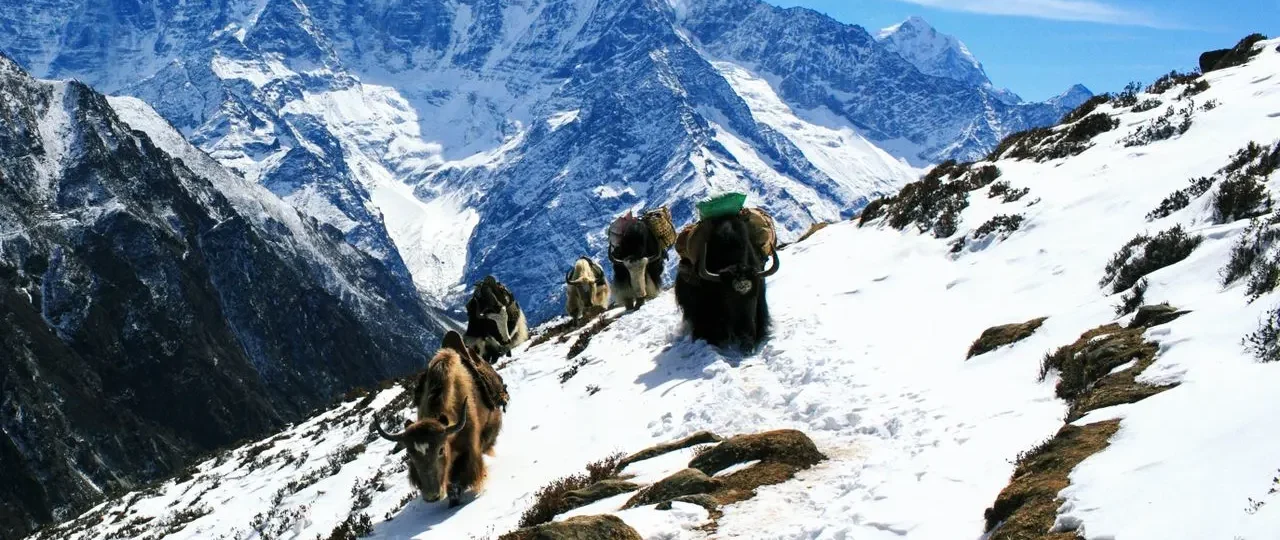
One of the most common misconceptions about Mount Everest animals involves yaks. The animals seen carrying loads along the EBC trail are domestic yaks, not wild yaks. Domestic yaks are an essential part of Khumbu culture and economy. They are bred for transport, milk, wool, and meat.
True wild yaks once roamed the high Tibetan Plateau, but they are now restricted to remote areas far north of Everest. Wild yaks are larger, shaggier, and more aggressive than their domestic counterparts. They are not found in Sagarmatha National Park. The animals trekkers encounter near Namche, Tengboche, and Lobuche are all domesticated or semi-domesticated.
Himalayan Wolf: The Elusive High-Altitude Predator
The Himalayan wolf is a rare and poorly understood canid found in high-altitude regions of Nepal and Tibet. It is genetically distinct from the gray wolf and adapted to thin air and cold temperatures. Himalayan wolves occasionally range into the upper Khumbu, but they are extremely rare and rarely seen.

Birds of the Everest Region
Himalayan Monal: Nepal’s National Bird
The Himalayan monal is a spectacular pheasant species and the national bird of Nepal. Males are iridescent, with metallic green, blue, and purple plumage. Females are mottled brown for camouflage. Monals inhabit forested slopes and alpine meadows between 2,800 and 4,500 meters.
Trekkers may spot monals foraging in the undergrowth near Tengboche or Dingboche. They are ground feeders, using their strong bills to dig for roots and invertebrates. Their loud, repetitive calls often reveal their presence before visual contact.
Blood Pheasant: The High-Altitude Resident
The blood pheasant is a hardy species found between 3,500 and 5,000 meters. It prefers scrubby alpine habitats and rocky slopes. Males have striking red and green plumage, while females are more subdued. Blood pheasants are often seen in small flocks near the treeline.
Choughs: The High-Flying Companions
Yellow-billed and red-billed choughs are among the most visible birds in the upper Khumbu. These corvids are highly intelligent, acrobatic fliers and are often seen near teahouses, villages, and even Everest Base Camp. They scavenge for food scraps and insects, thriving in places where few other birds can survive.
Himalayan Griffon: The High-Altitude Scavenger
The Himalayan griffon is a large vulture that soars over the high Himalayas with remarkable efficiency. These birds have been recorded flying at altitudes exceeding 8,000 meters, though they do not live at such elevations. They nest on cliffs and patrol vast areas in search of carrion. Trekkers may see them circling over the valleys between Namche and Tengboche.
Bar-Headed Goose: The High-Altitude Migrant
The bar-headed goose is famous for its ability to migrate over the Himalayas, sometimes at altitudes above 7,000 meters. These birds do not reside permanently in the Everest region, but they may pass through during migration. Their physiological adaptations to low oxygen are among the most studied in avian biology.
The Highest-Altitude Animals: What Actually Lives Near the Top?
When people ask about animals that live on Mount Everest, they often mean the upper slopes. But what is the highest-dwelling animal in the Everest region?
The answer is not a mammal or a bird. It is a spider—the Himalayan jumping spider. This tiny arachnid has been found living at elevations up to 6,700 meters, making it one of the highest-dwelling animals on Earth. It survives by preying on tiny insects carried upslope by wind currents.
Above this elevation, vertebrate life is essentially absent. The summit of Everest is a biological desert. No mammal, bird, reptile, or amphibian lives there permanently. The idea that animals live on Mount Everest at its highest reaches is a misconception.
How Do Animals Survive Extreme Altitude?
High-altitude animals have evolved remarkable adaptations to survive where oxygen is scarce and temperatures plummet.
-
Hemoglobin efficiency: Many high-altitude birds and mammals have hemoglobin that binds oxygen more effectively.
-
Lung capacity: Bar-headed geese have larger lungs and more efficient oxygen extraction than lowland birds.
-
Thick fur and feathers: Insulation is critical. Snow leopards have dense fur, while Himalayan marmots have thick undercoats.
-
Hibernation and torpor: Marmots hibernate to survive winter food scarcity. Pikas store food to avoid hibernation.
-
Behavioral adaptations: Many species migrate seasonally to lower elevations during harsh conditions.
What Animals Can Trekkers Realistically See?
Trekkers on the standard Everest Base Camp route should not expect a safari. Most large mammals are secretive or absent from heavily traveled trails. However, certain species are reliably observed.
-
Himalayan marmots – common near Lobuche and Gorak Shep.
-
Choughs – present throughout, including at Everest Base Camp.
-
Himalayan monals – possible in forested sections near Tengboche.
-
Domestic yaks – ubiquitous along the trail.
-
Pikas – common in rocky alpine areas.
-
Himalayan griffons – often seen soaring overhead.
Snow leopards, red pandas, musk deer, and Himalayan wolves are extremely unlikely to be seen on the standard route. Their presence is real but secretive.
Why Snow Leopard Sightings Are So Rare
Snow leopards are not rare because they are absent. They are rare because they are perfectly adapted to avoid detection. Their spotted coats blend into rocky terrain. They move silently. They are most active at dawn and dusk, when few trekkers are on the trail.
Additionally, snow leopards require enormous territories. A single individual may roam hundreds of square kilometers. The probability of encountering one on a busy trekking trail is negligible.
Conservation and Environmental Pressures
The wildlife of the Everest region faces growing threats. Climate change is altering habitats and food availability. Tourism growth increases waste, noise, and habitat disturbance. Poaching remains a concern for musk deer and snow leopards. Habitat fragmentation from infrastructure development affects species like the red panda.
Sagarmatha National Park plays a critical role in protecting these ecosystems. Trekkers can contribute by following responsible travel practices: staying on trails, disposing of waste properly, avoiding wildlife feeding, and supporting local conservation initiatives.
Responsible Wildlife Viewing in the Everest Region
If you encounter wildlife on the trail, observe from a distance. Do not approach, feed, or attempt to touch animals. Use zoom lenses instead of getting closer. Avoid playing recorded bird calls to attract species. Respect all park regulations and the guidance of local guides.
At Merriment Treks, we train our guides to prioritize wildlife safety and ethical viewing. We believe that responsible tourism is essential to preserving the very ecosystems travelers come to experience.
Common Myths About Mount Everest Animals
Several persistent myths deserve correction:
-
Myth: Snow leopards live on the summit of Everest.
Reality: Snow leopards inhabit lower rocky terrain, generally below 5,000 meters. -
Myth: Yaks are wild animals.
Reality: The yaks on the EBC trail are domestic animals. -
Myth: Red pandas are high-altitude animals.
Reality: Red pandas live in forested zones below 4,000 meters. -
Myth: Birds live permanently at Everest’s summit.
Reality: Birds may fly over Everest, but none live there. -
Myth: Everest Base Camp is full of wildlife.
Reality: The immediate Base Camp area is glaciated and biologically sparse.
Final Thoughts: What Does “Animals That Live on Mount Everest” Really Mean?
The search for animals that live on Mount Everest is really a search for understanding. It is a question about survival, adaptation, and the limits of life. The answer is not a simple list of species. It is a story of ecological zones, evolutionary resilience, and the striking contrast between the mountain itself and the living world that surrounds it.
For trekkers, this understanding transforms the journey. When you walk through the forests near Namche or pause to watch a marmot near Lobuche, you are witnessing life at the edge of possibility. You are not just walking toward Everest. You are walking through one of the most remarkable high-altitude ecosystems on Earth.
FAQs about Animals That Live on Mount Everest
1. What animals live on Mount Everest?
Strictly speaking, very few animals live on Mount Everest itself. The upper slopes are too harsh for most life. However, the wider Everest region and Sagarmatha National Park support species like Himalayan tahr, snow leopard, red panda, musk deer, Himalayan marmot, pika, and many bird species.
2. Do animals live on the summit of Mount Everest?
No. The summit of Mount Everest is a biological desert. No mammal, bird, or reptile lives there permanently. The highest-dwelling animal is the Himalayan jumping spider, found up to approximately 6,700 meters.
3. What animals are found near Everest Base Camp?
Near Everest Base Camp, trekkers may see Himalayan marmots, pikas, yellow-billed choughs, and occasionally Himalayan griffons. Larger mammals are rare in the immediate glacial environment.
4. Are snow leopards found near Mount Everest?
Snow leopards are found in the wider Everest region, generally between 3,000 and 5,000 meters. They are extremely secretive and rarely seen on standard trekking routes.
5. Are there red pandas on Mount Everest?
Red pandas are not found on Mount Everest itself. They live in lower-altitude forests with bamboo, typically between 2,800 and 3,800 meters in the Everest region.
6. What is the highest animal found on Mount Everest?
The Himalayan jumping spider holds the record for the highest-dwelling animal in the Everest region, living up to approximately 6,700 meters. Among vertebrates, certain birds like the bar-headed goose can fly higher, but none live permanently above 6,000 meters.
7. Can animals survive above 5,000 meters?
Yes, some animals survive above 5,000 meters. Himalayan marmots, pikas, choughs, and certain insects and spiders are adapted to these extreme conditions. However, diversity is extremely low compared to lower elevations.
8. What birds live around Mount Everest?
Birds around Mount Everest include the Himalayan monal, blood pheasant, yellow-billed chough, red-billed chough, Himalayan griffon, and occasionally bar-headed goose during migration.
9. Can birds fly over Mount Everest?
Yes, some birds can fly over Mount Everest. The bar-headed goose is famous for migrating over the Himalayas at altitudes exceeding 7,000 meters. Himalayan griffons have also been recorded at extreme altitudes.
10. Are yaks wild animals?
The yaks seen on the Everest Base Camp trek are domestic animals. True wild yaks are found in remote areas of the Tibetan Plateau and are not present in Sagarmatha National Park.
11. Can you see wildlife on the Everest Base Camp trek?
Yes, but with realistic expectations. The most commonly seen animals are domestic yaks, Himalayan marmots, pikas, and choughs. Large predators and rare mammals are highly unlikely to be seen on the standard route.
12. What is the rarest animal in the Everest region?
The snow leopard and red panda are among the rarest and most elusive animals in the Everest region. Both are threatened by habitat loss and poaching.
13. Why are snow leopard sightings so rare?
Snow leopard sightings are rare because these cats are solitary, crepuscular, and superbly camouflaged. They inhabit remote terrain and avoid human activity.
14. How do animals survive Everest’s cold?
Animals survive through thick fur or feathers, hibernation, food caching, seasonal migration to lower elevations, and physiological adaptations that improve oxygen use.
15. How can trekkers protect Everest wildlife?
Trekkers can protect wildlife by staying on marked trails, disposing of waste properly, not feeding animals, avoiding off-trail exploration, and supporting local conservation efforts.