-
Hotel, Lodges
-
Kathmandu
-
Spring, Autumn
-
5,190m
-
Breakfast, Lunch, Dinner
-
Drive
Lower Dolpo Trek Overview
The 17 Days Lower Dolpo Trek is one of the most remote, culturally immersive, and visually extraordinary trekking experiences available anywhere in the Himalayan world. Located in the far northwestern corner of Nepal, the Dolpo region sits in the rain shadow of the Dhaulagiri and Annapurna massifs, creating a dramatically arid, high-altitude landscape that bears a closer resemblance to the Tibetan plateau than the lush green hills more commonly associated with Nepal.
This ancient, isolated land has preserved its Tibetan Buddhist culture, traditions, architecture, and way of life largely unchanged for centuries, giving trekkers a rare and deeply moving glimpse into a world that feels entirely untouched by modernity.
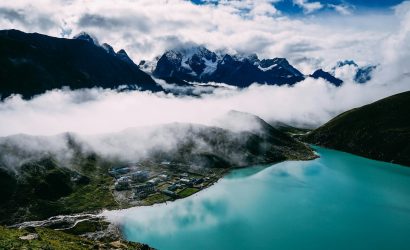
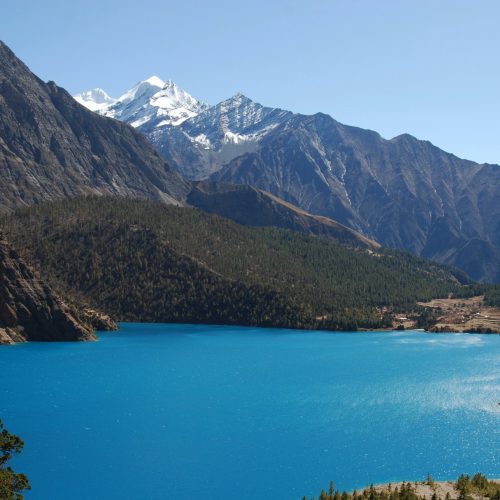
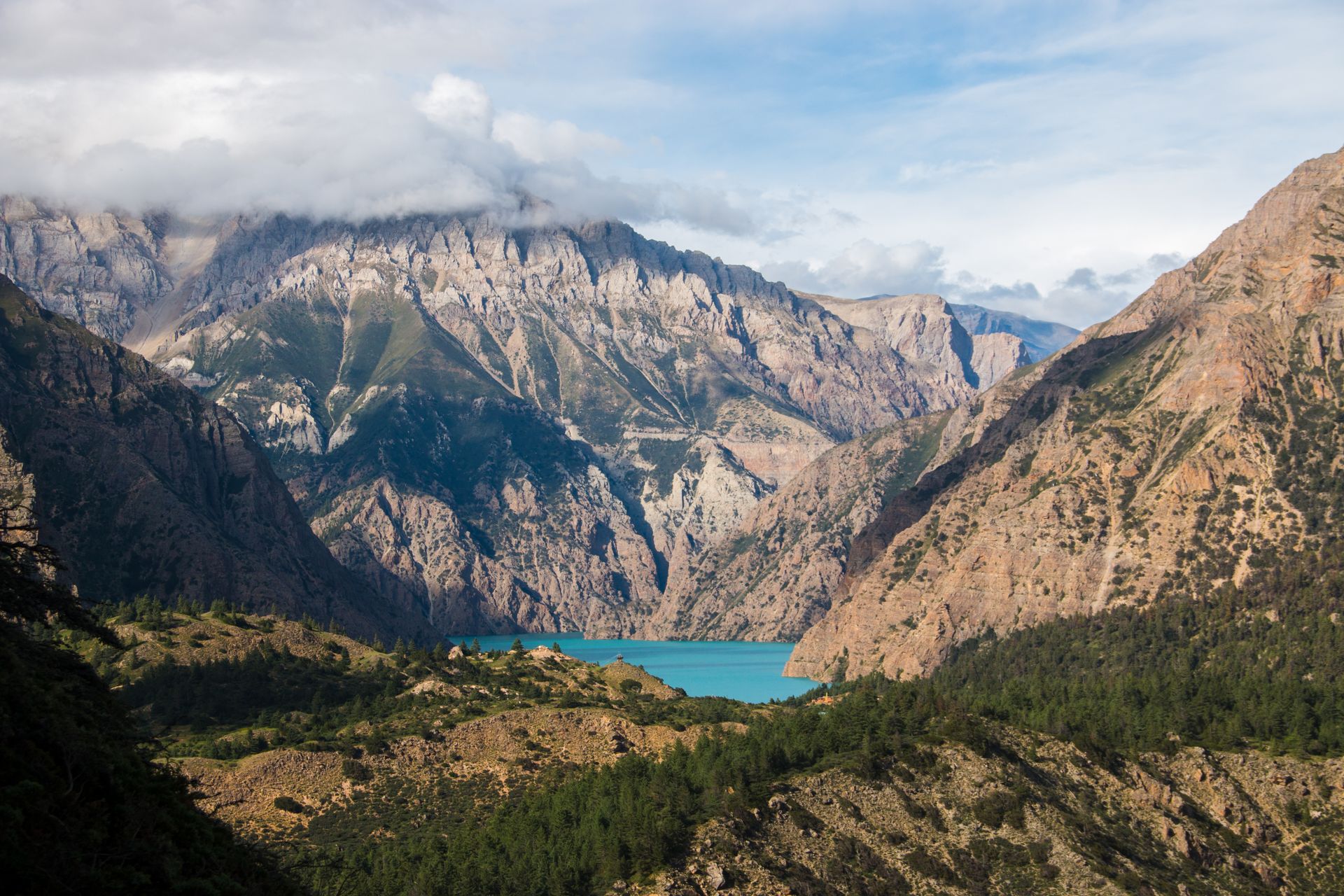
The Lower Dolpo Trek traverses an extraordinary landscape of turquoise lakes, ancient monasteries, remote villages, high mountain passes, and vast open valleys that stretch toward the Tibetan border, passing through the iconic Phoksundo National Park and the legendary Shey Phoksundo Lake, the deepest lake in Nepal and one of the most breathtakingly beautiful natural features in the entire Himalayan range.
Made famous to Western audiences through Peter Matthiessen’s classic book “The Snow Leopard,” the Dolpo region carries an almost mythical allure for trekkers and adventurers seeking something genuinely wild, remote, and profound.
This seventeen-day journey is not simply a trek; it is a transformative expedition into one of the last truly hidden corners of our world, where ancient Bon and Tibetan Buddhist traditions continue to thrive in magnificent isolation beneath some of the most dramatic mountain scenery on earth.
Trek at a Glance
- Duration: 17 Days
- Maximum Altitude: Approximately 5,190m (Numa La Pass) or 4,535m (Baga La Pass, depending on route variation)
- Trek Difficulty: Strenuous to Very Strenuous
- Region: Dolpo District, Karnali Province, Northwestern Nepal
- Starting/Ending Point: Kathmandu (with domestic flights to Nepalgunj and Juphal)
- Accommodation: Teahouses, camping, and basic lodges
- Best For: Experienced trekkers, cultural adventurers, wilderness seekers, and photographers
- Meals: All meals included during the trekking days
- Mode of Travel: On foot, with domestic flights to and from the trailhead
Best Season for Lower Dolpo Trek
Due to its location in the Himalayan rain shadow, Dolpo has a unique climate that differs significantly from most other trekking regions in Nepal, allowing for a slightly different trekking season:
- Late Spring (May-June): One of the best times to trek in Dolpo, as the rain shadow effect keeps the region relatively dry even as monsoon approaches; trails are clear, wildflowers are blooming, and the landscape is at its most vibrant
- Autumn (September-November): The other prime season, with stable weather, clear skies, excellent visibility, and ideal trekking conditions following the monsoon; October is considered the absolute peak month
- Summer/Monsoon (July-August): Unlike most of Nepal, Dolpo remains relatively protected from monsoon rains due to its rain shadow position; experienced trekkers willing to accept some rain and cloud cover can trek during this period with fewer crowds
- Winter (December-February): Not recommended due to extreme cold, heavy snowfall blocking high mountain passes, and very limited facilities and supplies in the remote villages
What Makes Lower Dolpo Trek Special?
- The Lower Dolpo Trek is special in ways that are difficult to fully convey through words alone, because what sets it apart from virtually every other trekking experience in Nepal is its extraordinary combination of profound remoteness, ancient living culture, and raw, otherworldly natural beauty.
- Dolpo is not merely a trekking destination; it is a journey into a surviving fragment of ancient Trans-Himalayan civilization that has existed largely cut off from the outside world for centuries.
- The villages of Dolpo, with their flat-roofed stone houses, fluttering prayer flags, mani walls, and ancient gompas perched on impossible cliffsides, look and feel like living museums of Tibetan culture that have been frozen in time.
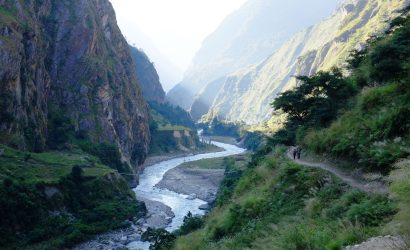
- The landscape itself is unlike anything else in Nepal, shifting dramatically from the deep green gorges of the lower Bheri River valley through the breathtaking turquoise depths of Shey Phoksundo Lake to the vast, arid, wind-swept high-altitude plateaus and passes that dominate the upper reaches of the trek.
- The region is also home to the rare and elusive snow leopard, the Himalayan wolf, blue sheep, and dozens of other rare Himalayan wildlife species, making it a paradise for naturalists and wildlife enthusiasts.
- Perhaps most uniquely, the Bon religion, the ancient pre-Buddhist spiritual tradition of Tibet, is still actively practiced in Dolpo’s remote villages and monasteries, providing trekkers with a window into a spiritual tradition rarely encountered anywhere else in the modern world.
How Difficult Is 17 Days Lower Dolpo Trek?
This trek is rated as strenuous to very strenuous and is firmly recommended for experienced trekkers with significant prior high-altitude trekking experience and an excellent level of physical fitness.
Key difficulty factors include:
- Daily walking durations of 6-9 hours on challenging, often poorly marked or unmaintained trails
- Multiple high-altitude passes including Numa La (5,190m) or Baga La (4,535m) requiring sustained physical effort and proper acclimatization
- Maximum altitudes well above 5,000m on some route variations, with serious altitude sickness risks
- Extremely remote location with no road access along much of the route and very limited emergency evacuation options in some sections
- Basic to very basic accommodation and limited food variety in the most remote sections of the route
- Navigation challenges on less-traveled sections of the trail that require an experienced guide
- Physically and mentally demanding multi-day sections without teahouse facilities where camping may be required
- Unpredictable weather conditions at high altitudes requiring complete preparation for cold, wind, and sudden snowfall at any time
This trek is not suitable for beginners or those without significant prior high-altitude trekking experience. It demands not only physical strength but also mental resilience, patience, and a genuine spirit of adventure.
Permits Required for Lower Dolpo Trek
The Lower Dolpo region is a restricted area requiring multiple permits, which adds to its exclusive and pristine character.
All permits are arranged by Merriment Treks on your behalf:
- Restricted Area Permit (RAP): A mandatory government permit required for all foreign trekkers entering the Lower Dolpo restricted area; this permit is the primary access control for the region and must be obtained before entering
- Dolpo Special Permit: An additional special permit specifically for the Dolpo region, issued by the Department of Immigration in Kathmandu
- Shey Phoksundo National Park Entry Permit: Required for entry into the national park, which encompasses much of the trekking route including Phoksundo Lake; proceeds support conservation efforts
- TIMS Card (Trekkers’ Information Management System): Mandatory for all foreign trekkers in Nepal
These permits collectively make the Lower Dolpo Trek one of the more administratively complex trekking itineraries in Nepal, which also contributes to keeping visitor numbers low and the region’s wilderness character intact.
Safety, Training & Preparation
Given the extreme remoteness, high altitude, and strenuous nature of this trek, thorough preparation is absolutely essential:
- Physical Training: Begin intensive training at least 3-4 months before the trek, incorporating long-distance hiking with a loaded pack, high-intensity cardiovascular exercise, strength training for legs and core, and extended elevation training if possible
- Prior Experience: Completion of at least one previous high-altitude trek above 4,500m is strongly recommended before attempting this route
- Acclimatization: The itinerary incorporates deliberate acclimatization days and gradual ascent profiles, but trekkers should be prepared to spend additional rest days if altitude symptoms develop
- Medical Preparation: A comprehensive pre-trek medical check-up is essential; discuss altitude sickness prevention and Diamox use with a physician before departure
- Guide and Support Staff: All groups must be accompanied by experienced, licensed high-altitude guides who know the Dolpo region specifically; Merriment Treks guides have extensive local knowledge of this remote and challenging route
- Emergency Equipment: Guides carry first-aid kits, pulse oximeters, satellite communication devices, and emergency oxygen where feasible
- Satellite Communication: Given the complete absence of mobile network coverage in most of the trek, satellite phones or GPS emergency beacons are carried by all Merriment Treks guide teams for emergency communication
Mountain Views
The Lower Dolpo Trek delivers some of the most dramatic and unusual mountain panoramas available on any trekking route in Nepal, with views that reflect the region’s unique position between the Himalayan range and the Tibetan plateau:
- Dhaulagiri (8,167m): The seventh highest mountain in the world, providing a stunning and dominant presence visible from multiple points along the trek
- Putha Hiunchuli (7,246m): Known as Churen Himal, visible from higher elevations along the route
- Kanjiroba Massif (6,883m): The most prominent peak within the Dolpo region itself, visible from various points along the trek
- Numerous unnamed peaks and ridgelines of the Karnali Himalayan range surrounding the trek on all sides
- The extraordinary high-altitude plateau views from passes such as Numa La and Baga La, offering vast, sweeping panoramas of an ancient Tibetan-influenced mountain landscape stretching to the horizon
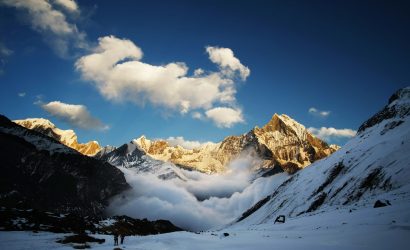
- The dramatic visual contrast between the deep turquoise waters of Shey Phoksundo Lake and the towering arid cliffs and peaks surrounding it creates one of the most distinctive and memorable mountain-lake panoramas in all of Nepal
Altitude Sickness and Prevention
Altitude sickness is a very serious and real concern on the Lower Dolpo Trek, given that the route reaches above 5,000 meters and traverses multiple high passes over several consecutive days in an extremely remote location:
- The itinerary is carefully designed with gradual altitude gain and mandatory acclimatization days, but individual responses to altitude vary significantly and cannot be fully predicted
- Trekkers must stay extremely well-hydrated (4-5 liters of water daily) and strictly avoid alcohol and smoking throughout the trek
- All three forms of altitude sickness, Acute Mountain Sickness (AMS), High-Altitude Pulmonary Edema (HAPE), and High-Altitude Cerebral Edema (HACE), are genuine risks at these elevations
- Guides carry pulse oximeters and monitor blood oxygen levels daily, particularly after significant altitude gains
- Diamox (acetazolamide) is strongly recommended as a preventive measure and should be discussed with a physician before departure
- The golden and absolute rule of this trek is that any worsening altitude sickness symptoms require immediate descent, regardless of how close to the destination the trekker may be
- Emergency helicopter evacuation is the primary response option for severe cases, which is why comprehensive travel insurance with evacuation coverage is non-negotiable
- The extreme remoteness of the Dolpo region means that evacuation response times may be significantly longer than in more accessible trekking areas; prevention and early detection are therefore even more critical
Internet Access and Mobile Network
The Lower Dolpo region is one of the most remote and least connected areas of Nepal, and trekkers should set their expectations for connectivity accordingly:
- Mobile Network: Essentially non-existent along the vast majority of the trekking route; some limited NTC signal may be available in Juphal and the very early sections of the trail, but this disappears quickly as you enter the deeper Dolpo valleys
- Wi-Fi: Not available along the trekking route; some very basic connectivity may occasionally be found in Dunai (the district headquarters), but this is unreliable
- Satellite Communication: Merriment Treks guide teams carry satellite phones or GPS emergency devices for communication in case of emergencies; trekkers should inform family members that communication will be extremely limited during the trek
- Recommended Preparation: Download offline maps, upload final updates to family and friends before departing Juphal, and consider renting or purchasing a personal satellite messenger device (such as Garmin inReach) for additional peace of mind during the remote sections
17 Days Lower Dolpo Trek Itinerary
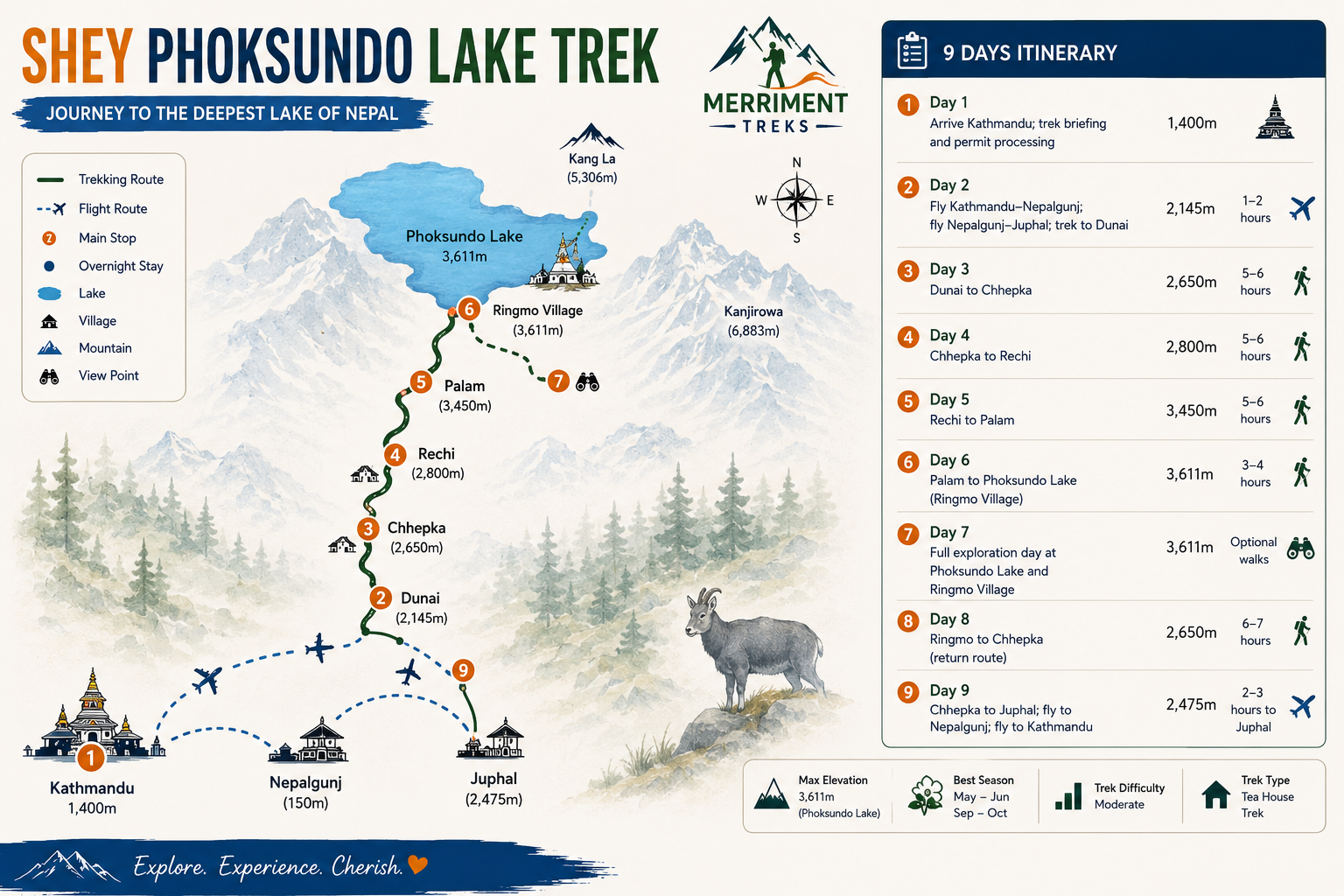
- Day 1: Arrival in Kathmandu, Trek Briefing and Permit Preparation
- Day 2: Fly from Kathmandu to Nepalgunj, Onward Flight to Juphal, Trek to Dunai
- Day 3: Trek from Dunai to Chhepka
- Day 4: Trek from Chhepka to Rechi/Amchi Hospital Area
- Day 5: Trek from Rechi to Phoksundo Lake (Ringmo Village)
- Day 6: Acclimatization and Exploration Day at Shey Phoksundo Lake and Ringmo
- Day 7: Trek from Ringmo toward Phoksundo Khola Valley, Camp at High Camp
- Day 8: Cross Numa La Pass (5,190m), Descend to Pelung Tang
- Day 9: Trek from Pelung Tang to Shey Gompa Area
- Day 10: Exploration of Shey Gompa, Rest and Acclimatization
- Day 11: Trek from Shey Gompa toward Saldang via Naura La
- Day 12: Trek from Saldang to Tinje Village
- Day 13: Trek from Tinje, Cross Baga La Pass (4,535m), Descend to Chharka Bhot
- Day 14: Trek from Chharka Bhot toward Tarap Valley
- Day 15: Trek through Tarap Valley to Dunai
- Day 16: Trek from Dunai to Juphal, Fly to Nepalgunj, Fly to Kathmandu
- Day 17: Final Departure from Kathmandu
Why Choose Merriment Treks for Your Lower Dolpo Trek 17 Days
Merriment Treks brings specialized expertise, genuine local knowledge, and an unwavering commitment to safety and responsible tourism to one of Nepal’s most demanding and rewarding trekking regions.
Here’s why we are the right choice for your Lower Dolpo adventure:
- Dolpo Specialist Knowledge: Our guides have years of experience specifically in the Dolpo region and possess intimate knowledge of the trail, weather patterns, cultural customs, and logistical complexities unique to this remote area
- Comprehensive Safety Infrastructure: We carry satellite communication devices, pulse oximeters, first-aid kits, and emergency supplies, and have established emergency evacuation protocols for the remote sections of the route
- Experienced High-Altitude Guide Team: All guides leading Dolpo treks are senior, highly experienced professionals with specific high-altitude certification and extensive knowledge of altitude sickness management
- Ethical and Responsible Tourism: We are deeply committed to supporting the fragile communities and ecosystems of the Dolpo region, ensuring that trekker visits contribute positively to local livelihoods and conservation efforts
- Exceptional Logistics Management: The complex permit requirements, domestic flight bookings, and supply chain management for a remote 17-day expedition require experienced coordination that Merriment Treks handles seamlessly
- Cultural Respect and Sensitivity: Our guides approach the sacred and culturally sensitive environment of Dolpo with deep respect, helping trekkers engage with local communities in a meaningful and appropriate way
- Fair Staff Practices: All porters, cooks, and support staff are paid fair wages, provided with proper equipment, and assigned appropriate loads, regardless of how remote the location
Cost of Lower Dolpo Trek 17 Days
The cost of the 17 Days Lower Dolpo Trek is USD 2,450 per person (for the full package, based on standard group size; prices may vary depending on group size, domestic flight availability, and any additional services required).
Given the extreme remoteness, multiple required permits, domestic flights, and comprehensive support team required for this expedition, this price represents excellent value for what is one of Nepal’s most exclusive and challenging trekking experiences.
The package typically includes:
- All domestic flights (Kathmandu-Nepalgunj-Juphal and return)
- All accommodation throughout the trek (teahouses, lodges, and camping where necessary)
- All meals from Day 2 through Day 16
- All required permits (Restricted Area Permit, Dolpo Special Permit, Shey Phoksundo National Park Permit, TIMS)
- Experienced senior English-speaking high-altitude trekking guide with specific Dolpo expertise
- Porter services with appropriate equipment for the remote conditions
- Satellite communication device carried by the guide team
- First-aid kit, pulse oximeter, and emergency supplies
- Camping equipment for sections requiring tented accommodation
For solo travelers or groups wanting additional luxury camping arrangements, extended itineraries, or extra acclimatization days, please contact us for a fully customized quote.
Things You Should Know
- The Dolpo region is one of the most remote inhabited areas in Nepal; self-sufficiency and mental resilience are as important as physical fitness for this trek
- Teahouse facilities in the most remote sections are extremely basic, with pit toilets, limited menu options, and cold or no running water; camping may be necessary in certain sections
- Fresh food supplies are extremely limited in the higher villages; the diet on this trek is simpler and more repetitive than on more accessible trekking routes
- Domestic flights to Juphal are operated by small twin-propeller aircraft and are highly weather-dependent; delays of one to several days are not uncommon and require flexibility in your overall travel schedule
- The population of Dolpo is small and their traditional way of life is fragile; trekkers are strongly encouraged to minimize environmental impact, avoid distributing sweets or money to children, and follow leave-no-trace principles
- The Bon religion practiced in parts of Dolpo is distinct from Tibetan Buddhism and has its own unique rituals, temples, and customs; approach all religious sites and practices with maximum respect
- Currency exchange and banking services are non-existent in Dolpo; carry all necessary cash from Kathmandu or Nepalgunj before departure
Is Lower Dolpo Trek for You?
This trek is ideal for:
- Highly experienced trekkers with multiple prior high-altitude Himalayan expeditions seeking a genuinely extraordinary and off-the-beaten-path adventure
- Cultural and anthropological travelers with a deep interest in Tibetan Buddhist and Bon traditions in their most authentic surviving form
- Wilderness seekers and naturalists interested in the unique flora, fauna, and landscape of the Trans-Himalayan rain shadow zone
- Wildlife enthusiasts hoping to spot snow leopard, Himalayan wolf, blue sheep, and other rare high-altitude species
- Photography adventurers seeking dramatically different and rarely photographed Himalayan landscapes and cultural subjects
- Those who have read Peter Matthiessen’s “The Snow Leopard” or similar works and feel a deep calling to experience the Dolpo region firsthand
- Trekkers with high levels of mental flexibility and resilience who can embrace the uncertainty and physical challenges of a remote expedition
This trek is definitively not suitable for:
- First-time or inexperienced trekkers
- Those unwilling or unable to handle very basic accommodation and limited food variety
- Travelers with fixed, inflexible schedules that cannot accommodate weather-related flight delays
- Anyone with significant cardiovascular, respiratory, or joint health conditions
Meals & Accommodation
Accommodation:
- A combination of basic teahouses and lodges in villages such as Dunai, Ringmo, and Saldang, and camping or very basic shelter in the more remote sections between high passes
- Teahouse rooms are simple twin-sharing with shared bathroom facilities; in the most remote sections, facilities may be limited to pit toilets and cold water only
- A sleeping bag rated to at least -15°C is essential, as temperatures at altitude and in unheated rooms can be extremely cold
- Camping equipment (tents, sleeping mats) is provided by Merriment Treks for sections where teahouse accommodation is not available
Meals:
- All meals are included from Day 2 through Day 16 of the itinerary
- Food options become progressively simpler and more limited as the trek moves into the most remote sections; dal bhat, tsampa (roasted barley flour), noodle soup, and basic rice dishes dominate the menu at higher elevations
- In more accessible sections near Dunai and Ringmo, a somewhat wider variety of Nepali and basic Continental food is available
- The camp cook provides freshly prepared meals during camping sections, ensuring nutritious and adequate food even in the most remote areas
- Vegetarian options are naturally predominant in this Buddhist-influenced region; special dietary requirements should be communicated well in advance
Travel Insurance
Travel insurance is absolutely mandatory for the Lower Dolpo Trek and must be carefully selected and verified before departing for Nepal. Given the extreme remoteness and high altitude of this trek, your insurance policy must specifically cover:
- Helicopter evacuation up to at least 5,500m: This is non-negotiable and must be explicitly stated in your policy; helicopter evacuation is the only viable emergency response in most sections of the Dolpo route
- Emergency medical treatment and hospitalization
- High-altitude trekking activities (explicitly verify coverage above 5,000m)
- Trip cancellation, interruption, and delay (particularly important given the high likelihood of weather-related domestic flight delays)
- Loss, theft, or damage to trekking equipment and personal belongings
Carry multiple copies of your insurance policy, your insurer’s 24-hour emergency contact number, and your policy number at all times during the trek. Share this information with the Merriment Treks office before departure so our team can initiate evacuation claims on your behalf if necessary. Do not attempt this trek without comprehensive and verified insurance coverage.
Booking Process
Booking the 17 Days Lower Dolpo Trek requires more advance planning than standard trekking itineraries due to the complex permit requirements and limited domestic flight availability:
- Initial Inquiry: Contact us as early as possible (ideally 3-6 months in advance) with your preferred dates, group size, and prior trekking experience
- Experience Assessment: We discuss your prior trekking experience and fitness level to confirm the trek is appropriate for you
- Itinerary and Logistics Finalization: We finalize the detailed itinerary, arrange domestic flight bookings, and outline all permit requirements
- Deposit Payment: A deposit (typically 30% of the total cost) secures your booking and allows us to begin permit processing and flight reservations
- Permit Processing: Passport copies, photographs, and completed permit application forms are submitted well in advance
- Gear Consultation: We provide a detailed pre-trek gear briefing and can advise on equipment rental in Kathmandu
- Pre-Trek Briefing: A comprehensive in-person briefing in Kathmandu covers the itinerary, altitude safety, emergency protocols, cultural sensitivity, and any final questions
- Final Payment: The remaining balance is settled before departure from Kathmandu
- Expedition Begins: Your senior guide and support team meet you for a fully prepared and professionally managed Dolpo expedition
Packing List, Gears, and Equipment
Clothing:
- High-quality moisture-wicking thermal base layers (heavyweight, for extreme cold)
- Insulating mid-layers including a high-loft down jacket (essential; temperatures can be extreme at high passes)
- Waterproof and windproof hard-shell jacket and trousers
- Warm trekking trousers and fleece pants for evenings and high-altitude sections
- Balaclava, heavyweight warm hat, and sun hat
- Heavyweight insulated gloves and waterproof outer mittens
- Heavyweight thermal socks and moisture-wicking trekking socks (5-6 pairs)
- High-quality, well-broken-in high-ankle mountaineering or expedition trekking boots with excellent insulation and ankle support
- Lightweight camp shoes or sandals for evenings at lodges
Gear and Equipment:
- Sleeping bag rated for at least -15°C (absolutely essential; do not compromise on this)
- Trekking poles (essential for high passes and rocky terrain)
- Headlamp with multiple sets of spare batteries (cold kills batteries rapidly)
- Large expedition daypack (35-45 liters)
- Large duffel bag for porter-carried main luggage
- Water bottles (3 liters minimum capacity) and water purification tablets or filter
- Glacier sunglasses with maximum UV protection and side shields
- Gaiters for snow-covered pass crossings
- Emergency bivy bag or space blanket
- Personal GPS device or downloaded offline maps (signal-dependent apps are not reliable here)
Personal Items:
- Comprehensive personal first-aid kit including altitude medication (Diamox), antibiotics, pain relief, blister care, and any personal prescription medications
- Maximum-protection sunscreen (SPF 50+) and high-protection lip balm (UV intensity at altitude is extreme)
- Hand sanitizer, wet wipes, and toilet paper
- Satellite messenger device (Garmin inReach or similar, strongly recommended)
- Power banks (multiple, as charging opportunities are very limited)
- Camera with multiple spare batteries and large-capacity memory cards
- High-calorie emergency snacks (nuts, energy gels, chocolate, dried fruit) for high-altitude sections
- All required cash in Nepalese Rupees for the entire trek, obtained in Kathmandu before departure
Cancellation & Refund Policy
- Cancellations made 45 days or more before the trek start date: full refund minus administrative and permit processing fees already incurred
- Cancellations made 30-44 days before departure: 60% of the total package cost will be refunded
- Cancellations made 15-29 days before departure: 30% of the total package cost will be refunded
- Cancellations made less than 14 days before departure: non-refundable
- Domestic flight cancellations or delays due to weather are outside Merriment Treks’ control; we will work to rebook flights and adjust the itinerary accordingly, but refunds for weather-related delays are not possible
- Early return from the trek due to altitude sickness, personal illness, or personal reasons is non-refundable for any unused services; this reinforces why comprehensive travel insurance is absolutely mandatory
- In cases of trek cancellation due to government restrictions, natural disasters, or force majeure events, rescheduling options will be offered where possible
- All cancellation and refund requests must be submitted in writing to the Merriment Treks office for formal processing; permit fees paid to the government are generally non-refundable regardless of cancellation timing
Lower Dolpo Trek Highlights
- Stand at the shores of Shey Phoksundo Lake, the deepest lake in Nepal and one of the most strikingly beautiful turquoise mountain lakes in the entire Himalayan world
- Cross the dramatic Numa La Pass (5,190m), one of the highest and most rewarding high passes on any Lower Dolpo route variation, with sweeping panoramas of the surrounding Himalayan and Trans-Himalayan landscape
- Visit the ancient and sacred Shey Gompa, one of the most revered monasteries in the Dolpo region and a place of profound spiritual significance for both Buddhist and Bon practitioners
- Experience the extraordinary living culture of the Dolpo people, whose Tibetan-influenced traditions, language, architecture, and spiritual practices have remained virtually unchanged for centuries
- Witness the breathtaking transition from the lush gorges of the Bheri River valley through alpine forests to the vast, arid, other-worldly high-altitude plateau of inner Dolpo, one of the most dramatic landscape transitions on any trek in Nepal
- Encounter rare Himalayan wildlife including blue sheep and potentially the elusive snow leopard in one of the last truly wild high-altitude wilderness areas remaining in Asia
- Explore the remote and rarely visited villages of the upper Tarap Valley and Tinje, offering authentic cultural encounters with communities that receive only a handful of trekking visitors each year
- Walk through the UNESCO-listed Shey Phoksundo National Park, a vast protected wilderness area of exceptional ecological and cultural importance
- Experience the extraordinary privilege of genuine expedition-style trekking in one of the most remote and least-visited regions of Nepal, with a profound sense of adventure and discovery that is increasingly rare in the modern trekking world
- Return home permanently changed by an encounter with a land and a people that offer one of the last remaining windows into the ancient, unchanged world of Trans-Himalayan civilization